Beaver Creek Township near Grayling in Crawford County, Michigan — The American Midwest (Great Lakes)
Native Plants
| — | Forest Heritage Trail | — |
Photographed by Joel Seewald, July 4, 2025
1. Native Plants Marker
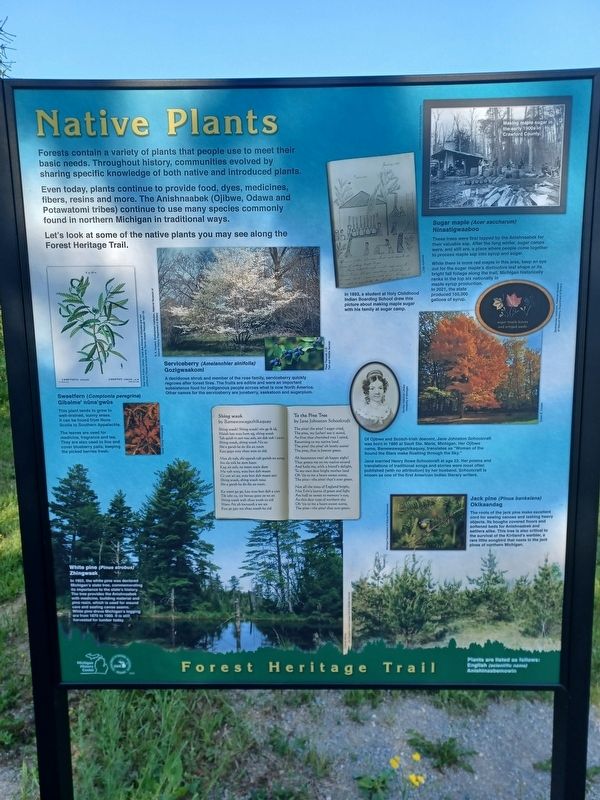
Forests contain a variety of plants that people use to meet their basic needs. Throughout history, communities evolved by sharing specific knowledge of both native and introduced plants.
Even today, plants continue to provide food, dyes, medicines, fibers, resins and more. The Anishnaabek (Ojibwe, Odawa and Potawatomi tribes) continue to use many species commonly found in northern Michigan in traditional ways.
Let's look at some of the native plants you may see along the Forest Heritage Trail.
Sweetfern (Comptonia peregrina)
Gibaime' nûna'gwûs
This plant tends to grow in well-drained, sunny areas. It can be found from Nova Scotia to Southern Appalachia.
The leaves are used for medicine, fragrance and tea. They are also used to line and cover blueberry pails, keeping the picked berries fresh.
Serviceberry (Amelanchier alnifolia)
Gozigwaakomi
A deciduous shrub and member of the rose family, serviceberry quickly regrows after forest fires. The fruits are edible and were an important subsistence food for indigenous people across what is now North America. Other names for serviceberry are juneberry, saskatoon
this page online
Sugar maple (Acer saccharum)
Ninaatigwaaboo
These trees were first tapped by the Anishnaabek for their valuable sap. After the long winter, sugar camps were, and still are, a place where people come together to process maple sap into syrup and sugar.
While there is more red maple in this area, keep an eye out for the sugar maple's distinctive leaf shape or its bright fall foliage along the trail. Michigan historically ranks in the top six nationally in maple syrup production. In 2021, the state produced 150,000 gallons of syrup.
White pine (Pinus strobus)
Zhingwaak
In 1955, the white pine was declared Michigan's state tree, commemorating its importance to the state's history. The tree provides the Anishnaabek with medicine, building material and pine resin, which is used for wound care and sealing canoe seams. White pine drove Michigan's logging era from 1870 to 1900. It is still harvested for lumber today.
Jack pine (Pinus banksiana)
Okikaandag
The roots of the jack pine make excellent cord for sewing canoes and lashing heavy objects. Its boughs covered floors and softened beds for Anishnaabek and settlers
Photographed by Joel Seewald, July 4, 2025
2. Native Plants Marker
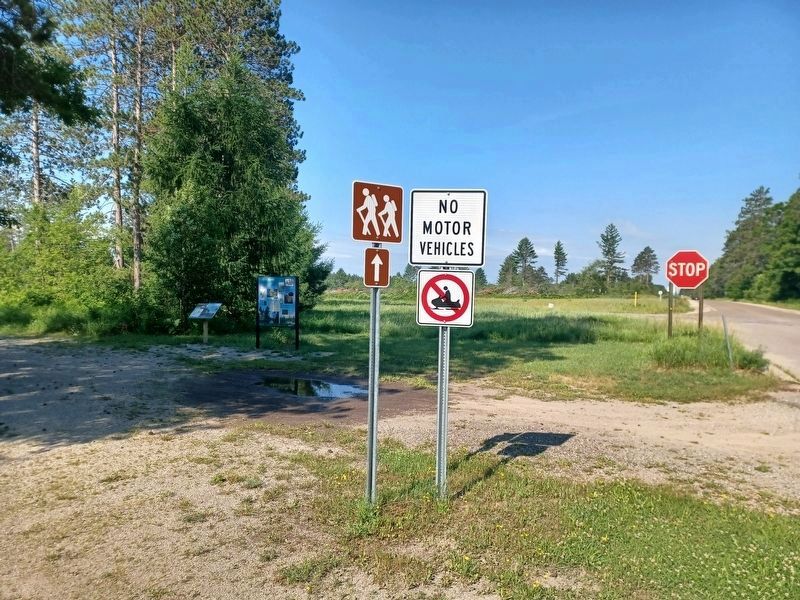
This marker is the upright marker on the right.
Plants are listed as follows:
English (scientific name)
Anishinaabemowin
Top drawing: In 1893, a student at Holy Childhood Indian Boarding School drew this picture about making maple sugar with his family at sugar camp.
Top right image caption: Making maple sugar in the early 1900s in Crawford County.
Center images caption: Of Ojibwe and Scotch-Irish descent, Jane Johnston Schoolcraft was born in 1880 at Sault Ste. Marie, Michigan. Her Ojibwe name, Bamewawagezhikaquay, translates as "Woman of the Sound the Stars make Rushing through the Sky."
Jane married Henry Row Schoolcraft at age 23. Her poems and translations of traditional songs and stories were most often published (with no attribution) by her husband. Schoolcraft is known as one of the first American Indian literary writers.
Erected 2023 by Michigan History Center and Michigan Department of Natural Resources.
Topics. This historical marker is listed in these topic lists: Environment • Indigenous Peoples and Communities. A significant historical year for this entry is 1893.
Location. 44° 32.402′ N, 84° 44.458′ W. Marker is near Grayling, Michigan, in Crawford County. It is in Beaver Creek Township. It is at the intersection of West Fletcher Road and South Old 27, on the left when traveling west on West Fletcher Road. Marker is along the Forest Heritage Trail, just east of the intersection. Touch for map. Marker is in this post office area: Roscommon MI 48653, United States of America. Touch for directions.

Regionally, this marker is in Northern Michigan Lower Peninsula. It is also in the American Midwest. Globally, it is in North America, the Great North Woods, the Western Hemisphere, the Western World, and the Anglosphere. Historically, it finds itself in what was once the Northwest Territory.
Other nearby markers. At least 8 other markers are within 2 miles of this marker, measured as the crow flies: Fletcher Fire (here, next to this marker); A Lot of No Good Land (approx. ¾ mile away); State Forest or State Park? (approx. 1.7 miles away); Thinning the Forest (approx. 1.8 miles away); Tree Progeny (approx. 1.8 miles away); Forest Heritage Trail (approx. 1.8 miles away); Welcome to the Higgins Lake Nursery and CCC Museum (approx. 1.8 miles away); Civilian Conservation Corps Museum (approx. 1.9 miles away).
Additional commentary.
1. Jane Johnston Schoolcraft's birth year is incorrect
The marker states that Jane Johnston Schoolcraft was born in 1880. She was actually born on January 31, 1800.
— Submitted July 17, 2025, by Joel Seewald of Madison Heights, Michigan.
Credits. This page was last revised on July 17, 2025. It was originally submitted on July 17, 2025, by Joel Seewald of Madison Heights, Michigan. This page has been viewed 79 times since then and 15 times this year. Photos: 1, 2. submitted on July 17, 2025, by Joel Seewald of Madison Heights, Michigan.
