Unity Township near Latrobe in Westmoreland County, Pennsylvania — The American Northeast (Mid-Atlantic)
Saint Vincent Gristmill and Westlands
Photographed by Bradley Owen, July 12, 2025
1. Saint Vincent Gristmill and Westlands Marker
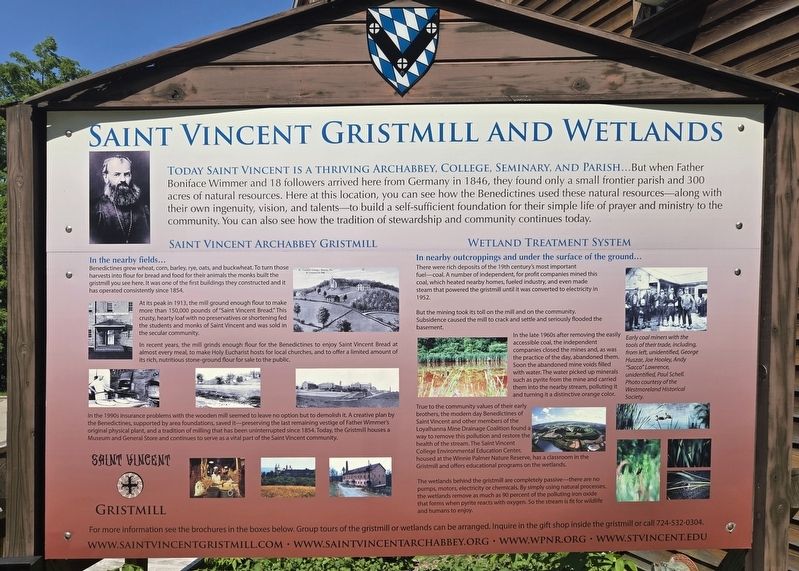
Today Saint Vincent is a thriving Archabbey, College, Seminary, and Parish...But when Father Boniface Wimmer and 18 followers arrived here from Germany in 1846, they found only a small frontier parish and 300 acres of natural resources. Here at this location, you can see how the Benedictines used these natural resources-along with their own ingenuity, vision, and talents-to build a self-sufficient foundation for their simple life of prayer and ministry to the community. You can also see how the tradition of stewardship and community continues today.
Saint Vincent Archabbey Gristmill
In the nearby fields...
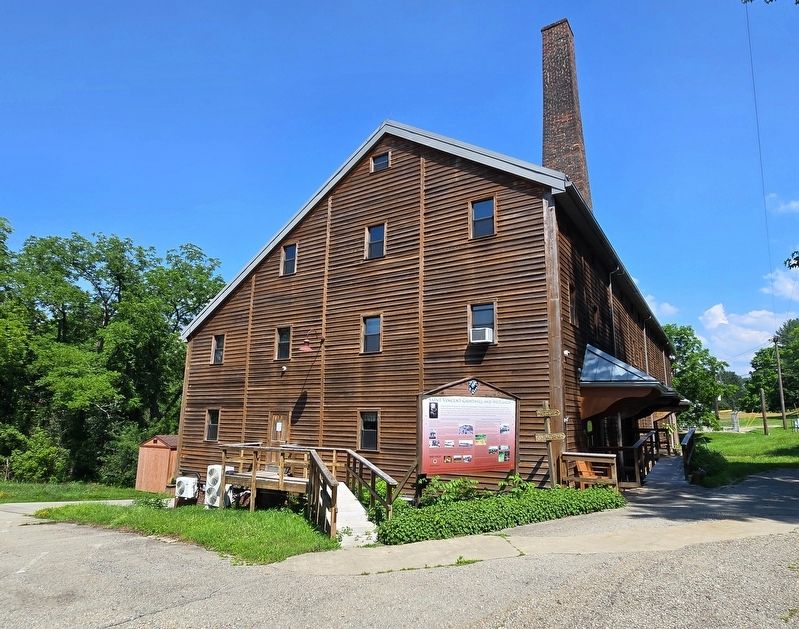
Benedictines grew wheat, corn, barley, rye, oats, and buckwheat. To turn those harvests into flour for bread and food for their animals the monks built the gristmill you see here. It was one of the first buildings they constructed and it has operated consistently since 1854.
At its peak in 1913, the mill ground enough flour to make more than 150,000 pounds of "Saint Vincent Bread." This crusty, hearty loaf with no preservatives or shortening fed the students and monks of Saint Vincent and was sold in the secular
this page online
In recent years, the mill grinds enough flour for the Benedictines to enjoy Saint Vincent Bread at almost every meal, to make Holy Eucharist hosts for local churches, and to offer a limited amount of its rich, nutritious stone-ground flour for sale to the public.
In the 1990s insurance problems with the wooden mill seemed to leave no option but to demolish it. A creative plan by the Benedictines, supported by area foundations, saved it-preserving the last remaining vestige of Father Wimmer's original physical plant, and a tradition of milling that has been uninterrupted since 1854. Today, the Gristmill houses a Museum and General Store and continues to serve as a vital part of the Saint Vincent community.
Wetland Treatment System
In nearby outcroppings and under the surface of the ground...
There were rich deposits of the 19th century's most important fuel-coal. A number of independent, for profit companies mined this coal, which heated nearby homes, fueled industry, and even made steam that powered the gristmill until it was converted to electricity in 1952.
But the mining took its toll on the mill and on
Photographed by Bradley Owen, July 12, 2025
2. Saint Vincent Gristmill and Westlands Marker
In the late 1960s after removing the easily accessible coal, the independent companies closed the mines and, as was the practice of the day, abandoned them. Soon the abandoned mine voids filled with water. The water picked up minerals such as pyrite from the mine and carried them into the nearby stream, polluting it and turning it a distinctive orange color.
True to the community values of their early brothers, the modern day Benedictines of Saint Vincent and other members of the Loyalhanna Mine Drainage Coalition found a way to remove this pollution and restore the health of the stream. The Saint Vincent College Environmental Education Center, housed at the Winnie Palmer Nature Reserve, has a classroom in the Gristmill and offers educational programs on the wetlands.
The wetlands behind the gristmill are completely passive-there are no pumps, motors, electricity or chemicals. By simply using natural processes, the wetlands remove as much as 90 percent of the polluting iron oxide that forms when pyrite reacts with oxygen. So the stream is fit for wildlife and humans to enjoy.
(Photo Caption):
Early coal miners with the tools of their trade, including, from left, unidentified, George Huszar, Joe Hooley, Andy "Sacco" Lawrence, unidentified, Paul Schell. Photo courtesy of the Westmoreland Historical Society.
Erected by Saint Vincent Gristmill.
Topics. This historical marker is listed in these topic lists: Environment • Immigration • Industry & Commerce • Religion & Religious Structures. A significant historical year for this entry is 1846.
Location. 40° 17.73′ N, 79° 24.167′ W. Marker is near Latrobe, Pennsylvania, in Westmoreland County. It is in Unity Township. It is on Beatty County Road 0.2 miles west of Monastery Road when traveling west. Marker is located on the west side of Saint Vincent Gristmill. Touch for map. Marker is at or near this postal address: 555 Beatty County Road, Latrobe PA 15650, United States of America. Touch for directions.

Regionally, this marker is in the Laurel Highlands and in Greater Pittsburgh. It is also in the American Northeast, in the Mid-Atlantic, in Appalachia, and specifically in Northern Appalachia. Globally, it is in North America, the Western Hemisphere, the Western World, and the Anglosphere. Historically, it finds itself in what was once the Viceroyalty of New France, the Haudenosaunee (Iroquois) Confederacy, and one of the original Thirteen Colonies.
Other nearby markers. At least 8 other markers are within 2 miles of this marker, measured as the crow flies: Site of Sportsman's Hall Log Cabin (approx. 0.2 miles away); Right Reverend Boniface Wimmer, O.S. B. (approx. ¼ mile away); Saint Vincent (approx. 0.3 miles away); Saint Vincent Shaft Veterans Monument (approx. 0.7 miles away); Twelve Mile Camp (approx. 0.9 miles away); Unity Cemetery (approx. 1.1 miles away); Unity Chapel (approx. 1.1 miles away); Unity School Bell (approx. 1.1 miles away). Touch for a list and map of all markers in Latrobe.
Credits. This page was last revised on July 20, 2025. It was originally submitted on July 17, 2025, by Bradley Owen of Morgantown, West Virginia. This page has been viewed 154 times since then and 26 times this year. Photos: 1, 2. submitted on July 20, 2025, by Bradley Owen of Morgantown, West Virginia.
