Kure Beach in New Hanover County, North Carolina — The American South (South Atlantic)
Our Occupation Of The Fort, Was Not Equivalent To Its Possession.
Dr. James Mowriss, 117th New York Regiment

Photographed by Evan Dwyer, January 24, 2025
1. Our Occupation Of The Fort, Was Not Equivalent To Its Possession. Marker
Postwar occupation was not without incident. Maj. Frederick W. Prince, post commander in April 1865, described "the bursting of 10 inch Columbiads while firing a salute in honor of the restoration of the old flag on Sumpter[sic] killing two men of the 2nd Pa. Heavy Artillery."
White Union troops occupied the fort until they were mustered out of service in August, 1865. Due to strained relations between black Union soldiers and the larger white community, several companies of the 37th United States Colored Troops were reassigned to Fort Fisher and other Cape Fear District forts for the remainder of their service. There was considerable strife between the white and black troops, and fighting was commonplace.
On May 24, 1867, Secretary of War, Edwin Stanton declared, "Forts Hatteras, Fisher and Johnson, North Carolina, are to be abandoned, and the public property in each taken charge of by the
this page online
In February 1867, the United States government purchased 5 acres of land from a local resident for the construction of Wilmington National Cemetery. Union remains were moved from the Wilmington City Cemetery and nearby forts, and reinterred in the new cemetery. The Confederate dead were reinterred to the mass grave at Oakdale Cemetery in Wilmington.
Years later, Colonel Lamb, who served at Ft. Fisher, came to pay respects to his men who died there before the war and "was told that a contractor for the [U.S.] government had stolen their bones."
(captions)
Soldiers from Company E, 4th U.S. Colored Infantry, pose at Fort Lincoln, shortly after the Civil War. The unit was among those that saw action at Fort Fisher. Library of Congress
Auction notice for the public buildings at Fort Johnston and Fort Fisher, from the Wilmington Post, October 12, 1867.
Erected 2015.
Topics. This historical marker is listed in these topic lists: Cemeteries & Burial Sites
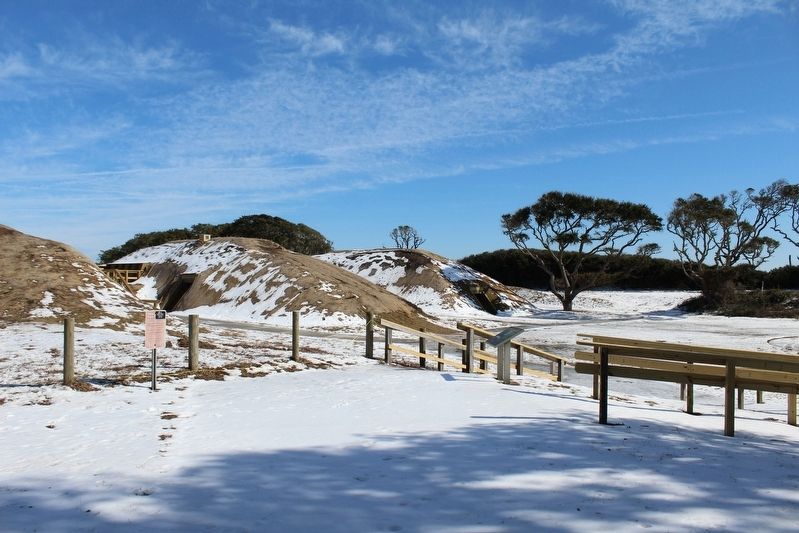
Photographed by Evan Dwyer, January 24, 2025
2. "Our Occupation Of The Fort, Was Not Equivalent To Its Possession" Marker
Marker is at the top of the stairs and accessibility ramp, lower right.
Location. 33° 58.254′ N, 77° 55.127′ W. Marker is in Kure Beach, North Carolina, in New Hanover County. It can be reached from Fort Fisher Boulevard South (U.S. 421) 0.1 miles west of Battle Acre Road, on the right when traveling south. Marker is on the walking trail around the Land Face of Fort Fisher State Historic Site. Touch for map. Marker is at or near this postal address: 1610 Fort Fisher Boulevard South, Kure Beach NC 28449, United States of America. Touch for directions.

Regionally, this marker is in the Coastal Plain and on the Cape Fear Coast. It is also in the American South, specifically in the Upper South, in the Tidewater, and on the Eastern Seaboard. Globally, it is in the North Atlantic Region, North America, the Western Hemisphere, the Western World, and the Anglosphere. Historically, it finds itself in what was once the territory of the Mississippian Culture, one of the original Thirteen Colonies, one of the Confederate States of America, and the Antebellum South.
Other nearby markers. At least 8 other markers are within walking distance of this marker: After Taking Fort Fisher, I Think Our Troops Could Storm Hell Itself. (within shouting distance of this marker); Fort Fisher (within shouting distance of this marker); 1st Battle Of Fort Fisher - December, 1864: A "Fiasco" (about 300 feet away, measured in a direct line); A Work Of More Labor Than The Pyramids (about 300 feet away); A Desolate Spit Of Land (about 300 feet away); W.H.C. Whiting (about 300 feet away); Every Charge Was Death Or Surrender. (about 300 feet away); a different marker also named Fort Fisher (about 400 feet away). Touch for a list and map of all markers in Kure Beach.
Other markers no longer nearby. Fort Fisher Since 1865 (was here, next to this marker but has been replaced with another marker now near it); Capture! (was within shouting distance of this marker but has been confirmed missing); A Trophy of War (was about 300 feet away but has been confirmed missing); Fort Fisher’s Armstrong Cannon (was about 300 feet away but has been confirmed missing); History Trail (was about 300 feet away but has been confirmed missing); Union Fiasco - The First Battle (was about 300 feet away but has been replaced with another marker now near it); Blockade-Running (was about 300 feet away but has been confirmed missing); Growth of Fort Fisher, 1861-1862 (was about 400 feet away but has been confirmed missing).
Regarding Our Occupation Of The Fort, Was Not Equivalent To Its Possession.. Note the marker says nothing about a cemetery at Fort Fisher, or burials at Fort Fisher, though there were substantial burials done at the fort following the battle and particularly the eventual explosion of the main magazine that occurred shortly after occupation thanks to the apparently errant torch of a drunken mischief maker - also curiously absent from the marker. Instead, the last two paragraphs on the marker seem to indicate a partial thought that is not connected to the rest of the marker's content - and are emotionally charged by the quote selected as the concluding sentence. It should be noted and understood by the viewer that grave relocation was widespread and common. Post-war, burials from both sides were reinterred in other cemeteries as land was returned to peace time uses. This was done not only by the Federal Government, which primarily was only involved in moving federal graves to centralized national cemeteries, but also by state committees, by Confederate women's and veterans groups, and by local citizens. No one had "stolen their bones" and the inclusion of that quote is misleading and unfair to history. In fact, Confederate remains were often left alone entirely by the Federal Government, their burial places to be administered as locals saw fit. To lead the reader to the conclusion that the US government stole bones because they were Confederate is inaccurate and lacking in context.
Additional commentary.
1. 2015 Series of Markers
The following markers were placed at Fort Fisher State Historic Site on the site walking trail as part of the 150th Anniversary of the battles in 2015:
278788
278793
278799
278843
278848
278856
278903
278907
278909
278913
278919
278923
278926
278936
A marker in the same style (278761) was placed at the Fort Fisher monument at Battle Acre in 2017. Three other markers outside of the site history trail (278940, 278774, and 278764) are all the same styling and may also be part of the 2015 re-signing effort.
— Submitted July 17, 2025, by Evan Dwyer of Richmond, Virginia.
Credits. This page was last revised on August 7, 2025. It was originally submitted on July 17, 2025, by Evan Dwyer of Richmond, Virginia. This page has been viewed 110 times since then and 21 times this year. Photos: 1, 2. submitted on July 17, 2025, by Evan Dwyer of Richmond, Virginia. • Bernard Fisher was the editor who published this page.
