West Harlem in Manhattan in New York County, New York — The American Northeast (Mid-Atlantic)
Yuri Kochiyama
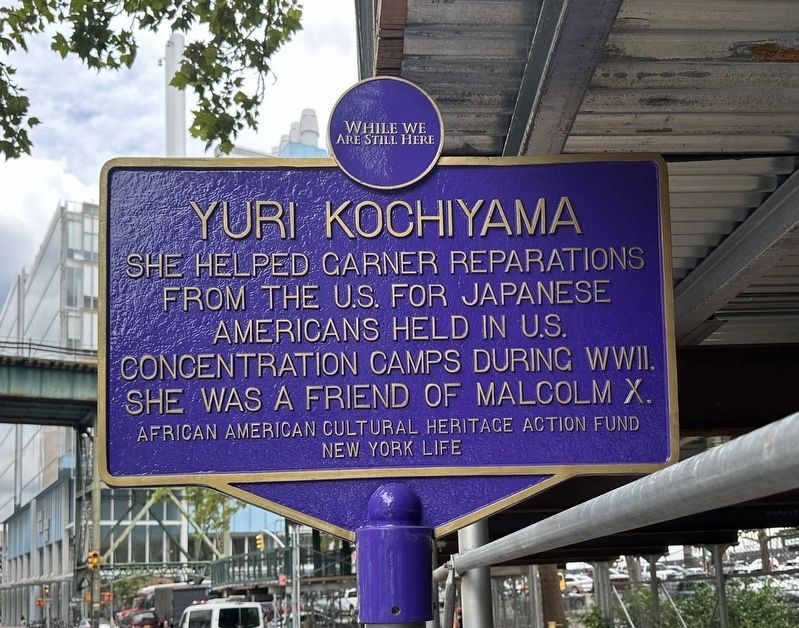
Photographed by Andrew Ruppenstein, July 19, 2025
1. Yuri Kochiyama Marker
She helped garner reparations from the U.S. for Japanese Americans held in U.S. concentration camps during WWII. She was a friend of Malcolm X.
Erected by While We Are Still Here.
Topics and series. This historical marker is listed in these topic lists: Asian Americans • Civil Rights • War, World II • Women. In addition, it is included in the While We Are Still Here series list.
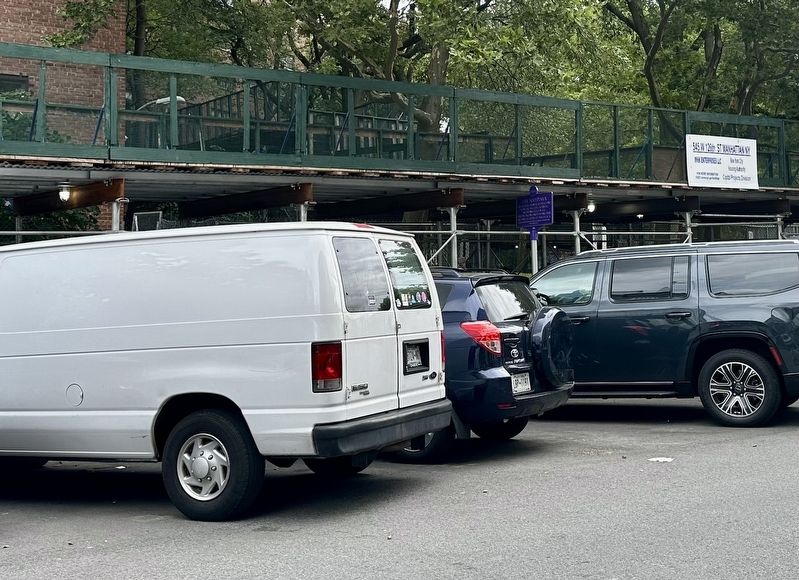
Location. 40° 48.947′ N, 73° 57.431′ W. Marker is in Manhattan, New York, in New York County. It is in West Harlem. It is on West 126th Street south of Broadway, on the left when traveling north. Touch for map. Marker is at or near this postal address: 545 W 126th Street, New York NY 10027, United States of America. Touch for directions.

Regionally, this marker is in New York City. It is also in the American Northeast, in the Mid-Atlantic, and on the Eastern Seaboard. Globally, it is in the North Atlantic Region, North America, the Western Hemisphere, the Western World, and the Anglosphere. Historically, it finds itself in what was once New Netherland and
this page online
Other nearby markers. At least 8 other markers are within walking distance of this marker: St. Mary’s Episcopal Church, Manhattanville (about 400 feet away, measured in a direct line); The Lenape Nation (about 400 feet away); Site of the Claremont Inn (approx. ¼ mile away); International House (approx. ¼ mile away); Claremont Playground (approx. ¼ mile away); Japanese Lantern (approx. 0.3 miles away); Sakura Park (approx. 0.3 miles away); The Amiable Child Monument (approx. 0.3 miles away). Touch for a list and map of all markers in Manhattan.
Also see . . .
1. Yuri Kochiyama (Wikipedia). Overview:
Yuri Kochiyama, (Kōchiyama Yuriko; born Mary Yuriko Nakahara; May 19, 1921 – June 1, 2014) was an American civil rights activist born in San Pedro, California. She was interned at the Jerome War Relocation Center in Arkansas during World War II, an experience that influenced her later views on racism in the United States. While interned, she helped run a letter-writing campaign to Nisei (transl. 'Second-generation') soldiers, wrote for the Jerome camp newspaper, and volunteered(Submitted on July 20, 2025.)with the United Service Organizations (USO).Photographed by Andrew Ruppenstein, July 19, 20252. Yuri Kochiyama Marker - wide view
After the end of the war, Kochiyama moved to New York and eventually to Harlem, where she became involved in the civil rights movement. At first working with the Congress of Racial Equality (CORE), Kochiyama's friendship with civil rights leader Malcolm X led her to affiliate with Black nationalist organizations such as the Organization of Afro-American Unity (OAAU), the Revolutionary Action Movement (RAM), and the Republic of New Afrika (RNA).
Kochiyama advocated for political prisoners, including imprisoned members of the civil rights movement, the Puerto Rican independence movement, and others, helping to found the National Committee to Defend Political Prisoners (NCDPP) in the early 1970s. She played an influential role in the Asian American movement and was a member of the organization Asian Americans for Action (AAA). In the 1980s, she participated in the redress movement for Japanese Americans interned during World War II, resulting in the signing of the Civil Liberties Act of 1988, which offered reparations to internment survivors.
2. Yuri Kochiyama (National Park Service). (Submitted on July 20, 2025.)
3. Yuri Kochiyama (YuriKochiyama.com). (Submitted on July 20, 2025.)
Additional keywords. 河内山 百合子 (ユリ・コウチヤマ)
Credits. This page was last revised on July 20, 2025. It was originally submitted on July 20, 2025, by Andrew Ruppenstein of Lamorinda, California. This page has been viewed 102 times since then and 19 times this year. Photos: 1, 2. submitted on July 20, 2025, by Andrew Ruppenstein of Lamorinda, California.
