Crownsville in Anne Arundel County, Maryland — The American Northeast (Mid-Atlantic)
A Challenged State Institution Evolves
From Tragedy to Transformation (1940s-1950s)

Photographed by Pete Skillman, July 24, 2025
1. A Challenged State Institution Evolves Marker
Crownsville was severely overcrowded following the Great Depression. Underfunding and chronic staff shortages resulted in horrific patient conditions during this period. In 1949, the Baltimore Sun and the Baltimore Afro-American published detailed incidents of patient neglect and abuse.
Unrest followed in the wake of the worsening conditions, and at several points in the early 1950s patients rose up against "C" building staff in bours-long disturbances. The incidents sparked major newspaper coverage. In 1955, the Baltimore Afro American asked, "What Causes Crownsville Riots?" discussing the "complex factors that have combined to create a situation that in the space of two years has
this page online
The most important transformation came in the form of community activism and empowerment. The Black community became involved in the affairs of Crownsville as church groups and patient families gained access to the Hospital, bringing increased public accountability to the standard of patient care. The Crownville Auxiliary, founded in 1954 in collaboration with the NAACP, brought white and Black female volunteers to the campus where they supported - and observed - day to day activities. The group was also instrumental in diversifying Crownsville's mostly white staff and physicians.
Dr. Jacob Morgenstern (below, left), a Holocaust survivor, become Superintendent in 1947 and ushered in a new era of reform, integration, and humanity at Crownsville. In 1948, he hired the facility's first Black medical staff member, Vernon W. Sparks, as a staff psychologist. He also hired Gwendolyn Lee (obove, right) as Supervisor of

Photographed by Pete Skillman, July 24, 2025
2. A Challenged State Institution Evolves Marker - wide view
(Captions):
1947 headlines from the Baltimore Afro-American alerted the Black community to the inhumane conditions and chronic understaffing at Crownsville Hospital.
Call for Auxiliary volunteers, 1959, Baltimore Afro-American
Gwendolyn Lee chatting with a staff member as some of Crownsville's Black nurses walk past patients at work, 1953.
Dr Jacob Morgenstern cuts the ribbon with staff members for the facility's new beauty parlour, 1949.
Erected 2025 by Anne Arundel County.
Topics. This historical marker is listed in these topic lists: African Americans • Civil Rights • Science & Medicine.
Location. 39° 1.431′ N, 76° 36.006′ W. Marker is in Crownsville, Maryland, in Anne Arundel County. It is on Crownsville Road, on the right when traveling north. Touch for map. Marker is at or near this postal address: 1519-1507 Crownsville Rd, Crownsville MD 21032, United States
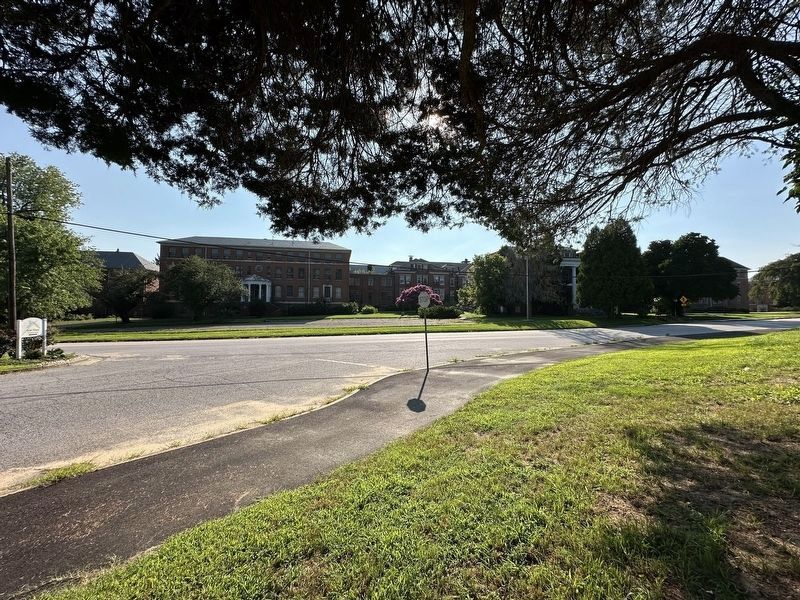
Photographed by Pete Skillman, July 24, 2025
3. A Challenged State Institution Evolves Marker
Some of the hospital buildings as seen from the area of the marker.

Regionally, this marker is in Central Maryland. It is also in the American Mid-Atlantic and on the Eastern Seaboard. Globally, it is in the North Atlantic Region, North America, the Western Hemisphere, the Western World, and the Anglosphere. Historically, it finds itself in what was once one of the original Thirteen Colonies and also the Antebellum South.
Other nearby markers. At least 8 other markers are within 2 miles of this marker, measured as the crow flies: Crownsville Hospital and Civil Rights (here, next to this marker); Founding of the Crownsville State Hospital (here, next to this marker); Crownsville Hospital Memorial Park (a few steps from this marker); St. Paul's Anglican Chapel (about 600 feet away, measured in a direct line); Belvoir (approx. 0.9 miles away); Henry Baldwin (approx. 1.4 miles away); Rising Sun Inn (approx. 1.9 miles away); a different marker also named Rising Sun Inn (approx. 1.9 miles away). Touch for a list and map of all markers in Crownsville.
Another marker is no longer nearby. Belvoir (was approx. one mile away but has been replaced with another marker now near it).
Credits. This page was last revised on July 24, 2025. It was originally submitted on July 24, 2025, by Pete Skillman of Wilmington, Delaware. This page has been viewed 173 times since then and 61 times this year. Photos: 1, 2, 3. submitted on July 24, 2025, by Pete Skillman of Wilmington, Delaware.
