Crownsville in Anne Arundel County, Maryland — The American Northeast (Mid-Atlantic)
Crownsville Hospital and Civil Rights
A New Era of Healing (1960s-1970s)
Photographed by Pete Skillman, July 24, 2025
1. Crownsville Hospital and Civil Rights Marker
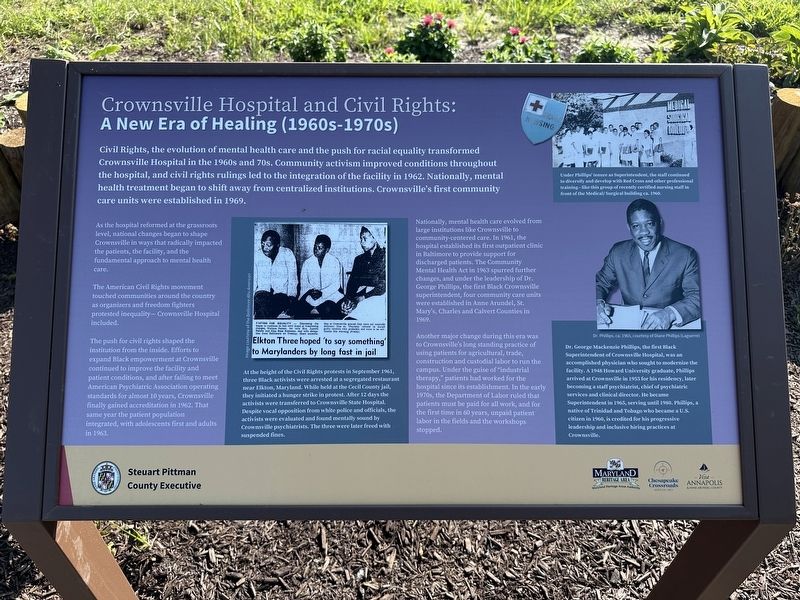
As the hospital reformed at the grassroots level, national changes began to shape Crownsville in ways that radically impacted the patients, the facility, and the fundamental approach to mental health care.
The American Civil Rights movement touched communities around the country as organizers and freedom fighters protested inequality - Crownsville Hospital included.
The push for civil rights shaped the institution from the inside. Efforts to expand Black empowerment at Crownsville continued to improve the facility and patient conditions, and after failing to meet American Psychiatric Association operating standards for almost 10 years, Crownsville finally gained accreditation in 1962. That
this page online
At the height of the Civil Rights protests in September 1961, three Black activists were arrested at a segregated restaurant near Elkton, Maryland. While held at the Cecil County jail, they initiated a hunger strike in protest. After 12 days the activists were transferred to Crownsville State Hospital. Despite vocal opposition from white police and officials, the actvists were evaluated and found mentally sound by Crownsville psychiatrists. The three were later freed with suspended fines.
Nationally, mental health care evolved from large institutions like Crownsville to community-centered care. In 1961, the hospital established its first outpatient clinic in Baltimore to provide support for discharged patients. The Community Mental Health Act in 1963 spurred further changes, and under the leadership of Dr. George Phillip, the first Black Crownsville superintendent, four community care units were established in Anne Arundel, St. Mary's, Charles and Calvert Counties in 1969.
Another major change during this era was to Crownsville's long standing
Photographed by Pete Skillman, July 24, 2025
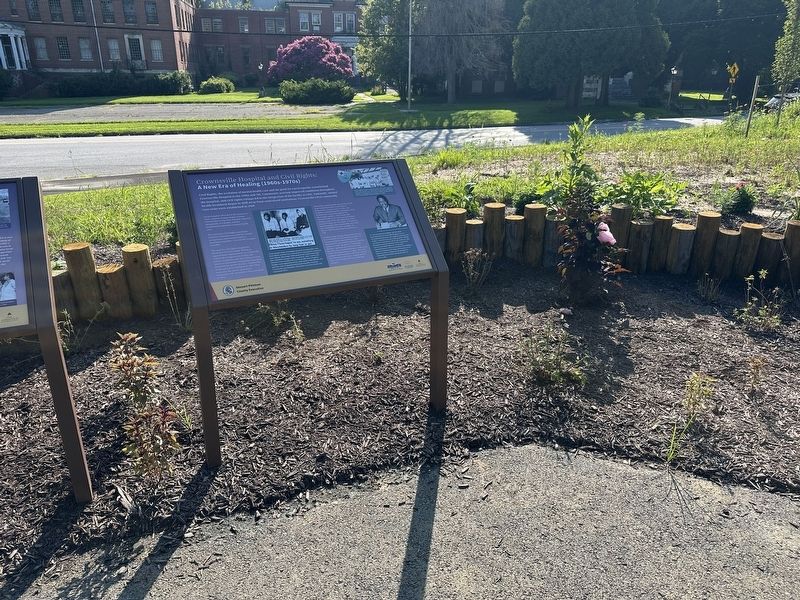
2. Crownsville Hospital and Civil Rights Marker - wide view
Under Phillips' tenure as Superintendent, the staff continued to diversify and develop with Red Cross and other professional training - like this group of recently certified nursing staff in front of the Medical/Surgical building ca. 1960.
Dr. George Mackenzie Phillips, the first Black Superintendent of Crownsville Hospital, was an accomplished physician who sought to modernize the facility. A 1948 Howard University graduate, Phillips arrived at Crownsville in 1955 for his residency, later becoming a staff psychiatrist, chief of psychiatric services, and clinical director. He became Superintendent in 1965, serving until 1980. Phillips, a native of Trinidad and Tobago who became a U.S. citizen in 1960, is credited for his progressive leadership

Photographed by Pete Skillman, July 24, 2025
3. Crownsville Hospital and Civil Rights Marker
Some of the hospital buildings as seen from the area of the marker.
(Captions):
Image courtesy of the Baltimore Afro American
Dr. Phillips, ca. 1965, courtesy of Diane Phillips (Laguerre)
Erected 2025 by Anne Arundel County.
Topics. This historical marker is listed in these topic lists: African Americans • Civil Rights • Science & Medicine.
Location. 39° 1.433′ N, 76° 36.007′ W. Marker is in Crownsville, Maryland, in Anne Arundel County. It is on Crownsville Road, on the right when traveling north. Touch for map. Marker is at or near this postal address: 1519-1507 Crownsville Rd, Crownsville MD 21032, United States of America. Touch for directions.

Regionally, this marker is in Central Maryland. It is also in the American Mid-Atlantic and on the Eastern Seaboard. Globally, it is in the North Atlantic Region, North America, the Western Hemisphere, the Western World, and the Anglosphere. Historically, it finds itself in what was once one of the original Thirteen Colonies and also the Antebellum South.
Other nearby markers. At least 8 other markers are within 2 miles of this marker, measured as the crow flies: A Challenged State Institution Evolves (here, next to this marker); Crownsville Hospital Memorial Park (here, next to this marker); Founding of the Crownsville State Hospital (a few steps from this marker); St. Paul's Anglican Chapel (about 600 feet away, measured in a direct line); Belvoir (approx. 0.9 miles away); Henry Baldwin (approx. 1.4 miles away); Rising Sun Inn (approx. 1.9 miles away); a different marker also named Rising Sun Inn (approx. 1.9 miles away). Touch for a list and map of all markers in Crownsville.
Another marker is no longer nearby. Belvoir (was approx. one mile away but has been replaced with another marker now near it).
Credits. This page was last revised on July 24, 2025. It was originally submitted on July 24, 2025, by Pete Skillman of Wilmington, Delaware. This page has been viewed 127 times since then and 49 times this year. Photos: 1, 2, 3. submitted on July 24, 2025, by Pete Skillman of Wilmington, Delaware.
