City Center in Mankato in Blue Earth County, Minnesota — The American Midwest (Upper Plains)
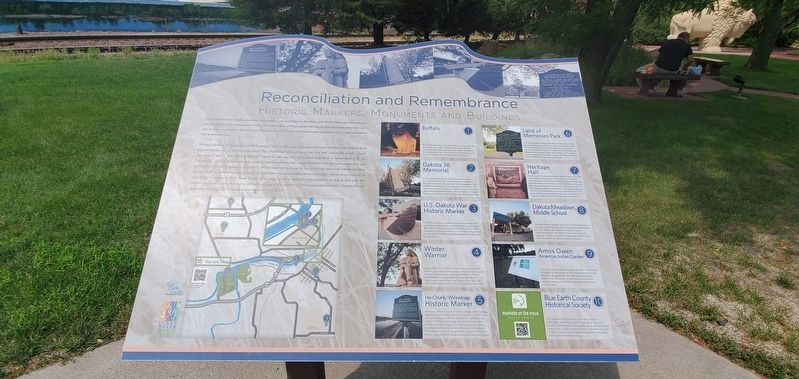
Reconciliation and Remembrance
Historic Markers, Monuments and Buildings
Photographed by Ian Lefkowitz, July 27, 2021
1. Reconciliation and Remembrance Marker
There are various historic markers, monuments and buildings in Mankato and North Mankato dedicated to reconciliation and remembrance of the U.S.-Dakota War of 1862 and the 38 Dakota Warriors executed. Visit each site to learn more about the War and efforts since 1972 for reconciliation and remembrance through education and understanding.
You are standing at Reconciliation Park, stops 1 and 2 on the map. It is a sacred parcel of land to the Dakota as it represents the site of the 1862 execution. For a historical perspective of the War and "casualties of war," check out stops 3 and 5. The "Winter Warrior" (stop 4) was the first monument dedicated in remembrance of the Dakota 38. Land of Memories Park (stop 6) commemorates the annual Mahkato Wacipi (pow wow) that has taken place on these grounds since 1972. North Mankato is home to two buildings honoring Dakota heritage (stops 7 and 8). Dakota Spiritual Leader Amos Owen was instrumental in reconciliation efforts as co-founder of the Mahkato Wacipi in 1972. Read his prayer at stop 1 and his vision for reconciliation at stop 6, and view the American Indian Garden named in
this page online
1. Buffalo
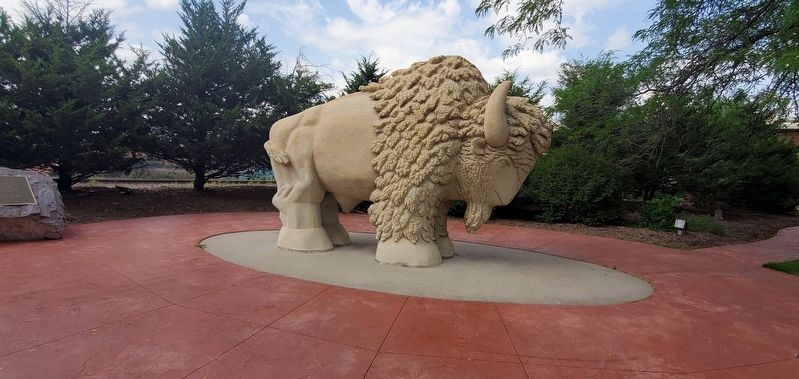
This limestone statue of a white buffalo is a symbol of the spiritual survival of the Dakota people and honors the Dakota heritage of this area. A prayer written by Dakota Spiritual Leader Amos Owen calls for reconciliation by all people. Local sculptor Thomas Miller is the artist.
2. Dakota 38 Memorial
In commemoration of the 150th Anniversary of the U.S.-Dakota War of 1862, a memorial was installed at Reconciliation Park. The memorial lists the names of the 38 Dakota Warriors who were hanged on December 26, 1862, near this same location. Included in this memorial is a prayer written by Eli Taylor and a poem by Katherine Hughes. The theme of the memorial is "Forgive Everyone Everything."
3. U.S.-Dakota War Historic Marker
This bronx historic marker recounting the events of the U.S.-Dakota War of 1862 is located on the grounds of the Blue Earth County Library, near the location of the 1862 Execution of 38 Dakota Warriors. The solitary red pipestone feather and the limestone pedestal
Photographed by Ian Lefkowitz, July 27, 2021
2. Buffalo
This limestone buffalo sculpture in Reconciliation Park is one of the stops on the tour of reconciliation and remembrance.
4. Winter Warrior
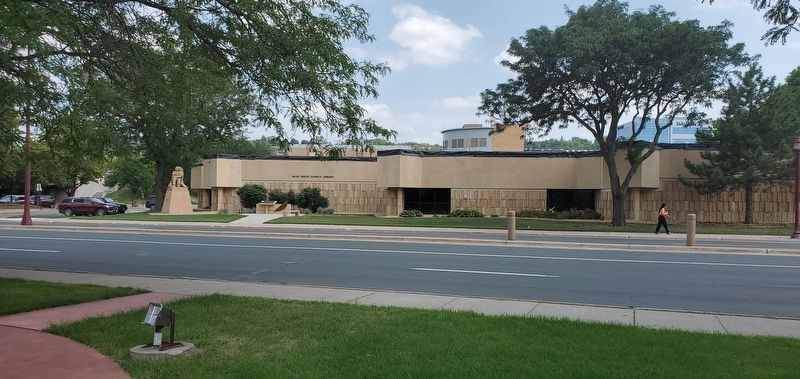
Winter Warrior, a limestone statue depicting a Dakota Warrior, is located onthe grounds of the Blue Earth County Library. The statue was installed in 1987-the "Year of Reconciliation"-in remembrance of the 38 Dakota Warriors who were killed in the Execution of 1862 near this location. Local Sculptor Thomas Miller was the artist.
5. Ho-Chunk/Winnebago Historic Marker
A historic plaque in honor of the Ho-Chunk, or Winnebago, people who lived in Blue Earth County prior to 1863. Due to the unrest following the U.S.-Dakota War of 1862, many Native American Tribes were removed from their land including the Winnebago. The tribe was forced to leave their farmland in 1863 and were relocated to Nebraska. This marker is located along the Minnesota River Trail at the site where they both arrived and departed Blue Earth County.
6. Land of Memories Park
The Dakota people historically gathered each fall to trade goods and share ideas at the confluence of the Blue Earth and Minnesota Rivers. However after 1862, the Dakota viewed Mankato as a place of tragedy and heartbreak. The Mahkato Wacipi
Photographed by Ian Lefkowitz, July 27, 2021
3. Winter Warrior
"Winter Warrior," a sculpture seen outside the Blue Earth County Library.
7. Heritage Hall
South Central College dedicated Heritage Hall in 1991 with the unveiling of the painting "Summer of '62" by local artist Rod Furan. Hereditary Dakota Chief Ernest Wabasha said about the painting: "The summer of 1862 was the last year our people were here. This picture shows the life of the Dakota people until then. After that, we were all gone, and that life disappeared not many years after that." The original painting hangs at Heritage Hall and prints are available at the Blue Earth County Historical Society.
8. Dakota Meadows Middle School
Dakota Meadows Middle School in North Mankato was opened and dedicated by Dakota and community leaders in 1993. Dedication festivities included a Dakota ceremonial dance. The school's name was chosen by students to honor the Dakota and the open prairie lands that were part of the area's original landscape.
9. Amos Owen American Indian Garden
The Amos Owen Garden of American Indian Horticulture is located on the campus of Minnesota State University, Mankato. The garden honors the American Indians' relationship with plants. Amos Owen was a Dakota spiritual leader and worked tirelessly for healing and reconciliation.
10. Blue Earth County Historical Society
The Museum highlights items from the Society's collections and reflects the rich heritage of Blue Earth County. Exhibits feature the people, places, and events that shaped this county including Native American tools and artifacts, a diorama of downtown Mankato in the 1880s and interactive children's areas.
Erected by Blue Earth County Historical Society.
Topics. This historical marker is listed in these topic lists: Indigenous Peoples and Communities • Wars, US Indian. A significant historical date for this entry is December 26, 1862.
Location. 44° 10.082′ N, 94° 0.208′ W. Marker is in Mankato, Minnesota, in Blue Earth County. It is in City Center. It can be reached from East Main Street. Touch for map. Marker is at or near this postal address: 101 E Main Street, Mankato MN 56001, United States of America. Touch for directions.

Regionally, this marker is in Southwest Minnesota and specifically in the Minnesota River Valley. It is also in the American Midwest and in the Corn Belt. Globally, it is in North America, the Western Hemisphere, the Western World, and the Anglosphere. Historically, it finds itself in what was once Rupert’s Land and also the territory of the Mississippian Culture.
Other nearby markers. At least 8 other markers are within walking distance of this marker: Minnesota River Steamboating (a few steps from this marker); Reconciliation Park (within shouting distance of this marker); Korean War (within shouting distance of this marker); Dakota (Sioux) Memorial – 1862 (within shouting distance of this marker); Navigating the River (approx. 0.2 miles away); Early Settlers (approx. 0.2 miles away); Early European Explorers (approx. 0.2 miles away); Native Americans (approx. 0.2 miles away). Touch for a list and map of all markers in Mankato.
Credits. This page was last revised on July 21, 2026. It was originally submitted on July 26, 2025, by Ian Lefkowitz of New York, New York. This page has been viewed 249 times since then and 65 times this year. Photos: 1, 2, 3. submitted on July 26, 2025, by Ian Lefkowitz of New York, New York. • Andrew Ruppenstein was the editor who published this page.
