Eisenhower East in Alexandria, Virginia — The American South (Mid-Atlantic)
Civil Rights
The right to equal treatment and opportunities guaranteed under law
| — | City of Alexandria, est. 1749 | — |
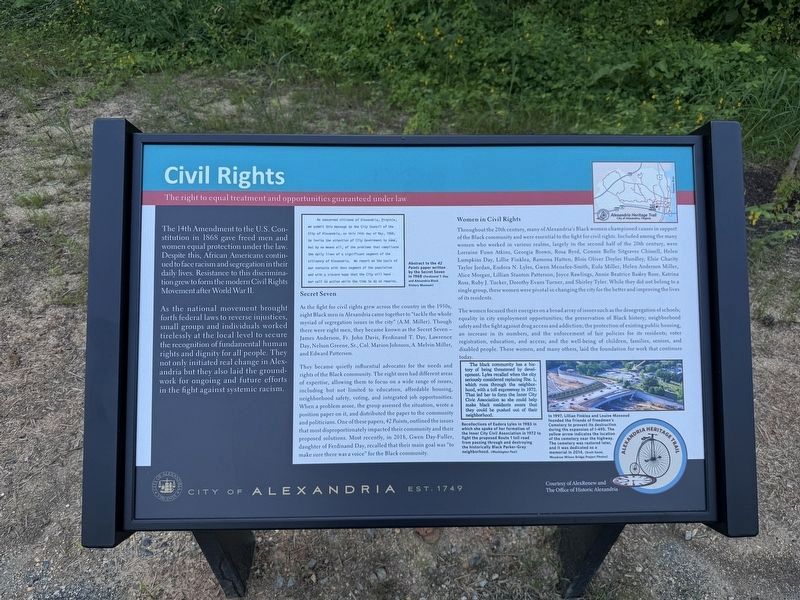
The 14th Amendment to the U.S. Constitution in 1868 gave freed men and women equal protection under the law. Despite this, African Americans continued to face racism and segregation in their daily lives. Resistance to this discrimination grew to form the modern Civil Rights Movement after World War II.
As the national movement brought forth federal laws to reverse injustices, small groups and individuals worked tirelessly at the local level to secure the recognition of fundamental human rights and dignity for all people. They not only initiated real change in Alexandria but they also laid the groundwork for ongoing and future efforts in the fight against systemic racism.
Secret Seven
As the fight for civil rights grew across the country in the 1950s, eight Black men in Alexandria came together to "tackle the whole myriad of segregation issues in the city" (A.M. Miller). Though there were eight men, they became known as the Secret Seven — James Anderson, Fr. John Davis, Ferdinand T. Day, Lawrence Day, Nelson Greene, Sr., Col. Marion Johnson, A. Melvin Miller, and Edward Patterson.
They became quietly influential
this page online
Women in Civil Rights
Throughout the 20th century, many of Alexandria's Black women championed causes in support of the Black community and were essential to the fight for civil rights. Included among the many women who worked in various realms, largely in the second half of the 20th century, were Lorraine Funn Atkins, Georgia Brown, Rosa Byrd, Connie Belle Sitgraves Chissell, Helen Lumpkins Day, Lillie Finklea, Ramona Hatten,
The women focused their energies on a broad array of issues such as the desegregation of schools; equality in city employment opportunities; the preservation of Black history; neighborhood safety and the fight against drug access and addiction; the protection of existing public housing, an increase in its numbers, and the enforcement of fair policies for its residents; voter registration, education, and access; and the well-being of children, families, seniors, and disabled people. These women, and many others, laid the foundation for the work that continues today.
As concerned citizens of Alexandria, Virginia, we submit this message to the City Council of the City of Alexandria, on this 14th day of May, 1968, to invite the attention of City Government to some, but by no means all, of the problems that complicate the daily lives of a significant segment of the citizenry of Alexandria. We report on the basis of our contacts with the segment of the population and with a sincere hope that the City will heed our call to action while the time to do so remains.
Abstract to the 42 Points paper written by the Secret Seven in 1968 (Ferdinand T. Day and Alexandria Black History Museum)
The black community has a history of being threatened by development. Lyles recalled when the city seriously considered replacing Rte. 1, which runs through the neighborhood, with a toll expressway in 1972. That led her to form the Inner City Civic Association so she could help make black residents aware that they could be pushed out of their neighborhood.
Recollections of Eudora Lyles in 1983 in which she spoke of her formation of the Inner City Civil Association in 1972 to fight the proposed Route 1 toll road from passing through and destroying the historically Black Parker-Gray neighborhood. (Washington Post)
[Caption:]
In 1997, Lillian Finklea and Louise Massoud founded the Friends of Freedmen's Cemetery to prevent its destruction during the expansion of I-495. The yellow arrow indicates the location of the cemetery near the highway. The cemetery was restored later, and it was dedicated as a memorial in 2014. (Scott Kozel, Woodrow Wilson Bridge Project Photos)
Erected 2025 by City of Alexandria, Virginia.
Topics and series. This historical marker is listed in these topic lists: African Americans • Arts, Letters, Music • Civil Rights • Women. In addition, it is included in the Virginia, The City of Alexandria series list. A significant historical month for this entry is May 1968.
Location. 38° 48.086′ N, 77° 3.559′ W. Marker is in Alexandria, Virginia. It is in Eisenhower East. It can be reached from the intersection of Holland Lane and Emerson Avenue, on the right when traveling north. Touch for map. Marker is at or near this postal address: 580 Holland Ln, Alexandria VA 22314, United States of America. Touch for directions.

Regionally, this marker is in the Washington Metropolitan Area and in Northern Virginia. It is also in the American South, specifically in the Upper South, in the Mid-Atlantic, and on the Eastern Seaboard. Globally, it is in the North Atlantic Region, North America, the Western Hemisphere, the Western World, and the Anglosphere. Historically, it finds itself in what was once the territory of the Mississippian Culture, one of the original Thirteen Colonies, one of the Confederate States of America, and the Antebellum South.
Other nearby markers. At least 8 other markers are within walking distance of this marker: Freedom (within shouting distance of this marker); Alexandria National Cemetery (about 300 feet away, measured in a direct line); "Pursuers of Booth the Assassin" (about 300 feet away); In Honor of Those Who Gave the Ultimate Sacrifice (about 400 feet away); A National Cemetery System (about 500 feet away); African American Heritage Park (about 500 feet away); Remembrance (about 500 feet away); African American Heritage Memorial (about 500 feet away). Touch for a list and map of all markers in Alexandria.
Credits. This page was last revised on July 28, 2025. It was originally submitted on July 28, 2025, by Devry Becker Jones of Washington, District of Columbia. This page has been viewed 137 times since then and 29 times this year. Photos: 1, 2. submitted on July 28, 2025, by Devry Becker Jones of Washington, District of Columbia.
