Near Fairburn in Custer County, South Dakota — The American Midwest (Upper Plains)
Market Hunting was a Gruesome Business
Photographed by Daniel Barriball, June 12, 2025
1. Market Hunting was a Gruesome Business Marker
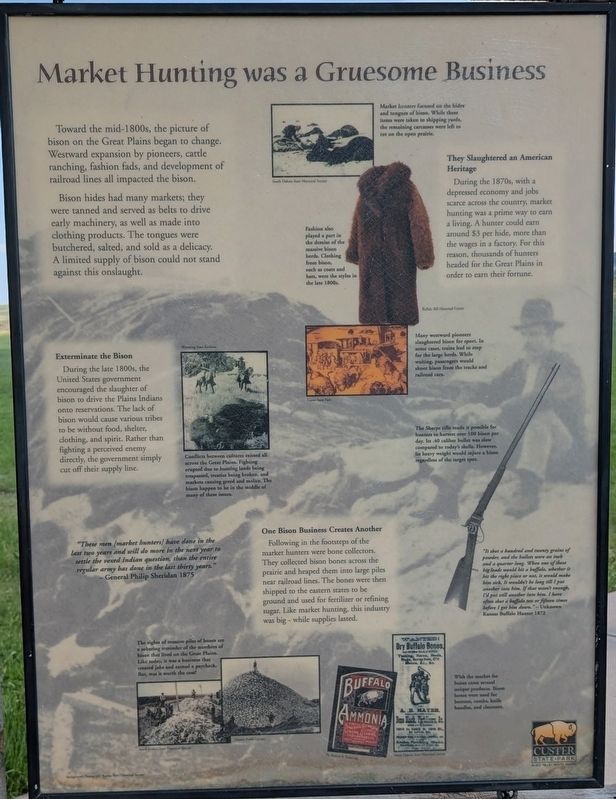
Toward the mid-1800s, the picture of bison on the Great Plains began to change. Westward expansion by pioneers, cattle ranching, fashion fads, and development of railroad lines all impacted the bison.
Bison hides had many markets; they were tanned and served as belts to drive early machinery, as well as made into clothing products. The tongues were butchered, salted, and sold as a delicacy. A limited supply of bison could not stand against this onslaught.
Photo captions: Market hunters focused on the hides and tongues of bison. While these items were taken to shipping yards, the remaining carcasses were left to rot on the open prairie.
Fashion also played a part in the demise of the massive bison herds. Clothing from bison, such as coats and hats, were the styles in the late 1800s.
They Slaughtered an American Heritage
During the 1870s, with a depressed economy and jobs scarce across the country, market hunting was a prime way to earn a living. A hunter could earn around $3 per hide, more than the wages in a factory. For this reason, thousands of hunters headed for the Great Plains in order to earn their fortune.
Captions
this page online
The Sharps rifle made it possible for hunters to harvest over 100 bison per day. Its .40 caliber bullet was slow compared to today's shells. However, its heavy weight would injure a bison regardless of the target spot.
"It shot a hundred and twenty grains of powder, and the bullets were an inch and a quarter long. When one of these big leads would hit a buffalo, whether it hit the right place or not, it would make him sick. It wouldn't be long till I put another into him. If that wasn't enough, I'd put still another into him. I have often shot a buffalo ten or fifteen times before I got him down." —Unknown Kansas Buffalo Hunter 1872
Exterminate the Bison
During the late 1800s, the United States government encouraged the slaughter of bison to drive the Plains Indians onto reservations. The lack of bison would cause various tribes to be without food, shelter, clothing, and spirit. Rather than fighting a perceived enemy directly, the government simply
Photographed by Daniel Barriball, June 12, 2025
2. Market Hunting was a Gruesome Business Marker
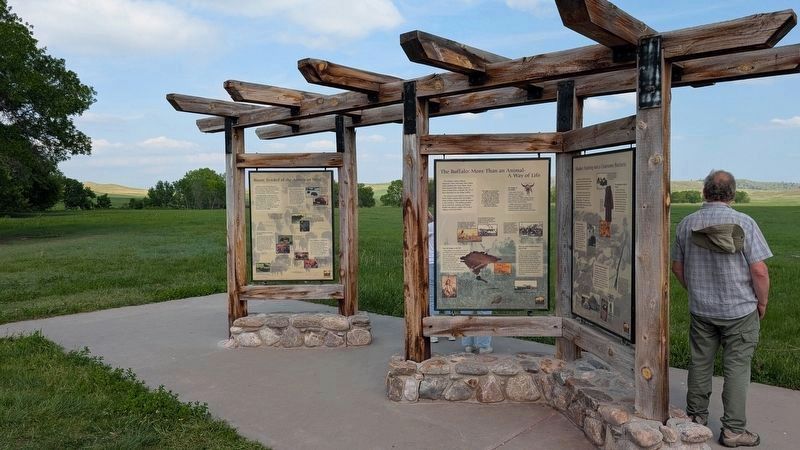
This marker is on the right panel.
Caption Conflicts between cultures existed all across the Great Plains. Fighting erupted due to hunting lands being trespassed, treaties being broken, and markets causing greed and malice. The bison happen to be in the middle of many of these issues.
"These men (market hunters) have done in the last two years and will do more in the next year to settle the vexed Indian question, than the entire regular army has done in the last thirty years." —General Philip Sheridan 1875
One Bison Business Creates Another
Following in the footsteps of the market hunters were bone collectors. They collected bison bones across the prairie and heaped them into large piles near railroad lines. The bones were then shipped to the eastern states to be ground and used for fertilizer or refining sugar. Like market hunting, this industry was big—while supplies lasted.
Photo captions: The sights of massive piles of bones are a sobering reminder of the numbers of bison that lived on the Great Plains. Like today, it was a business that created jobs and earned a paycheck. But, was it worth the cost?
With the market for bones came several unique products. Bison bones were used for buttons, combs, knife handles, and cleansers.
Erected by Custer State Park.
Topics. This historical marker is listed in these topic lists: Animals • Indigenous Peoples and Communities • Industry & Commerce • Wars, US Indian. A significant historical year for this entry is 1872.
Location. 43° 38.452′ N, 103° 22.054′ W. Marker is near Fairburn, South Dakota, in Custer County. It is on Csp Road 1, on the left when traveling west. This marker is located along the Wildlife Loop Road within Custer State Park. Touch for map. Marker is at or near this postal address: 13442 Csp Rd 1, Custer SD 57730, United States of America. Touch for directions.

Regionally, this marker is in West River and in Greater Rapid City. It is also in the American Black Hills, in the Lewis & Clark Corridor, on the prairies, and on the Northern Plains. Globally, it is in North America, the Western Hemisphere, the Western World, and the Anglosphere. Historically, it finds itself in what was once Rupert’s Land and also the Louisiana Purchase.
Other nearby markers. At least 8 other markers are within 8 miles of this marker, measured as the crow flies: The Buffalo: More Than an Animal-A Way of Life (here, next to this marker); America's First Environmental Success Story (here, next to this marker); Custer State Park: A Legacy of Conservation and Preservation (here, next to this marker); Bison: Symbol of the American West (here, next to this marker); Bison are Making a Comeback (here, next to this marker); The Buffalo Corrals (approx. 1.2 miles away); Life in a Prairie Dog Town (approx. 7.6 miles away); Early Game Preserve (approx. 7.6 miles away). Touch for a list and map of all markers in Fairburn.
Credits. This page was last revised on July 29, 2025. It was originally submitted on July 22, 2025, by Daniel Barriball of Chesterton, Indiana. This page has been viewed 245 times since then and 140 times this year. Last updated on July 29, 2025, by Daniel Barriball of Chesterton, Indiana. Photos: 1, 2. submitted on July 22, 2025, by Daniel Barriball of Chesterton, Indiana. • Devry Becker Jones was the editor who published this page.
