Port Dalhousie in St. Catharines in Niagara Region, Ontario — Central Canada (North America)
Lock 1, Third Welland Canal
History Insite
Photographed by Kevin Westell, July 30, 2025
1. History Insite - Lock 1, Third Welland Canal - Marker
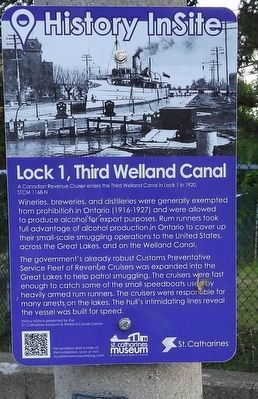
The photo within the marker faces north; in the foreground is the upper lock gate.
The government's already robust Customs Preventative Service Fleet of Revenue Cruisers was expanded into the Great Lakes to help patrol smuggling. The cruisers were fast enough to catch some of the small speedboats used by heavily armed rum runners. The cruisers were responsible for many arrests on the lakes. The hull's intimidating lines reveal the vessel was built for speed.
Erected by St. Catharines Museum & Welland Canals Centre.
Topics and series. This historical marker is listed in these topic lists: Industry & Commerce • Law Enforcement • Waterways & Vessels. In addition, it is included in the The Welland Canals series list. A significant historical year for this entry is 1916.
Location. 43° 11.912′ N, 79° 15.913′ W. Marker is in St. Catharines, Ontario, in Niagara Region. It is in Port Dalhousie. It is on Lakeport Road. Touch for map. Marker is at or near this postal address: 66 Lakeport Road, St Catharines ON L2N 4P6, Canada. Touch for directions.

Regionally, this marker is on the Golden Horseshoe and in Niagara Canada. It is also in Central Canada. Globally, it is in North America, on the Great Lakes, in the Western Hemisphere, in the Western World, and in the Anglosphere. Historically, it finds itself in what was once a British colony, the Viceroyalty of New France, the Haudenosaunee (Iroquois) Confederacy, and Rupert’s Land.
Other nearby markers. At least 8 other markers are within walking distance of this
this page online
Regarding Lock 1, Third Welland Canal. The third Welland canal operated during 1881-1930. But, even after most of the third canal closed, THIS lock continued to function until 1968, permitting ships to move between Lake Ontario and the shipyard on Martindale Pond.
Photographed by Kevin Westell, July 30, 2025
2. History Insite - Lock 1, Third Welland Canal - Marker in context
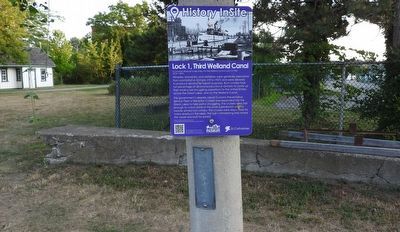
Picture faces north. The marker is on the north side of Lakeport Rd, affixed to a concrete utility pole, adjacent to the sidewalk. To the left is Howes Park, and a lockkeeper's shanty from the 3rd Welland canal era. To the right is the property for the Heywood electric generating station. The relics of the 3rd Welland canal locks are concealed by the sign, concrete pole and bushes; but accessible via the path on the left.
Photographed by Kevin Westell, May 15, 2025
3. Lock 1, Third Welland Canal
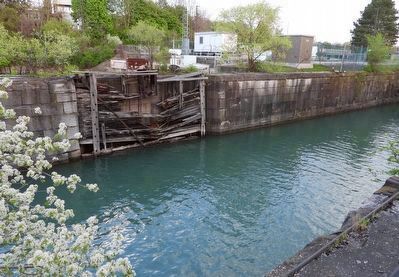
Photo faces south-east. The lock is about 14 metres (45 feet) wide. This lower lock gate door last closed around 1968. While the door's wood is in a decrepit state, we can see its metal structural components. The stonework is in amazing shape after 140 years.
Just left of the lock gate door, the many passing ships left plenty of scrapes.
Photographed by Kevin Westell, May 15, 2025
4. Lock 1 lower lock gate hinge
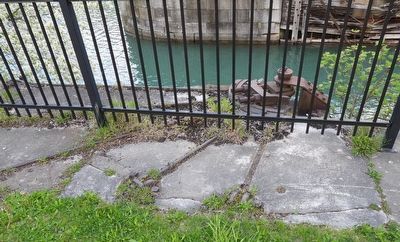
Rods giving the hinge support are sunk into the carved stone blocks.
Credits. This page was last revised on March 9, 2026. It was originally submitted on July 30, 2025, by Kevin Westell of St. Catharines, Ontario. This page has been viewed 117 times since then and 39 times this year. Photos: 1, 2, 3, 4. submitted on July 30, 2025, by Kevin Westell of St. Catharines, Ontario. • Andrew Ruppenstein was the editor who published this page.
