Near Ramah in Cibola County, New Mexico — The American Mountains (Southwest)
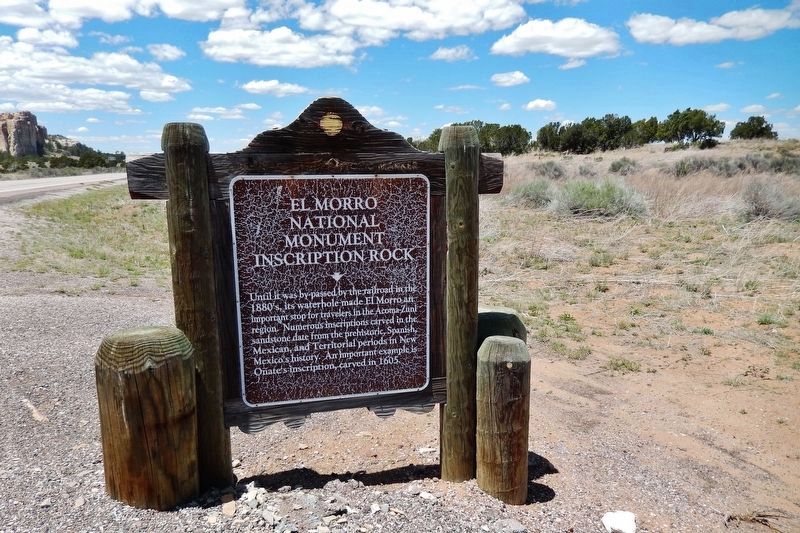
El Morro National Monument Inscription Rock

Photographed by Mike Stroud, June 6, 2003
1. El Morro National Monument Marker
Erected by New Mexico Historic Preservation Division.
Topics. This historical marker is listed in these topic lists: Communications • Hispanic Americans • Indigenous Peoples and Communities • Settlements & Settlers. A significant historical year for this entry is 1605.
Location. 35° 2.595′ N, 108° 20.284′ W. Marker is near Ramah, New Mexico, in Cibola County. It is on State Road 53, on the right when traveling west. Touch for map. Marker is in this post office area: Ramah NM 87321, United States of America. Touch for directions.

Regionally, this marker is in New Mexico’s Navajo Nation and in the San Juan Basin. It is also in the American Southwest and on the Colorado Plateau. Globally, it is in North America, the Western Hemisphere, the Western World, and the Anglosphere. Historically, it finds itself in what was once New Spain.
Other nearby markers. At least 8 other markers are within 3 miles of this marker, measured as the crow flies: Welcome to El Morro (about 500 feet away, measured in a direct line); Visitors Through the Ages (approx. half a mile away); Preserving Our Heritage (approx. 0.7 miles away); Monumental Changes (approx. 0.7 miles away); Lemonade Sumac (approx. ¾ mile away); Oasis (approx. 0.8 miles away); Atsinna (approx. 0.9 miles away); Matilda Coxe Stevenson (1849-1915) / New Mexico Historic Women Marker Initiative (approx. 2.6 miles away). Touch for a list and map of all markers in Ramah.
More about this marker.
this page online
Regarding El Morro National Monument Inscription Rock. El Morro National Monument is located on an ancient east-west trail in western New Mexico.
The main feature of this National Monument is a great sandstone promontory with a pool of water at its base. As a shaded oasis in the western U.S. desert, this site has seen many centuries of travelers. The Spaniard explorers called it "El Morro" (The Headland). The Zuni Indians call it "A'ts'ina" (Place of writings on the rock). Anglo-Americans called it "Inscription Rock". Travelers left signatures, names, dates, and stories of their treks. While some of the inscriptions are fading, there are still many that can be seen today, some dating to the 17th century. Some petroglyphs and carvings were made by the Anasazi centuries before Europeans started making their mark. In 1906, U.S. federal law prohibited further carving.
Also see . . . National Park Service. El Morro (Submitted on December 5, 2008, by Mike Stroud of Bluffton, South Carolina.)
Photographed by Cosmos Mariner, May 20, 2016
2. El Morro National Monument Inscription Rock Marker
Photographed by Mike Stroud, 2003
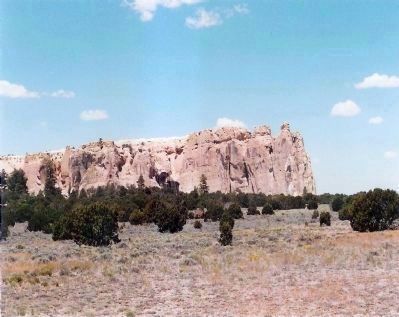
3. The Bluff at El Morro
Hundreds of years before Spanish conquistadores passed by here, a pool’s dependable water supply encouraged the settlement of Puebloan people on top of the bluff.
Photographed by Mike Stroud, 2003
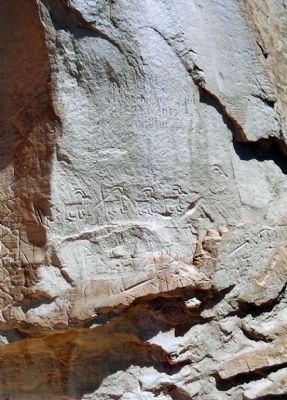
4. Some petroglyphs and carvings were made by the Anasazi
The inscriptions date back to the 1600s when the Spanish traveled through the area.

Photographed by Mike Stroud
5. Inscription from Don Juan de Oñate, as mentioned on marker
Translation: “Passed by here the Governor Don Juan de Oñate, from the discovery of the Sea of the South on the 16th of April, 1605.”
Photographed by Mike Stroud, 2003
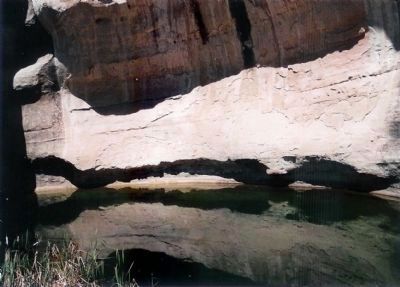
6. El Morro waterhole
A reliable waterhole hidden at the base of a sandstone bluff made El Morro (the headland) a popular campsite. Ancestral Puebloans and Spanish and American travelers carved over 2,000 signatures, dates, messages, and petroglyphs for hundreds of years.
After centuries of continuous human use, the pool today is used only by local wildlife taking advantage of its refreshing waters.
After centuries of continuous human use, the pool today is used only by local wildlife taking advantage of its refreshing waters.
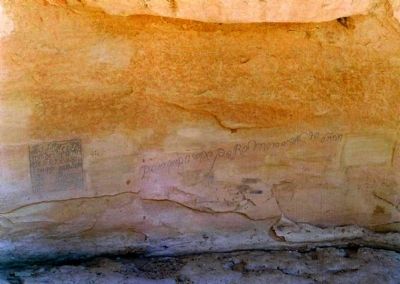
Photographed by Mike Stroud, June 6, 2003
7. El Morro National Monument Marker
(L) "On the 25th of the month of June, of this year of 1709, passed by here on the way to Zuni, Ramon Garcia Jurado."
(R) "By here passed Pedro Romero on the 22nd of August, year of 1751."
(R) "By here passed Pedro Romero on the 22nd of August, year of 1751."
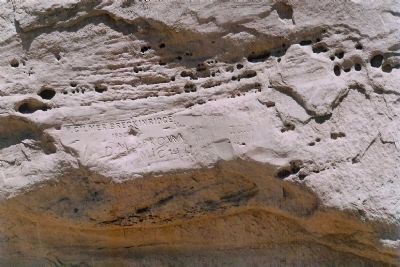
Photographed by Mike Stroud, 2003
8. In 1857, Breckinridge
was in charge of the 25 camels used by Lt. Edward Beale in his expedition.
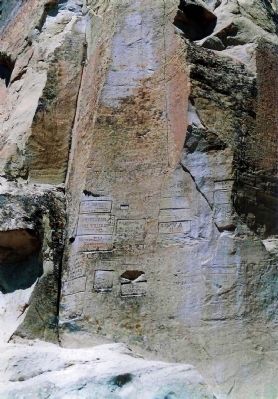
Photographed by Mike Stroud, June 6, 2003
9. Inscriptions at the point of El Morro
include old Spanish carvings as well as English carved
by members of the 1868 Union Pacific Railroad survey.
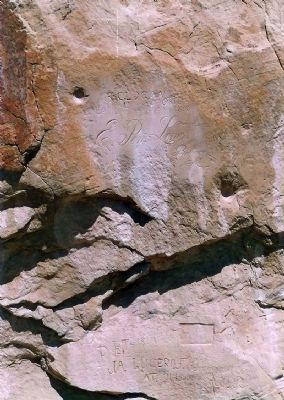
Photographed by Mike Stroud, 2003
10. Inscription Rock
E. Pen Long, Baltimore, Md
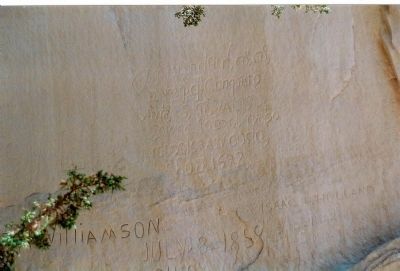
Photographed by Mike Stroud, 2003
11. Inscription Rock
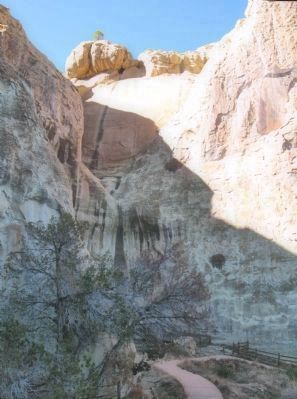
Photographed by Richard Denney, March 16, 2009
12. El Morro's Waterhole
El Morro's waterhole is located at the base of the sandstone bluff shown in this photo.
Photographed by Richard Denney, March 16, 2009
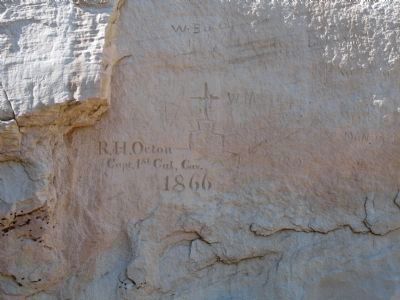
13. More signatures, Petroglyphs
One inscription reads "R.H. Orton, Capt. 1st Cal.. 1866". Also visible a petroglyph, perhaps a "cloud terrace" inspired church with cross.
Credits. This page was last revised on August 8, 2025. It was originally submitted on December 5, 2008, by Mike Stroud of Bluffton, South Carolina. This page has been viewed 4,312 times since then and 69 times this year. Last updated on July 30, 2025, by Bill Wingate of Albuquerque, New Mexico. Photos: 1. submitted on December 5, 2008, by Mike Stroud of Bluffton, South Carolina. 2. submitted on December 23, 2020, by Cosmos Mariner of Cape Canaveral, Florida. 3, 4, 5, 6, 7, 8, 9, 10, 11. submitted on December 5, 2008, by Mike Stroud of Bluffton, South Carolina. 12, 13. submitted on May 12, 2014, by Richard Denney of Austin, Texas. • Devry Becker Jones was the editor who published this page.
