Near Fort Sumner in De Baca County, New Mexico — The American Mountains (Southwest)
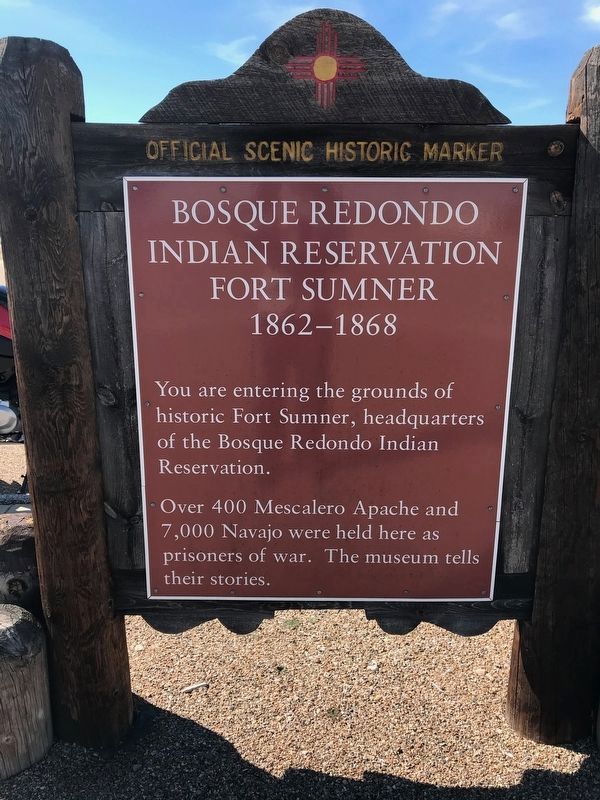
Bosque Redondo Indian Reservation
Fort Sumner 1862 - 1868
Photographed by Sandy Ballard, February 1, 2020
1. Bosque Redondo Indian Reservation Marker
You are entering the grounds of historic Fort Sumner, headquarters of the Bosque Redondo Indian Reservation.
Over 400 Mescalero Apache and 7,000 Navajo were held here as prisoners of war. The museum tells their stories.
Erected by New Mexico Historic Preservation Division.
Topics. This historical marker is listed in these topic lists: Forts and Castles • Indigenous Peoples and Communities • Settlements & Settlers • Wars, US Indian. A significant historical year for this entry is 1862.
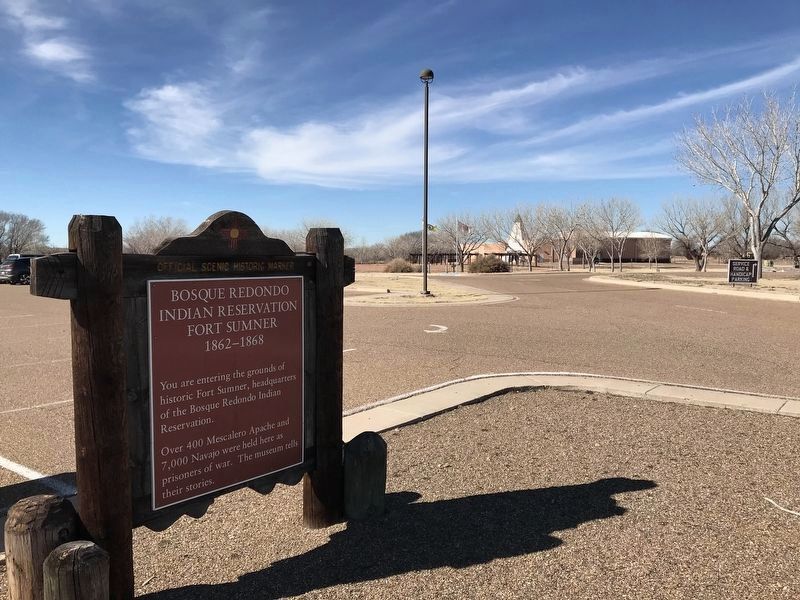
Location. 34° 24.12′ N, 104° 11.648′ W. Marker is near Fort Sumner, New Mexico, in De Baca County. It is on State Road 272 south of State Road 212, on the right when traveling south. This marker is located in the parking lot of the Bosque Redondo Memorial Park. Touch for map. Marker is at or near this postal address: 3591 Billy the Kid Dr, Fort Sumner NM 88119, United States of America. Touch for directions.

Regionally, this marker is in Eastern New Mexico and in the Pecos Valley. It is also in the American Southwest, on the Great Plains, on the Southern Plains, and specifically on the High Plains. Globally, it
this page online
Other nearby markers. At least 8 other markers are within walking distance of this marker: Deluvina Maxwell (about 600 feet away, measured in a direct line); Lucien Bonaparte Maxwell (about 700 feet away); Charlie Bowdre (about 700 feet away); Billy the Kid's Elusive Tombstone (about 700 feet away); Tom O'Folliard (about 700 feet away); Billy the Kid (about 700 feet away); Joe "Texas Red" Grant (about 800 feet away); Welcome to the Historic Fort Sumner Cemetery (about 800 feet away). Touch for a list and map of all markers in Fort Sumner.
Photographed by Sandy Ballard, February 1, 2020
2. Bosque Redondo Indian Reservation Marker
Photographed by Sandy Ballard, February 1, 2020
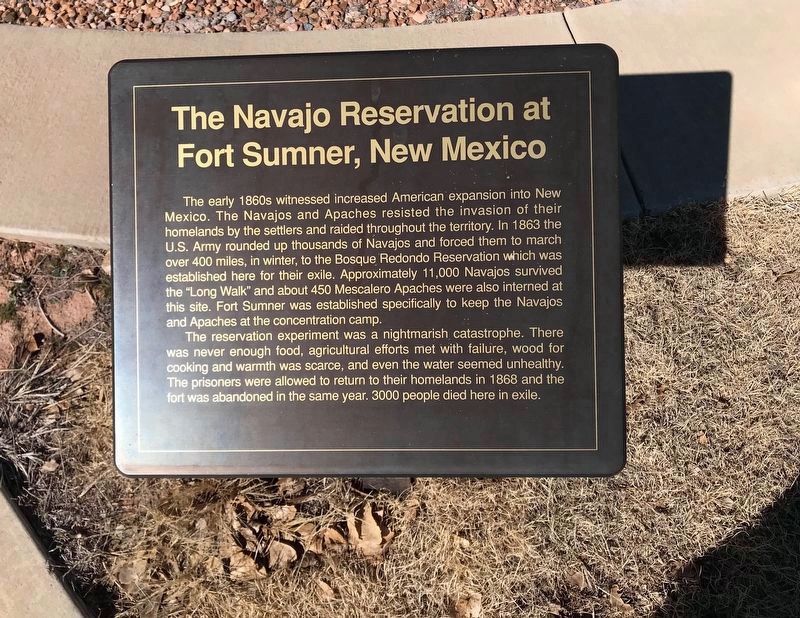
3. An additional nearby marker for the Navajo Reservation at Fort Sumner
The Navajo Reservation at Fort Sumner, New Mexico
The early 1860s witnessed increased American expansion into New Mexico. The Navajos and Apaches resisted the invasion of their homelands by the settlers and raided throughout the territory. In 1863 the U.S. Army rounded up thousands of Navajos and forced them to march over 400 miles, in winter, to the Bosque Redondo Reservation which was established here for their exile. Approximately 11,000 Navajos survived the “Long Walk” and about 450 Mescalero Apaches were also interned at this site. Fort Sumner was established specifically to keep the Navajos and Apaches at the concentration camp.
The reservation experiment was a nightmarish catastrophe. There was never enough food, agricultural efforts met with failure, wood for cooking and warmth was scarce, and even the water seemed unhealthy. The prisoners were allowed to return to their homelands in 1868 and the fort was abandoned in the same year. 3000 people died here in exile.
The early 1860s witnessed increased American expansion into New Mexico. The Navajos and Apaches resisted the invasion of their homelands by the settlers and raided throughout the territory. In 1863 the U.S. Army rounded up thousands of Navajos and forced them to march over 400 miles, in winter, to the Bosque Redondo Reservation which was established here for their exile. Approximately 11,000 Navajos survived the “Long Walk” and about 450 Mescalero Apaches were also interned at this site. Fort Sumner was established specifically to keep the Navajos and Apaches at the concentration camp.
The reservation experiment was a nightmarish catastrophe. There was never enough food, agricultural efforts met with failure, wood for cooking and warmth was scarce, and even the water seemed unhealthy. The prisoners were allowed to return to their homelands in 1868 and the fort was abandoned in the same year. 3000 people died here in exile.
Photographed by Sandy Ballard, February 1, 2020
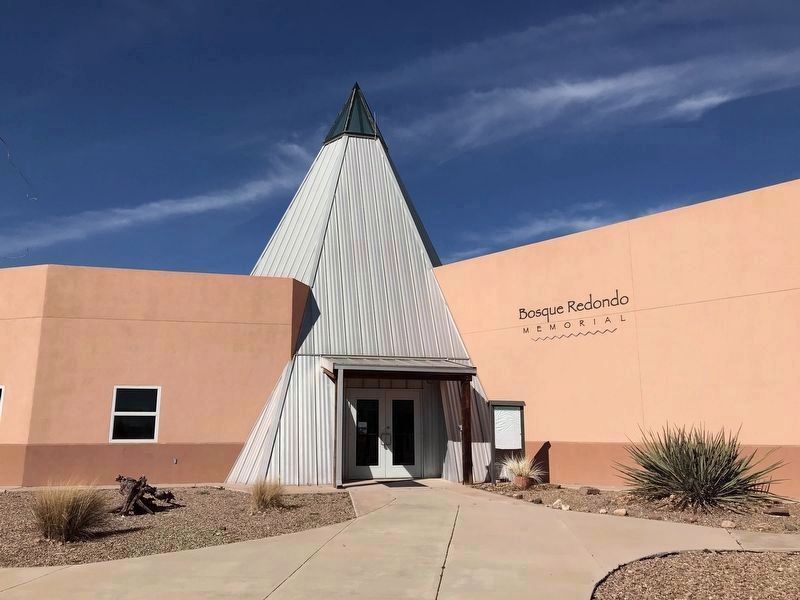
4. Bosque Redondo Memorial
Credits. This page was last revised on August 6, 2025. It was originally submitted on February 1, 2020, by Sandy Ballard of Albuquerque, New Mexico. This page has been viewed 824 times since then and 48 times this year. Last updated on July 30, 2025, by Bill Wingate of Albuquerque, New Mexico. Photos: 1, 2, 3, 4. submitted on February 1, 2020, by Sandy Ballard of Albuquerque, New Mexico. • Devry Becker Jones was the editor who published this page.
