
Cochiti Pueblo in Sandoval County, New Mexico — The American Mountains (Southwest)
Women of Cochiti
Cochiti Pueblo
| — | New Mexico Historic Women Marker Initiative | — |
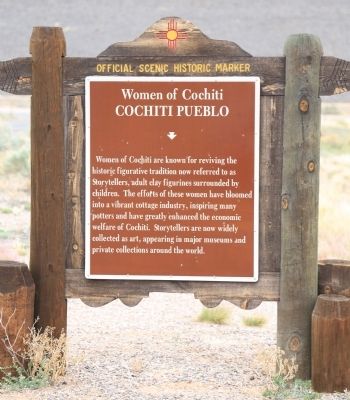
Photographed by J. J. Prats, April 26, 2014
1. Women of Cochiti Marker
Erected by New Mexico Historic Preservation Division.
Topics and series. This historical marker is listed in these topic lists: Arts, Letters, Music • Indigenous Peoples and Communities • Women. In addition, it is included in the New Mexico Women’s Historic Marker Initiative series list.
Location. 35° 37.688′ N, 106° 19.848′ W. Marker is in Cochiti Pueblo, New Mexico, in Sandoval County. It is on Cochiti Highway (State Road 22) near Road 85. Touch for map. Marker is in this post office area: Cochiti Pueblo NM 87072, United States of America. Touch for directions.

Regionally, this marker is in the San Juan Basin and in Greater Albuquerque.
this page online
Other nearby markers. At least 8 other markers are within 12 miles of this marker, measured as the crow flies: La Bajada (approx. 6.7 miles away); Pueblo of Santo Domingo Kiua (approx. 7.9 miles away); Kewa Women's Co-op (approx. 10.7 miles away); Houses (approx. 11½ miles away); Gold and Turquoise (approx. 12 miles away); Bicentennial Celebration / La Bajada (approx. 12 miles away); Amelia Elizabeth White / Mary Cabot Wheelwright (approx. 12 miles away); Maria Gertrudis Barceló (approx. 12 miles away).
More about this marker. The New Mexico Historic Women Marker Initiative was founded in 2005 by members of the New Mexico Women’s Forum in a statewide effort to recognize women’s contributions to New Mexico history on the state’s Official Scenic Historic Markers. The Initiative ensures that women’s diverse histories will be remembered and told, and will inspire and provide
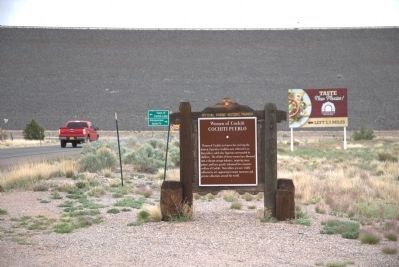
Photographed by J. J. Prats, April 26, 2014
2. Women of Cochiti Marker
The gray wall in the distance is the stone-covered dam for Cochiti Lake. Dam Crest Road runs atop it. Click on the link for the map to view its great length.
Also see . . . Wikipedia Entry for Storyteller Pottery. “A Storyteller is a clay figurine made by the Pueblo people of New Mexico. The first contemporary storyteller was made by Helen Cordero of the Cochiti Pueblo in 1964 in honor of her grandfather, who was a tribal storyteller. It is basically a figure of a storyteller, usually a man or a woman and its mouth is always open. It is surrounded by figures of children and other things, who represent those who are listening to the storyteller. The motif is based on the traditional ‘singing mother’ motif which depicts a woman with her mouth open holding one or two children.” (Submitted on April 27, 2014.)
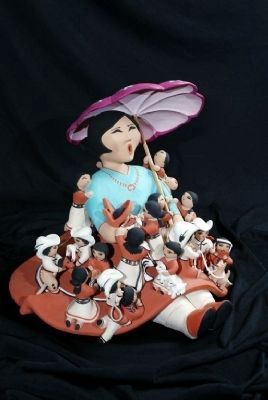
Photographed by Rose Pecos-SunRhodes, Jemez Pueblo, New Mexico, 1993
3. "Storyteller Under Sunny Skies"
Courtesy Wikipedia Commons. This work of art is at the Children’s Museum of Indianapolis. The following additional information is provided with the photograph:
“Clay figures have been present in the Pueblo culture since 400 A.D. Female figures, animals, birds and more recently the storyteller figure have been part of their tradition.
The "singing mother" with several children sitting on her lap was introduced by Cochiti artist Helen Cordero. In the 1960s, Helen created the first official grandfather-like storyteller that was modeled from her own grandfather and his storytelling skills.
Storytellers reveal the importance of oral tradition amongst Pueblo children--they teach about Pueblo culture, heritage and beliefs through abstract stories. Today, many Pueblo communities create storyteller figures. The word "storyteller" has taken a generic form and is used to describe not only the male figures, but female figures, clowns, turtles, bears, coyotes, and other non-traditional characters. All of these figures are classified as "storytellers" because of the many children gathered around them.
This particular storyteller is female and was made by Jemez Pueblo artist Rose Pecos-Sun Rhodes.” The Children’s Museum of Indianapolis, IMCPL Digital Collections
“Clay figures have been present in the Pueblo culture since 400 A.D. Female figures, animals, birds and more recently the storyteller figure have been part of their tradition.
The "singing mother" with several children sitting on her lap was introduced by Cochiti artist Helen Cordero. In the 1960s, Helen created the first official grandfather-like storyteller that was modeled from her own grandfather and his storytelling skills.
Storytellers reveal the importance of oral tradition amongst Pueblo children--they teach about Pueblo culture, heritage and beliefs through abstract stories. Today, many Pueblo communities create storyteller figures. The word "storyteller" has taken a generic form and is used to describe not only the male figures, but female figures, clowns, turtles, bears, coyotes, and other non-traditional characters. All of these figures are classified as "storytellers" because of the many children gathered around them.
This particular storyteller is female and was made by Jemez Pueblo artist Rose Pecos-Sun Rhodes.” The Children’s Museum of Indianapolis, IMCPL Digital Collections
Credits. This page was last revised on August 12, 2025. It was originally submitted on April 27, 2014, by J. J. Prats of Powell, Ohio. This page has been viewed 912 times since then and 21 times this year. Last updated on July 30, 2025, by Bill Wingate of Albuquerque, New Mexico. Photos: 1, 2, 3. submitted on April 27, 2014, by J. J. Prats of Powell, Ohio. • J. Makali Bruton was the editor who published this page.
