Dayton in Rockingham County, Virginia — The American South (Mid-Atlantic)
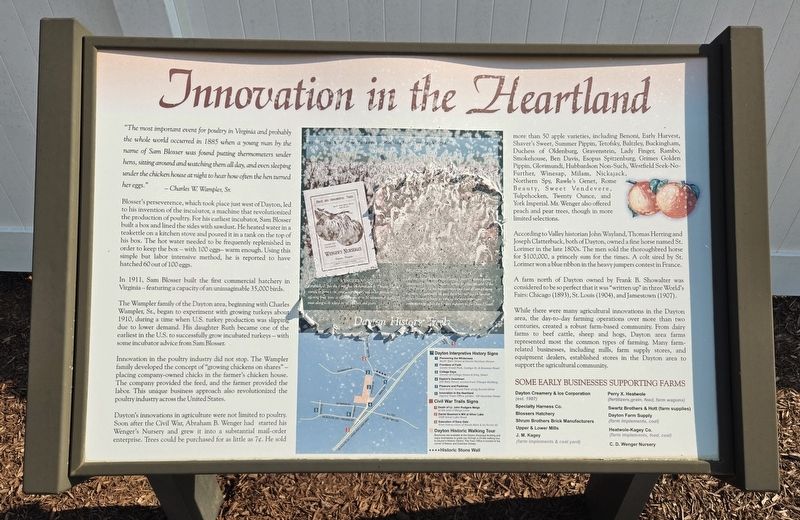
Innovation in the Heartland
Photographed by Bradley Owen, July 22, 2025
1. Innovation in the Heartland Marker
"The most important event for poultry in Virginia and probably the whole world occurred in 1885 when a young man by the name of Sam Blosser was found putting thermometers under hens, sitting around and watching them all day, and even sleeping under the chicken house at night to hear how often the hen turned her eggs."
-Charles W. Wampler, Sr.
Blosser's perseverence, which took place just west of Dayton, led to his invention of the incubator, a machine that revolutionized the production of poultry. For his earliest incubator, Sam Blosser built a box and lined the sides with sawdust. He heated water in a teakettle on a kitchen stove and poured it in a tank on the top of his box. The hot water needed to be frequently replenished in order to keep the box - with 100 eggs - warm enough. Using this simple but labor intensive method, he is reported to have hatched 60 out of 100 eggs.
In 1911, Sam Blosser built the first commercial hatchery in Virginia - featuring a capacity of an unimaginable 35,000 birds.
The Wampler family of the Dayton area, beginning with Charles Wampler, Sr., began to experiment with growing
this page online
Innovation in the poultry industry did not stop. The Wampler family developed the concept of "growing chickens on shares" - placing company-owned chicks in the farmer's chicken house. The company provided the feed, and the farmer provided the labor. This unique business approach also revolutionized the poultry industry across the United States.
Dayton's innovations in agriculture were not limited to poultry. Soon after the Civil War, Abraham B. Wenger had started his Wenger's Nursery and grew it into a substantial mail-order enterprise. Trees could be purchased for as little as 7 cents. He sold more than 50 apple varieties, including Benoni, Early Harvest, Shaver's Sweet, Summer Pippin, Tetofsky, Baltzley, Buckingham, Duchess of Oldenburg, Gravenstein, Lady Finger, Rambo, Smokehouse, Ben Davis, Esopus Spitzenburg, Grimes Golden Pippin, Glorimundi, Hubbardson Non-Such, Westfield Seek-No-Further,
Photographed by Bradley Owen, July 22, 2025
2. Innovation in the Heartland Marker
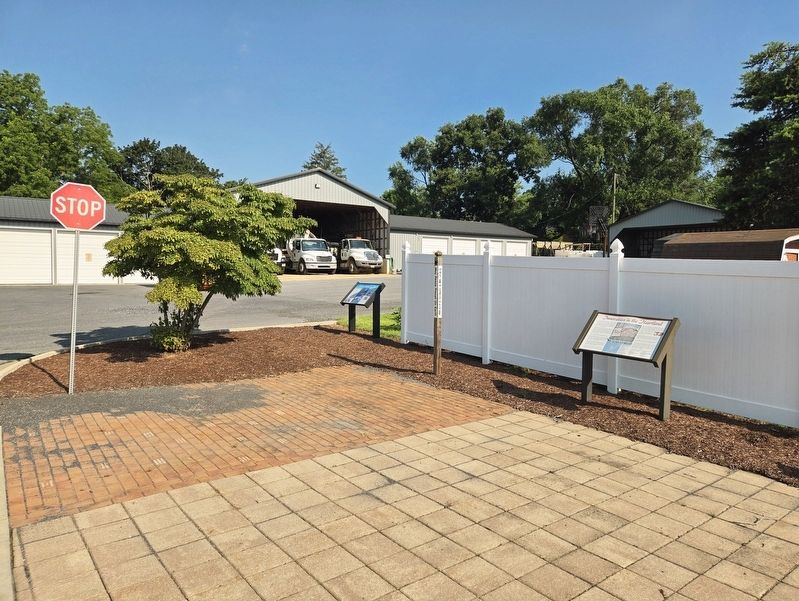
Marker is on the right.
According to Valley historian John Wayland, Thomas Herring and Joseph Clatterbuck, both of Dayton, owned a fine horse named St. Lorimer in the late 1800s. The men sold the thoroughbred horse for $100,000, a princely sum for the times. A colt sired by St. Lorimer won a blue ribbon in the heavy jumpers contest in France.
A farm north of Dayton owned by Frank B. Showalter was considered to be so perfect that it was "written up" in three World's Fairs: Chicago (1893), St. Louis (1904), and Jamestown (1907).
While there were many agricultural innovations in the Dayton area, the day-to-day farming operations over more than two centuries, created a robust farm-based community. From dairy farms to beef cattle, sheep and hogs, Dayton area farms represented most the common types of farming. Many farm-related businesses, including mills, farm supply stores, and equipment dealers, established stores in the Dayton area to support the agricultural community.
Some Early Businesses Supporting Farms
Dayton Creamery & Ice Corporation (est. 1907) • Specialty Harness Co. • Blossers Hatchery • Shrum Brothers Brick Manufacturers • Upper & Lower Mills • J. M. Kagey (farm implements & coal yard) • Perry X. Heatwole (fertilizers, grain, feed, farm wagons) • Swartz Brothers & Hott (farm supplies) • Dayton Farm Supply (farm implements, coal) • Heatwole-Kagey Co. (farm implements, feed, coal) • C. D. Wenger Nursery
(Captions):
WENGER'S NURSERIES
Established, after the Civil War by Abraham B. Wenger, The company grew to become a significant mail-order operation offering fruit trees. It offered more than 50 varieties of apple trees along with selections of peaches and pears.
BRONZE TURKEYS
Like the rest of Rockingham County, Dayton's turkey farms specialized in "bronze" turkeys for the first few decades of the 20th Century. As the industry reshaped itself to attract more business, it eventually adopted the white turkeys so familiar today. Dayton is home to some of the most important innovations to affect the poultry industry in the United States.
Erected by The Town of Dayton, Va.
Topics. This historical marker is listed in these topic lists: Agriculture • Horticulture & Forestry • Industry & Commerce • Science & Medicine. A significant historical year for this entry is 1885.
Location. 38° 24.808′ N, 78° 56.57′ W. Marker is in Dayton, Virginia, in Rockingham County. It is on Walnut Lane north of Mason Street (Virginia Route 257), on the right when traveling north. Marker is located behind the Town of Dayton Municipal Building. Touch for map. Marker is at or near this postal address: 149 Walnut Lane, Dayton VA 22821, United States of America. Touch for directions.

Regionally, this marker is in the Shenandoah Valley. It is also in the American South and specifically in the Upper South. Globally, it is in North America, the Western Hemisphere, the Western World, and the Anglosphere. Historically, it finds itself in what was once the territory of the Mississippian Culture, one of the original Thirteen Colonies, one of the Confederate States of America, and the Antebellum South.
Other nearby markers. At least 8 other markers are within walking distance of this marker: Inventor Samuel H. Blosser (here, next to this marker); Dayton (about 800 feet away, measured in a direct line); Dayton's Downtown (approx. ¼ mile away); Origins of Shenandoah University (approx. 0.3 miles away); In Honor and Remembrance (approx. 0.3 miles away); Lt. Col. Thomas F. Wildes (approx. 0.3 miles away); Pleasures and Pastimes (approx. 0.3 miles away); College Days (approx. 0.4 miles away). Touch for a list and map of all markers in Dayton.
Another marker is no longer nearby. Dayton (was about 800 feet away but has been replaced with another marker now near it).
Regarding Innovation in the Heartland. Marker includes a map of Dayton (Dayton History Trails) featuring locations for Dayton Interpretive History Signs, Civil War Trails Signs, the Dayton Historic Walking Tour area and the Historic Stone Wall.
Credits. This page was last revised on July 31, 2025. It was originally submitted on July 31, 2025, by Bradley Owen of Morgantown, West Virginia. This page has been viewed 106 times since then and 28 times this year. Photos: 1, 2. submitted on July 31, 2025, by Bradley Owen of Morgantown, West Virginia.
