Downtown in Frederick in Frederick County, Maryland — The American Northeast (Mid-Atlantic)
Frederick
A Town becomes a City
| — | The Historic National Road - The Road That Built The Nation | — |
Photographed by Craig Swain, September 9, 2007
1. Frederick Marker
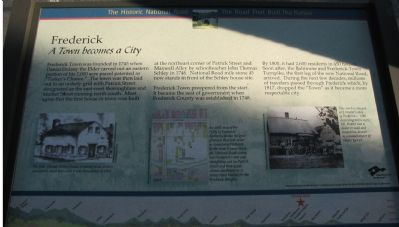
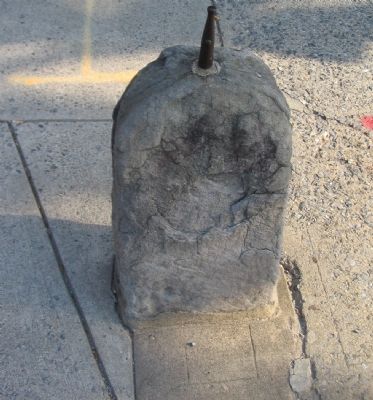
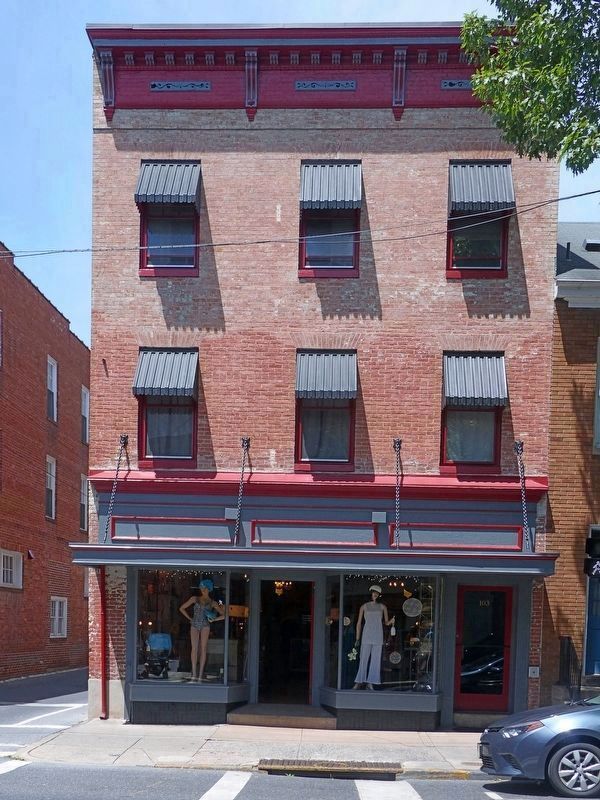
Frederick Town was founded in 1745 when Daniel Dulany the Elder carved out an eastern portion of his 7,000 acre parcel patented as "Tasker's Chance." The town was then laid out in an orderly grid with Patrick Street designated as the east-west thoroughfare and Market Street running north-south. Most agree that the first house in town was built at the northeast corner of Patrick Street and Maxwell Alley by schoolteacher John Thomas Schley in 1746. National Road mile stone 45 now stands in front of the Schley house site.
Frederick Town prospered from the start. It became the seat of government when Frederick County was established in 1748. By 1800 it had 2,600 residents in 450 houses. Soon after, the Baltimore and Frederick-Town Turnpike, the first leg of the new National Road, arrived. During the next few decades, millions of travelers passed through Frederick which, by 1817, dropped the "Town" as it became a more respectable city.
Erected by America's ByWays.
Topics and series. This historical marker is listed in these topic lists: Roads & Vehicles • Settlements & Settlers. In addition, it is included
this page online
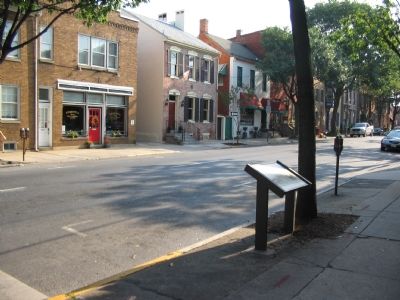
Location. This marker has been replaced by another marker nearby. It was located near 39° 24.843′ N, 77° 24.547′ W. Marker was in Frederick, Maryland, in Frederick County. It was in Downtown. It was at the intersection of East Patrick Street (State Highway 144) and Maxwell Alley, on the left when traveling east on East Patrick Street. Touch for map. Marker was at or near this postal address: 57 Maxwell Ave, Frederick MD 21701, United States of America. Touch for directions.

Regionally, this marker was in the Washington Metropolitan Area and in Central Maryland. It was also in the American Mid-Atlantic. Globally, it was in North America, the Western Hemisphere, the Western World, and the Anglosphere. Historically, it found itself in what was once one of the original Thirteen Colonies and also the Antebellum South.
Other nearby markers. At least 8 other markers are within walking distance of this location: One Vast Hospital (a few steps from this marker); a different marker also named Frederick (a few steps from this marker); 1862 Antietam Campaign
Photographed by Craig Swain, September 9, 2007
2. Wayside 21's Marker Along Patrick Street - The Old National Road
Other markers no longer nearby. Frederick (has been replaced with this marker); a different marker also named 1862 Antietam Campaign (was within shouting distance of this marker but has been replaced with another marker now near it); a different marker also named Hospitals in Frederick (was within shouting distance of this marker but has been replaced with another marker now near it).
More about this marker. "The John Thomas Schley House, rendered in an artist's conception, stood here until it was demolished in 1853," is on the lower left of the marker.
"An 1841 map of the 'City of Frederick' distinctly shows the grid of streets that still exists in downtown Frederick. In the town's lower third, the
Photographed by Craig Swain, September 9, 2007
3. Old National Road Milestone
A few yards away on the opposite side of Patrick Street is one of the Old National Road Milestones.
On the lower right a photograph displays, "This coach is stopped at J. Walter's shop in Frederick c. 1880. According to his sign, Mr. Walter was a dealer in wool and sheepskins, as well as a manufacturer of Neat's foot oil."
The marker's background is "National Road at Fairview Inn," the standard for this marker series. This marker is listed as Wayside 21 in the series.
Related marker. Click here for another marker that is related to this marker. This marker has been replaced by the linked marker. There are differences in subtitle and erecting organizations.
Photographed by Allen C. Browne, July 2, 2016
4. The Northeast Corner of Patrick Street and Maxwell Alley
National Road Mile marker # 45 no longer stands on this corner. It was hit by a car.
Credits. This page was last revised on June 30, 2024. It was originally submitted on October 6, 2007, by Craig Swain of Leesburg, Virginia. This page has been viewed 3,015 times since then and 36 times this year. Photos: 1, 2, 3. submitted on October 6, 2007, by Craig Swain of Leesburg, Virginia. 4. submitted on September 15, 2016, by Allen C. Browne of Silver Spring, Maryland.
