Bethlehem in Grafton County, New Hampshire — The American Northeast (New England)
Stream Meets Street
The Main Street Culvert - Bethlehem New Hampshire

Photographed by William Fischer, Jr., July 28, 2025
1. Stream Meets Street Marker
Under your feet there is a stream that has always flowed here. In the 18th century settlers from the seacoast traveling into the north country followed a path that crossed this stream. When a group of them decided to stay in this place, that path became the main street of their new town. Over the years the stream and the street have found ways to coexist. This is their story.
A STEADFAST STREAM
Several small streams flow downhill off Mt. Agassiz northward to the Ammonoosuc River. The largest is Barrett Brook, which is under the street. In the beginning, the low spot where the stream met the street was a muddy place that had to be crossed with care. By the early 1800s a small culvert carried the water under the street.
The stream found a greater purpose in the early 1900s when the town used its water to form a pond they called Sunset Lake; then after the hurricane of 1938 they rebuilt the pond as a swimming pool.
PATH TO THE MOUNTAINS
The street was on the route through the White Mountains connecting the seacoast and the Connecticut River Valley that eventually became part of the New Hampshire turnpike system
this page online
At that time, the street was simply an irregular dirt path worn by the horses and carts over the uneven ground; but the farms and houses on the sides of the street kept their yards in a straight even line marked by fences and stone walls, and so the town took shape. These farmhouses were later replaced by summer cottages and hotels as the first tourists arrived by stagecoach and the street began to change.
The growth of Bethlehem as a summer tourist destination relied on creating new infrastructure. In 1875 the hotel and business owners formed the Bethlehem Improvement Association. At the end of the 1870s the street was leveled and graded. The town filled in the dip in the road and the older culvert was replaced. They built wooden sidewalks and installed kerosene streetlights in 1887 that were lit during the summer months and in 1896 they installed electric lights. The street was transformed into a tree-lined boulevard.
The
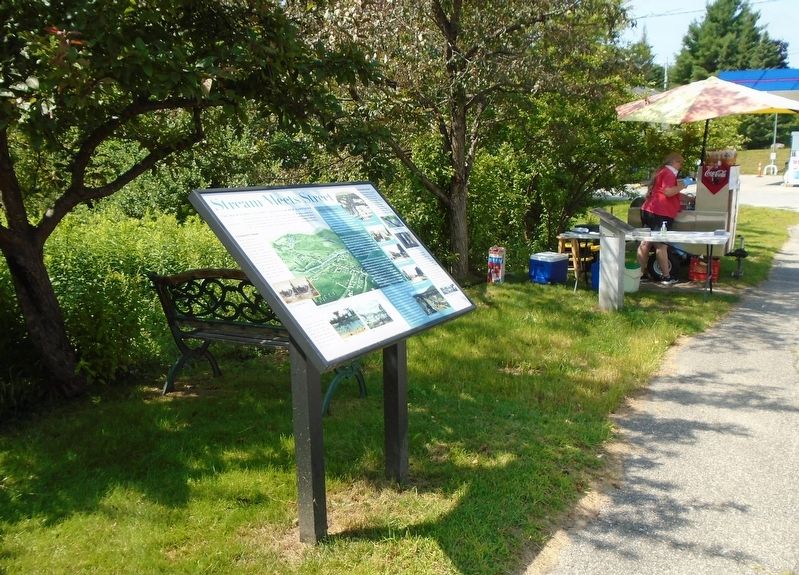
Photographed by William Fischer, Jr., July 28, 2025
2. Stream Meets Street Marker
THE STONE CULVERT
When the roadway was leveled and graded in the 1870s, a new deep stone box culvert was built under the street. That culvert is still there below the street. It consists of three different parts. The original stone box culvert under the roadway is 66 long. Its stone walls are mortared random rubble boulders and fieldstones.
The original stone box culvert has an interior clearance of seven feet. Highway plans from 1920 show that the old culvert was retained when the road was rebuilt. The stone culvert was extended at the inlet (south) with a 33'-long concrete box. The outlet (north) was lengthened with a 68' corrugated steel pipe and fill was added on top to create a parking area north of the road for the adjacent 1940s restaurant, now the post office.
[Illustration captions, clockwise from far left center, read]
• 1870s LOOKING WEST
• 1883 LOOKING SOUTHEAST [Birdseye view]
• EARLY 1870s LOOKING EAST
• 1890s LOOKING WEST
• EARLY 1900s LOOKING EAST
• EARLY 1900s LOOKING EAST
• 1920s LOOKING EAST
• 2015 LOOKING NORTH [stone culvert]
• 2015 LOOKING SOUTH [stone culvert]
• 1950s LOOKING NORTH [now Post Office]
• 1920s LOOKING EAST
• 1950s [Playground and pool]
• 1920s [Lake]
Erected by Federal Highway Administration, NH Division of Historical Resources, and the Town of Bethlehem.
Topics. This historical marker is listed in these topic lists: Roads & Vehicles • Settlements & Settlers • Waterways & Vessels. A significant historical year for this entry is 1938.
Location. 44° 16.819′ N, 71° 41.148′ W. Marker is in Bethlehem, New Hampshire, in Grafton County. It is on Main Street (U.S. 302) east of Maple Street (New Hampshire Route 142), on the right when traveling east. Touch for map. Marker is at or near this postal address: 2182 Main Street, Bethlehem NH 03574, United States of America. Touch for directions.

Regionally, this marker is in the White Mountains. It is also in the American Northeast and in New England. Globally, it is in North America, the Great North Woods, the Western Hemisphere, the Western World, and the Anglosphere. Historically, it finds itself in what was once one of the original Thirteen Colonies.
Other nearby markers. At least 8 other markers are within walking distance of this marker: Bethlehem Heritage Center (here, next to this marker); Bethlehem, New Hampshire Bicentennial (within shouting distance of this marker); Town Building (about 300 feet away, measured in a direct line); Cruft/Jackson Block (about 400 feet away); Mt. Agassiz Hotel and Fairlawn House (about 400 feet away); Jodo Karate (about 500 feet away); The Sinclair (about 800 feet away); Durrell United Methodist Church (approx. 0.2 miles away). Touch for a list and map of all markers in Bethlehem.
Other markers no longer nearby. Town Building (was about 300 feet away but has been permanently removed); Site of Sinclair Hotel (was about 600 feet away but has been permanently removed).
Credits. This page was last revised on August 4, 2025. It was originally submitted on August 4, 2025, by William Fischer, Jr. of Reynoldsburg, Ohio. This page has been viewed 90 times since then and 29 times this year. Photos: 1, 2. submitted on August 4, 2025, by William Fischer, Jr. of Reynoldsburg, Ohio.
