
Trinidad in Las Animas County, Colorado — The American Mountains (Southwest)
Trinidad
Scenic Highway of Legends
Photographed by Cosmos Mariner, July 10, 2025
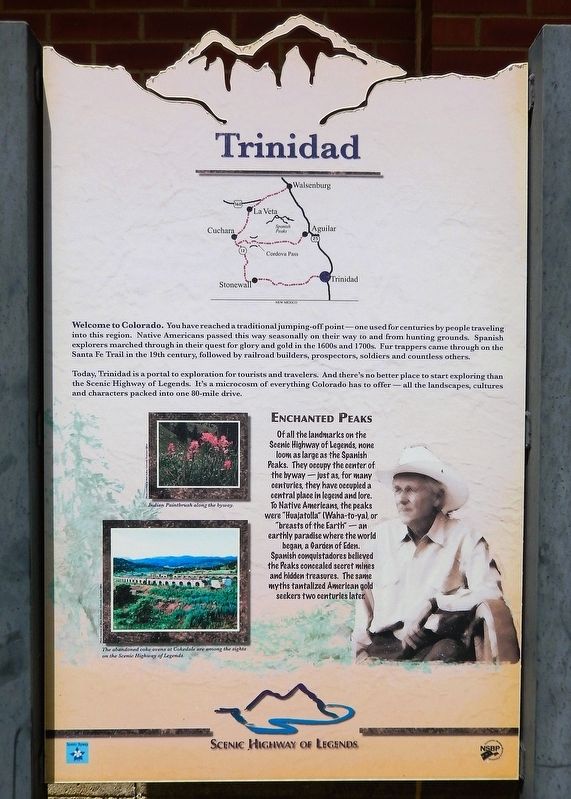
1. Trinidad Marker (left panel)
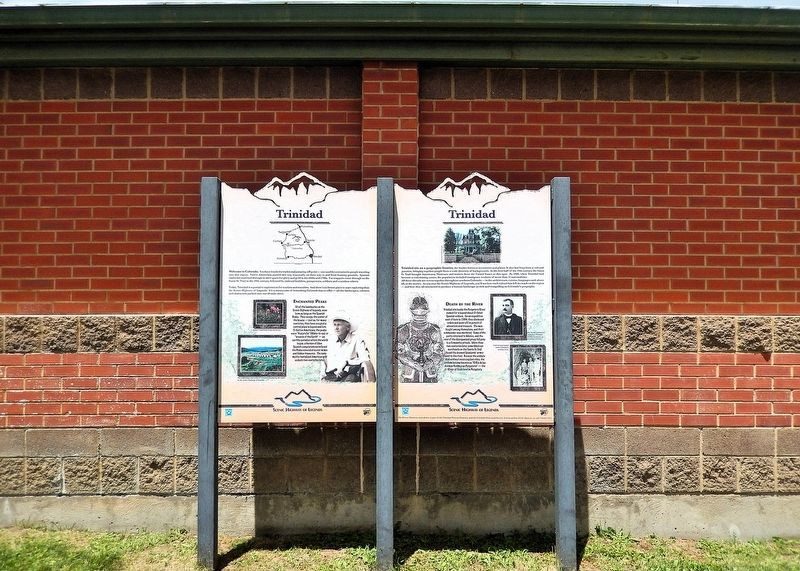
Welcome to Colorado. You have reached a traditional jumping-off point — one used for centuries by people traveling into this region. Native Americans passed this way seasonally on their way to and from hunting grounds. Spanish explorers marched through in their quest for glory and gold in the 1600s and 1700s. Fur trappers came through on the Santa Fe Trail in the 19th century, followed by railroad builders, prospectors, soldiers and countless others.
Today, Trinidad is a portal to exploration for tourists and travelers. And there's no better place to start exploring than the Scenic Highway of Legends. It's a microcosm of everything Colorado has to offer — all the landscapes, cultures and characters packed into one 80-mile drive.
Enchanted Peaks
Of all the landmarks on the Scenic Highway of Legends, none loom as large as the Spanish Peaks. They occupy the center of the byway just as, for many centuries, they have occupied a central place in legend and lore. To Native Americans, the peaks were "Huajatolla" (Waha-to-ya), or "breasts of the Earth" — an earthly paradise where the world began, a Garden of Eden. Spanish conquistadores
this page online
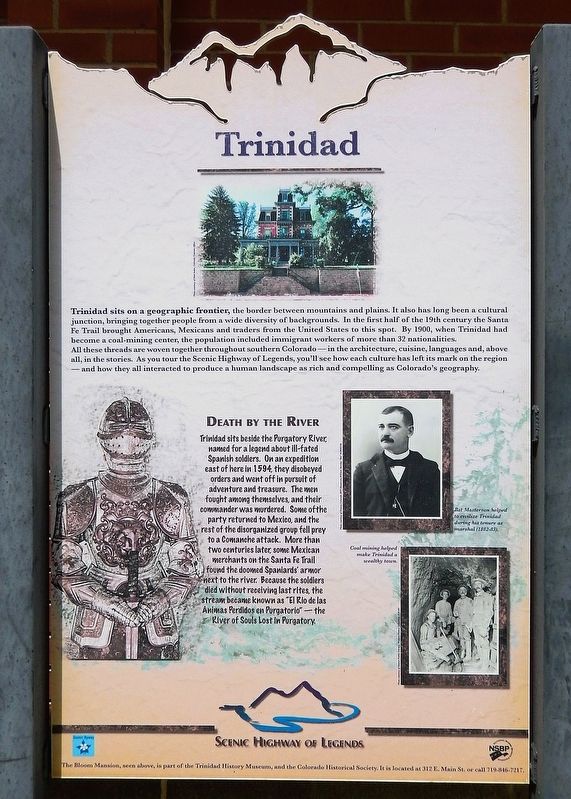
Trinidad sits on a geographic frontier, the border between mountains and plains. It also has long been a cultural junction, bringing together people from a wide diversity of backgrounds. In the first half of the 19th century the Santa Fe Trail brought Americans, Mexicans and traders from the United States to this spot. By 1900, when Trinidad had become a coal-mining center, the population included immigrant workers of more than 32 nationalities.
All these threads are woven together throughout southern Colorado — in the architecture, cuisine, languages and, above all, in the stories. As you tour the Scenic Highway of Legends, you'll see how each culture has left its mark on the region — and how they all interacted to produce a human landscape as rich and compelling as Colorado's geography.
Death by the River
Trinidad sits beside the Purgatory River, named for a legend about ill-fated Spanish soldiers. On an expedition east of here in 1594, they disobeyed orders and went off in pursuit of adventure and treasure.
Photographed by Cosmos Mariner, July 10, 2025
2. Trinidad Marker (right panel)
[photo captions]
• Indian Paintbrush along the byway
• The abandoned coke ovens at Cokedale are among the sights on the Scenic Highway of Legends
• The Bloom Mansion, seen above, is part of the Trinidad History Museum, and the Colorado Historical Society. It is located at 312 E. Main St. or call 719-846-7212
Erected by National Scenic Byways Program.
Topics and series. This historical marker is listed in these topic lists: Indigenous Peoples and Communities • Industry & Commerce • Settlements & Settlers • Waterways & Vessels. In addition, it is included in the Former U.S. Presidents: #18 Ulysses S. Grant, and the Santa Fe Trail series lists.
Location. 37° 10.196′ N,
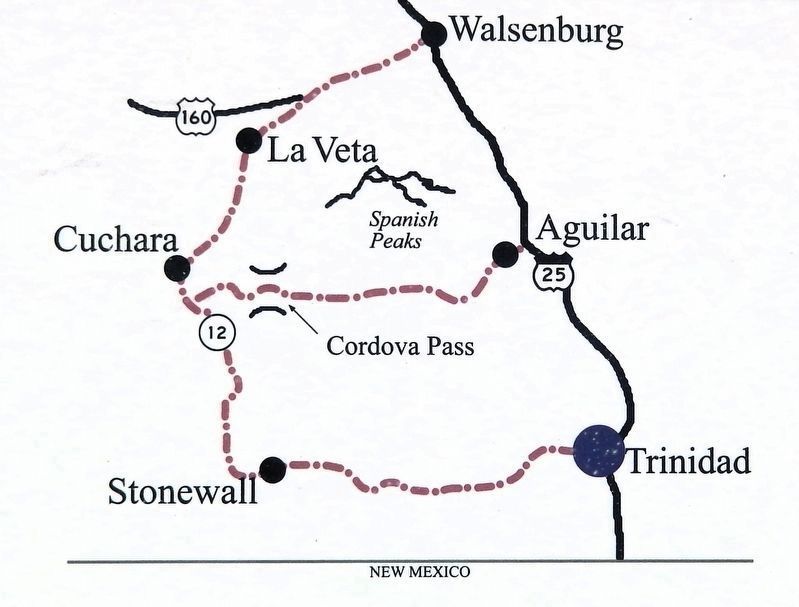
3. Marker detail: Scenic Highway of Legends map

Regionally, this marker is in the American Mountain West, on the Great Plains, on the Southern Plains, and on the Santa Fe Trail Corridor. Globally, it is in North America, the Western Hemisphere, the Western World, and the Anglosphere. Historically, it finds itself in what was once New Spain, the Comanchería, the Dust Bowl, and the Republic of Texas.
Other nearby markers. At least 8 other markers are within walking distance of this marker: Welcome to Colorado / Trinidad Country / Trinidad / Army of the West (a few steps from this marker); World War II Veterans Memorial (a few steps from this marker); Viet-Nam War Memorial (a few steps from this marker); The Last Coal Burning Steam Engine (about 700 feet away, measured in a direct line);
Courtesy History Colorado (BPF-Masterson, William Barclay “Bat” #10040258)
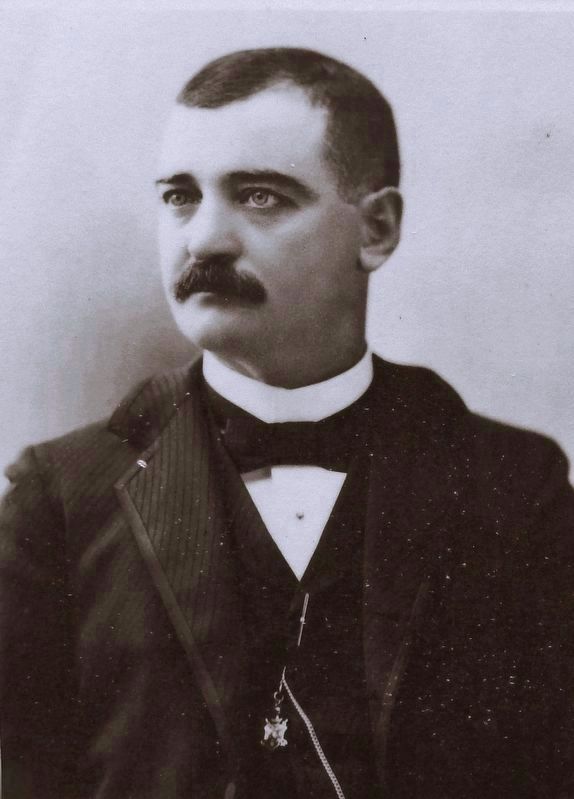
4. Marker detail: Bat Masterson
Bat Masterson helped to civilize Trinidad during his tenure as marshal (1882-83)
Also see . . .
1. Trinidad, Colorado (Wikipedia).
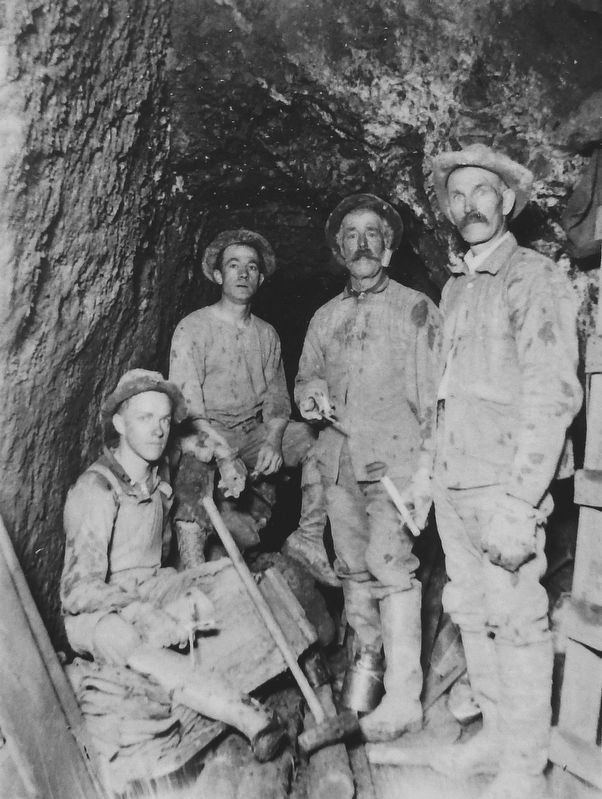
Excerpt: Trinidad was first explored by Spanish and Mexican traders, who liked its proximity to the Santa Fe Trail. It was founded in 1862 soon after coal was discovered in the region. This led to an influx of immigrants eager to capitalize on this natural resource. By the late 1860s, the town had about 1,200 residents. Trinidad was officially incorporated in 1876, just a few months before Colorado became a state. In 1878 the Atchison, Topeka and Santa Fe Railway reached Trinidad, making it easier for goods to be shipped from distant locations. In the 1880s Trinidad became home to a number of well-known people, including Bat Masterson, who briefly served as the town's marshal in 1882. By 1900 Trinidad's population had grown to 7,500 and it had two English-language newspapers and(Submitted on August 4, 2025, by Cosmos Mariner of Cape Canaveral, Florida.)one in Spanish.Denver Public Library, Western History Collection, X.632035. Marker detail: Coal MinersCoal mining helped make Trinidad a wealthy town.
2. Purgatoire River (Wikipedia).
Excerpt: It was named by New Mexican Governor Antonio Valverde y Cosío in 1719 during his exploration of the region. Valverde named it "Rio de las Ánimas," meaning "River of the Spirits," as a warning to subsequent explorers of the dangers of crossing the nearby Ratón Pass. Over time, the true meaning of the river's name became lost, and various interpretations emerged. By the end of the 18th-century Spanish traders believed it to be "Rio de las Ánimas en Purgatorio," or "River of the Souls in Purgatory," after a supposed massacre that occurred on its banks. French trappers learned the name and later translated it as "Rivière des âmes au Purgatoire." They related their translation to members of the Stephen H. Long expedition in 1820 who renamed it "Purgatory Creek" by removing all references to souls. Mexican traders on the old Santa Fe Trail expanded on the legend and named the river "Rio de las Ánimas Perdidas en Purgatorio," or "River of the Souls Lost in Purgatory," believing the souls(Submitted on August 4, 2025, by Cosmos Mariner of Cape Canaveral, Florida.)to have become lost. Mountain Men had difficulty pronouncing the French translation and called it "Picatoire," while Anglophone settlers during the Colorado Gold Rush anglicized it to "Picketwire," despite the river having no relation to any fence.Photographed by Cosmos Mariner, July 10, 20256. Trinidad MarkerThe 2-panel marker is located on the south side of Trinidad’s Colorado Welcome Center.Depending on the language spoken, the river had five different names - Ánimas, Purgatorio, Purgatoire, Purgatory, and Picketwire — by the end of the 19th century. On December 6, 1911, the US Board on Geographic Names resolved the naming issue by selecting the French translation "Purgatoire" as the official name of the river. It is one of the state's oldest continuously named rivers, spanning over 300 years. Most locals today refer to it simply as "Purgatory."
Credits. This page was last revised on August 4, 2025. It was originally submitted on August 4, 2025, by Cosmos Mariner of Cape Canaveral, Florida. This page has been viewed 165 times since then and 53 times this year. Photos: 1, 2, 3, 4, 5, 6. submitted on August 4, 2025, by Cosmos Mariner of Cape Canaveral, Florida.
