Killbuck in Holmes County, Ohio — The American Midwest (Great Lakes)
History of Killbuck
Photographed by Craig Doda, July 26, 2025
1. History of Killbuck Marker
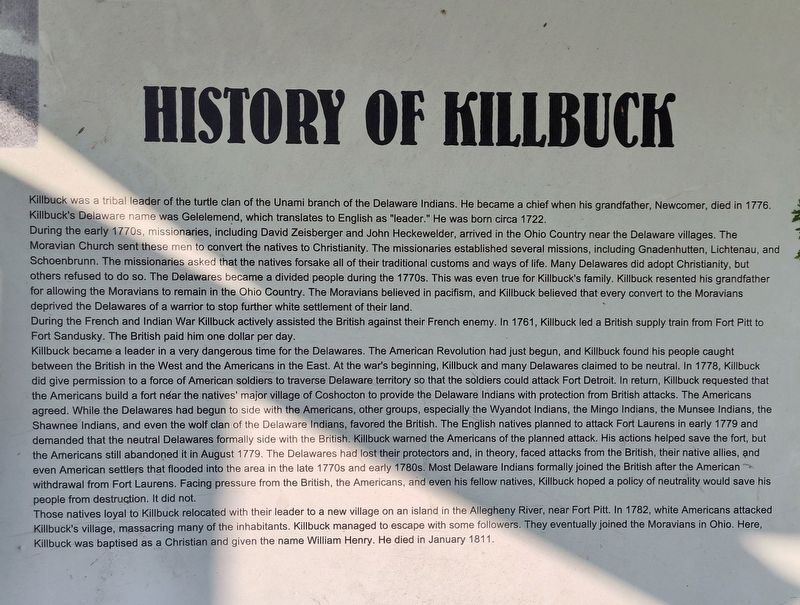
During the early 1770s, missionaries, including David Zeisberger and John Heckewelder, arrived in the Ohio Country near the Delaware villages. The Moravian Church sent these men to convert the natives to Christianity. The missionaries established several missions, including Gnadenhutten, Lichtenau, and Schoenbrunn. The missionaries asked that the natives forsake all of their traditional customs and ways of life. Many Delawares did adopt Christianity, but others refused to do so. The Delawares became a divided people during the 1770s. This was even true for Killbuck's family. Killbuck resented his grandfather for allowing the Moravians to remain in the Ohio Country. The Moravians believed in pacifism, and Killbuck believed that every convert to the Moravians deprived the Delawares of a warrior to stop further white settlement of their land.
During the French and Indian War Killbuck actively assisted the British against their French enemy. In 1761, Killbuck led a British supply train from Fort Pitt to Fort Sandusky.
this page online
Killbuck became a leader in a very dangerous time for the Delawares. The American Revolution had just begun, and Killbuck found his people caught between the British in the West and the Americans in the East. At the war's beginning, Killbuck and many Delawares claimed to be neutral. In 1778, Killbuck did give permission to a force of American soldiers to traverse Delaware territory so that the soldiers could attack Fort Detroit. In return, Killbuck requested that the Americans build a fort near the natives' major village of Coshocton to provide the Delaware Indians with protection from British attacks. The Americans agreed. While the Delawares had begun to side with the Americans, other groups, especially the Wyandot Indians, the Mingo Indians, the Munsee Indians, the Shawnee Indians, and even the wolf clan of the Delaware Indians, favored the British. The English natives planned to attack Fort Laurens in early 1779 and demanded that the neutral Delawares formally side with the British. Killbuck warned the Americans of the planned attack. His actions helped save the fort, but the Americans still abandoned it in August 1779. The Delawares had lost their protectors and, in theory, faced attacks from the British, their native allies, and even

Photographed by Craig Doda, July 26, 2025
2. History of Killbuck Marker
Those natives loyal to Killbuck relocated with their leader to a new village on an island in the Allegheny River, near Fort Pitt. In 1782, white Americans attacked Killbuck's village, massacring many of the inhabitants. Killbuck managed to escape with some followers. They eventually joined the Moravians in Ohio. Here, Killbuck was baptised as a Christian and given the name William Henry. He died in January 1811.
Topics. This historical marker is listed in these topic lists: Forts and Castles • Indigenous Peoples and Communities • Settlements & Settlers • War, French and Indian • War, US Revolutionary. A significant historical month for this entry is January 1811.
Location. 40° 30.226′ N, 81° 58.863′ W. Marker is in Killbuck, Ohio, in Holmes County. It is at the intersection of North Main Street and Township Road, on the right when traveling south on North Main Street. Touch for map. Marker is at or near this postal address: 1082-1068

Photographed by Craig Doda, July 26, 2025
3. History of Killbuck Marker

Regionally, this marker is in Amish Country. It is also in the American Midwest, in the Corn Belt, and in Northern Appalachia. Globally, it is in North America, the Western Hemisphere, the Western World, and the Anglosphere. Historically, it finds itself in what was once the Haudenosaunee (Iroquois) Confederacy, the territory of the Mississippian Culture, and the Northwest Territory.
Other nearby markers. At least 8 other markers are within 5 miles of this marker, measured as the crow flies: Killbuck Cemetery Veterans Memorial (approx. half a mile away); VFW Post 7079 POW/MIA Memorial (approx. 0.6 miles away); Millersburg Historical Information (approx. 4.7 miles away); Welcome to Millersburg (approx. 4.7 miles away); Holmes County Watering Trough (approx. 4.8 miles away); Hotel Millersburg (approx. 4.8 miles away); Brenner Building (approx. 4.8 miles away); Holmes County Veterans Memorial (approx. 4.8 miles away). Touch for a list and map of all markers in Killbuck.

Photographed by Craig Doda, July 26, 2025
4. History of Killbuck Marker
Credits. This page was last revised on August 7, 2025. It was originally submitted on August 7, 2025, by Craig Doda of Napoleon, Ohio. This page has been viewed 280 times since then and 113 times this year. Photos: 1, 2, 3, 4. submitted on August 7, 2025, by Craig Doda of Napoleon, Ohio. • Andrew Ruppenstein was the editor who published this page.
