Ostia Antica in Città metropolitana di Roma Capitale, Latium, Rome, Italy — Central Italy (Tyrrhenian Coast)
Ostia Antica: Storia e Sviluppo Urbano
⎯⎯⎯
Ancient Ostia: History and Urban Development

Photographed by Sean P. Flynn, August 5, 2025
1. Ostia antica: storia e Sviluppo Urbano / Ancient Ostia: History and Urban Development Marker
this page online

Photographed by Sean P. Flynn, August 5, 2025
2. Ostia Antica: Storia e Sviluppo Urbano / Ancient Ostia: History and Urban Development Marker
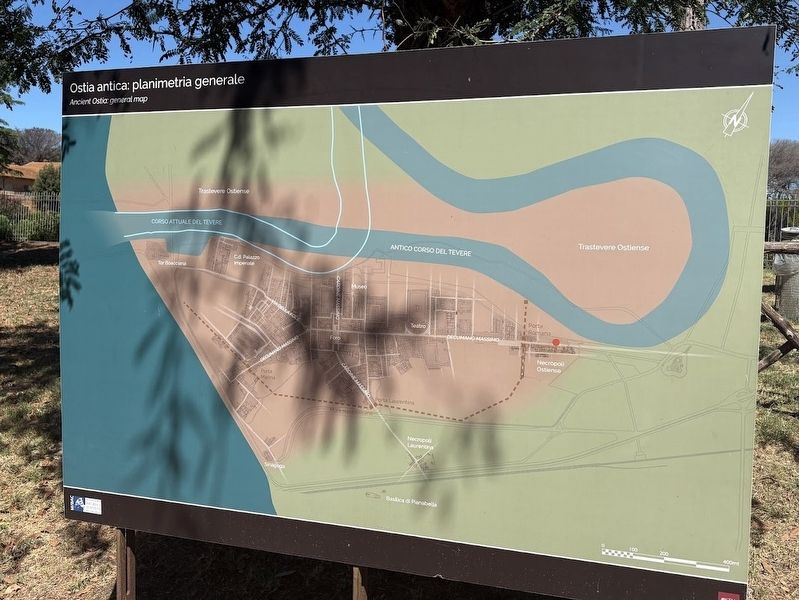
Two nearby signs have the rules for the park and a map of the area that shows the current flow of the Tiber River and its historical location.
Its proximity to the mouth of the Tiber and the coastal salt pans were the main factors leading to the birth and development of Ostia (from the Latin ostium, "river mouth"), first with a strategic military function and later playing a predominantly commercial role. The literary tradition ascribes the foundation of the city to the fourth king of Rome, Ancus Marcius (ca. 640-616 BC), but the earliest remains belong to the fortified settlement (castrum) of the 4th century BC Roman colony. The settlement gradually expanded outside the walls of the castrum and this entailed the need to build a new, larger wall circuit in the 1st century BC. The city was arranged around the pre-existing streets of the Cardo and Decumanus, and the Forum was built where they crossed. The construction and later enlargement of the maritime port at Portus, between the periods of Claudius (AD 42) and Trajan (ca. AD 110), boosted Ostia's role as Rome's commercial harbour. The resulting economic and demographic development led to an extraordinary residential and monumental construction boom that completely renewed the city's appearance in accordance with specific urban planning policy between the late 1st and early 3rd century AD. From the mid-3rd century AD onwards, in part as the result of a more generalized crisis in the Empire, Ostia began to decline, leading to the slow and gradual abandonment of large areas of the city, even in the centre; here, however, some luxurious domus (houses) were installed over earlier residential complexes. The coastal zone, gravitating around the Via Severiana next to the sea, retained its vitality for longer. In around the mid-6th century. Ostia must have been in a general state of abandonment: the population moved immediately inland, around the church of St Aurea, where the new fortified settlement of Gregoriopoli sprang up in the 9th century.
Erected by Italian

Photographed by Sean P. Flynn, August 5, 2025
3. Necropolis ruins near the marker
Ancient Roman burial sites were outside city walls; the remnants of Ostia's necropoli can be found on the main road into the city, near the park's entrance.
Topics. This historical marker is listed in these topic lists: Anthropology & Archaeology • Settlements & Settlers • Waterways & Vessels.
Location. 41° 45.475′ N, 12° 17.815′ E. Marker is in Ostia Antica, Lazio (Latium, Rome), in Città metropolitana di Roma Capitale. It can be reached from Viale degli Scavi. The marker is in Ostia Antica Archaeological Park, a short walk from the entrance. Touch for map. Marker is in this post office area: Ostia Antica, Lazio 00119, Italy. Touch for directions.

Regionally, it is in Europe, the European Union, the Schengen Area, a coastal Mediterranean country, and the Western World. Historically, it finds itself in what was once the Roman Empire.
Other nearby markers. At
Photographed by Sean P. Flynn, August 5, 2025
4. Ostia Antica map
Near the marker is a sign comparing the ancient map of Ostia Antica with today's map.

Photographed by Sean P. Flynn, August 5, 2025
5. Close-up of the depiction of ancient Ostia
More about this marker. The marker is found along the city's main entry road, known as Decumanus Maximus. It is about 130 meters east of the Porto Romano, which was the ancient gateway into the city.
Credits. This page was last revised on August 8, 2025. It was originally submitted on August 8, 2025, by Sean P. Flynn of Oak Park, Illinois. This page has been viewed 92 times since then and 22 times this year. Photos: 1, 2, 3, 4, 5. submitted on August 8, 2025, by Sean P. Flynn of Oak Park, Illinois.
