Grimsby in Niagara Region, Ontario — Central Canada (North America)
Gibson Street Bridge
Photographed by Kevin Westell, August 7, 2025
1. Gibson Street Bridge - Marker
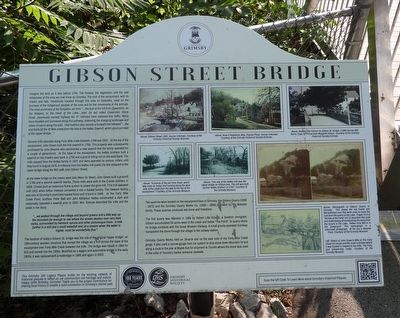
Several mills operated along Forty Mile creek between 1788 and 1920. At the top of the escarpment, John Green built the first sawmill in 1788. This property was subsequently purchased by John Beamer who constructed a new sawmill
this page online
At the lower bridge on the creeks west side (Main St. West), John Green built a gristmill in 1789 and a second sawmill nearby. These mills were sold to the Crooks brothers in 1808. Crooks built an extensive flume system to power the grist mill. This mill operated until 1921 when Arthur Hewson converted it into a basket factory. The Hewson factory was one of Grimsby's prominent basket firms until it burnt in 1948. At the Forty Mile Creek Pond, brothers Peter Ball and John Adolphus Nelles constructed a dam and seasonally operated a sawmill prior to 1850. Mrs. Simcoe described the mills and the creek in her diary:
"...we walked through the village and beyond greens mill a little way up the mountain far enough to see where the stream dashes over very dark rocks, surrounded by hemlock spruce and other picturesque trees. A mile further is a mill and a small waterfall and, at a season when the water is higher, must be wonderfully fine."
The
Photographed by Kevin Westell, August 7, 2025
2. Gibson Street Bridge
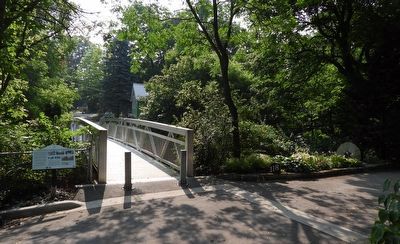
Photo faces east over the bridge, from the dead-end of Gibson St.
Two quarries were located on the escarpment face in Grimsby; the Gibson Quarry (1866 - 1872) and the Grimsby Quarry works Co. (1890 - 1896) operated by the Webster family. These quarries produced red stone and limestone.
The first quarry was founded in 1866 by Robert Lille Gibon, a Scottish immigrant. Gibson accumulated 56 acres west of the creek and below "The Point", to quarry stone for bridge contracts with the Great Western Railway. A small gravity-operated tramway transported the stone through the village to the railway station.
Grimsby Quarry Works held an 18-acre site on the east side of the Forty Mile Creek gorge. It also used a narrow-gauge tram car system to ship stone down Mountain
Photographed by Kevin Westell, August 7, 2025
3. Gibson Street Bridge
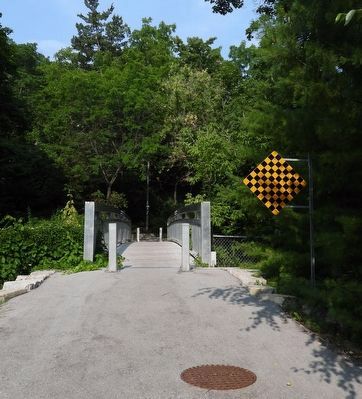
Photo faces west over the bridge, from the OTHER dead-end of Gibson St.
Topics. This historical marker is listed in these topic lists: Bridges & Viaducts • Industry & Commerce • Roads & Vehicles. A significant historical year for this entry is 1788.
Location. 43° 11.481′ N, 79° 33.882′ W. Marker is in Grimsby, Ontario, in Niagara Region. It is on Gibson Street, on the left when traveling east. The panel is at the west end of the walking bridge that connects the two sections of Gibson Street. Touch for map. Marker is at or near this postal address: 116 Gibson Street, Grimsby ON L3M 1G9, Canada. Touch for directions.

Regionally, this marker is on the Golden Horseshoe and in Niagara Canada. It is also in Central Canada. Globally, it is in North America, on the Great Lakes, in the Western Hemisphere, in the Western World, and in the Anglosphere. Historically, it finds itself in what was once a British colony, the Viceroyalty of New France, the Haudenosaunee (Iroquois) Confederacy, and Rupert’s Land.
Other nearby markers. At least 8 other markers are within walking distance of this marker: This Mill Stone Recovered From Nelles Grist Mill (a few steps from this marker); Gibson House c. 1860 (within shouting distance of this marker); Moore Cottage 1864 (about 150 meters away, measured in a direct line); Nelles Fitch House 1791 (approx. 0.2 kilometers away); Watering trough from Grimsby's Main Street (approx. 0.3 kilometers away); First Town Meeting (approx. 0.3 kilometers away); Grimsby Cenotaph (approx. 0.3 kilometers away); Grimsby Town Bell (approx. 0.3 kilometers away). Touch for a list and map of all markers in Grimsby.
Credits. This page was last revised on August 13, 2025. It was originally submitted on August 8, 2025, by Kevin Westell of St. Catharines, Ontario. This page has been viewed 87 times since then and 39 times this year. Photos: 1, 2, 3. submitted on August 8, 2025, by Kevin Westell of St. Catharines, Ontario. • Andrew Ruppenstein was the editor who published this page.
