Central Business District in New Orleans in Orleans Parish, Louisiana — The American South (West South Central)
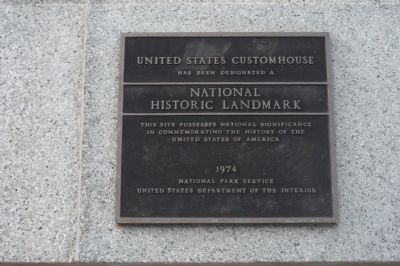
United States Customhouse
Photographed by Richard E. Miller, July 15, 2009
1. United States Customhouse Marker
Has been designated a
National
Historic Landmark
This site possesses national significance
in commemorating the
history of the
United States of America
Erected 1974.
Topics and series. This historical marker is listed in these topic lists: Animals • Architecture • Communications • Education • Science & Medicine • War, US Civil. In addition, it is included in the National Historic Landmarks series list.
Location. 29° 57.102′ N, 90° 3.989′ W. Marker is in New Orleans, Louisiana, in Orleans Parish. It is in the Central Business District. It is at the intersection of Canal Street and Decatur/Magazine Street, on the right when traveling west on Canal Street. Touch for map. Marker is at or near this postal address: 423 Canal Street, New Orleans LA 70130, United States of America. Touch for directions.

Regionally, this marker is in one of the River Parishes. It is also in the American South, specifically in the Deep South, on the Gulf Coast, and in the Great River Road Region. Globally, it is in North America, a Gulf
this page online
Other nearby markers. At least 8 other markers are within walking distance of this marker: Canal Street Historic District (within shouting distance of this marker); 114 Magazine Street (about 300 feet away, measured in a direct line); Bienville's Plantation (about 400 feet away); UpStairs Lounge Memorial (about 800 feet away); Bank’s Arcade (about 800 feet away); Louis André Martinet / Office of L.A. Martinet, The Crusader & Comité Des Citoyens (approx. 0.2 miles away); Merchants Mutual Insurance Company Building (approx. 0.2 miles away); America's First Movie Theater / Vitascope Hall (approx. 0.2 miles away). Touch for a list and map of all markers in New Orleans.
Also see . . .
1. U.S. Customs House, New Orleans. (Submitted on February 16, 2010, by Richard E. Miller of Oxon Hill, Maryland.)
2. "Old Pete" at Liberty Place [September 14, 1874].
Photographed by Richard E. Miller, July 13, 2009
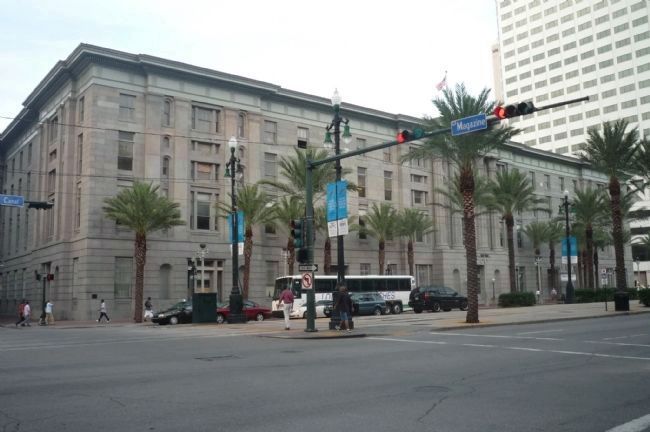
2. United States Customhouse, New Orleans, Louisiana
Marker is visible on the Canal Street wall, at the corner, lower left.
Additional keywords. "Old Post Office"; Reconstruction; Battle of Liberty Place; Customs House; James Longstreet, Surveyor of Customs at New Orleans
Postcard by the Lipsher Specialty Co., circa 1910
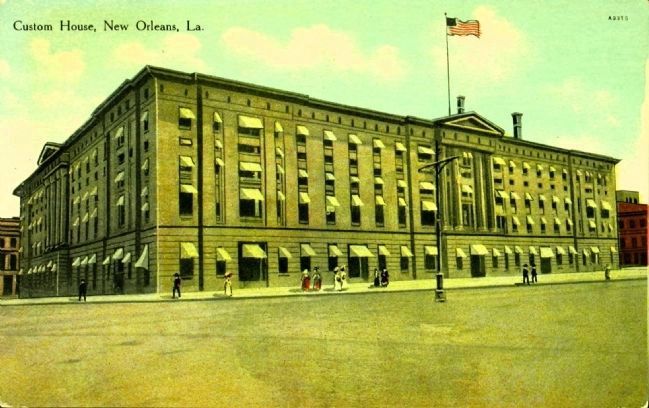
3. Custom House, New Orleans, La.
The back of the card reads:The Custom House is a large granite building, occupying an entire Square of ground on Canal St. between N. Peters and Decatur streets. The Cornerstone was laid in 1847 by Henry Clay. The Architecture is modified egyptian, and the cost of building was over Four Million Dollars.
Photographed by Barry Swackhamer, December 27, 2011
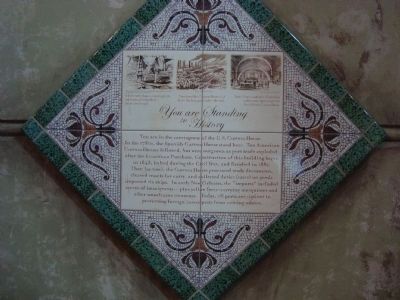
4. You are Standing in History Marker
You are in the carriageway of the U.S. Custom House. In the 1780s, the Spanish Custom House stood here. Two American Custom Houses followed, but were outgrown as port of trade exploded after the Louisiana Purchase. Construction of this building began in 1843, halted during the Civil War, and finished in 1881. Then (as now) the Customs House processed trade documents, cleared vessels for entry, and collected duties (taxes) on goods imported via ships. In early New Orleans, the “imports” included scores of immigrants – plus yellow fever-carrying mosquitoes and other unwelcome stowaways. Today, all ports are vigilant in preventing foreign insect pest from coming ashore.
[Illustration captions: left] A stone cutter shapes a massive granite chunk into a finished block for an exterior wall; [center] View from the Custom House root shows the busy port before the war; [right] Under Union occupation, Confederate soldiers were imprisoned in the New Orleans Custom House.
Editor's Note: This marker is inside the Custom House.
[Illustration captions: left] A stone cutter shapes a massive granite chunk into a finished block for an exterior wall; [center] View from the Custom House root shows the busy port before the war; [right] Under Union occupation, Confederate soldiers were imprisoned in the New Orleans Custom House.
Editor's Note: This marker is inside the Custom House.
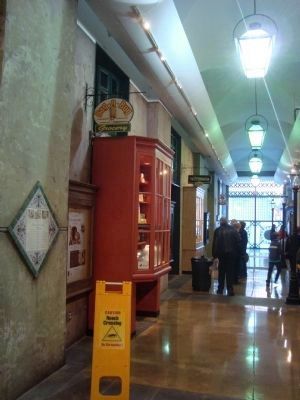
Photographed by Barry Swackhamer, December 27, 2011
5. You are Standing in History Marker
The carriageway is now enclosed inside the Custom House. Access to the "You are Standing in History" marker is gained by entering the Audubon Insectarium. The marker is near the cafeteria.
Credits. This page was last revised on February 12, 2023. It was originally submitted on February 16, 2010, by Richard E. Miller of Oxon Hill, Maryland. This page has been viewed 2,398 times since then and 84 times this year. Last updated on March 2, 2010, by Richard E. Miller of Oxon Hill, Maryland. Photos: 1, 2. submitted on February 16, 2010, by Richard E. Miller of Oxon Hill, Maryland. 3. submitted on February 24, 2015. 4, 5. submitted on January 13, 2012, by Barry Swackhamer of Brentwood, California. • Kevin W. was the editor who published this page.
