Ostia Antica in Città metropolitana di Roma Capitale, Latium, Rome, Italy — Central Italy (Tyrrhenian Coast)
Caserma dei Vigili
L'Area a Servizio del Fiume e Il Quartiere Dei Magazzini
⎯⎯⎯
Police Barracks
Area Serving River and Warehouse District
| — | (Reg. II, Is. V, 1) | — |
Photographed by Sean P. Flynn, August 5, 2025
1. Caserma dei Vigili / Police Barracks Marker
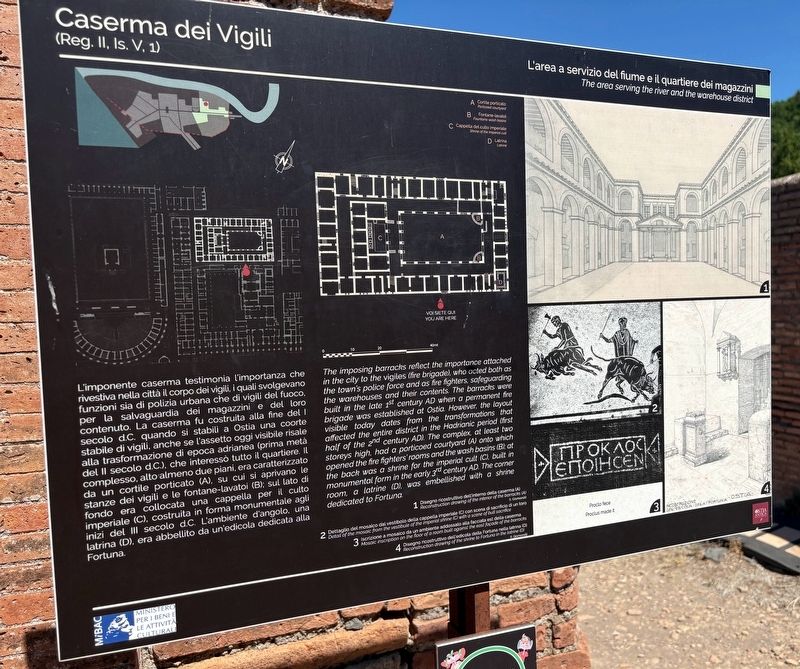
The imposing barracks reflect the importance attached in the city to the vigiles (fire brigade), who acted both as the town's police force and as fire fighters, safeguarding the warehouses and their contents. The barracks were built in the late 1st century AD when a permanent fire brigade was established at Ostia. However, the layout visible today dates from the transformations that affected the entire district in the Hadrianic period (first half of the 2nd century AD). The complex, at least two storeys high, had a porticoed courtyard (A) onto which opened the fire fighters' rooms and the wash basins (B): at the back was a shrine for the imperial cult (C), built in monumental form in the early 3rd century AD. The corner room, a latrine (D), was embellished with a shrine dedicated to Fortuna.
Erected by Italian
this page online
Topics. This historical marker is listed in these topic lists: Anthropology & Archaeology • Law Enforcement • Religion & Religious Structures.
Location. 41° 45.412′ N, 12° 17.535′ E. Marker is in Ostia Antica, Lazio (Latium, Rome), in Città metropolitana di Roma Capitale. It is on Viale degli Scavi. The marker is in Ostia Antica Archaelogical Park. Touch for map. Marker is in this post office area: Ostia Antica, Lazio 00119, Italy. Touch for directions.

Regionally, it is in Europe, the European Union, the Schengen Area, a coastal Mediterranean country, and the Western World. Historically, it finds itself in what was once the Roman Empire.
Other nearby markers. At least 8 other markers are within walking distance of this marker: Terme di Nettuno. I Mosaici / Baths of Neptune. The Mosaics (within shouting distance of this marker); Terme di Nettuno / Baths of Neptune (about 90 meters away, measured in a direct line); Piazzale delle Corporazioni / Square of the Corporations (about 90 meters away); Gli Interventi di Restauro e Rifunzionalizzazione del Teatro Romano di Ostia
Photographed by Sean P. Flynn, August 5, 2025
2. Caserma dei Vigili / Police Barracks Marker
Also see . . . The excavations of the barracks in Ostia.
Excerpt: "Lanciani believes that a Hadrianic domus with shops had been converted to barracks in the Severan period. A small room below a staircase (today numbered 31), receiving light through a narrow window, is identified as a prison. Graffiti were seen on the vault. Graffiti were also read on the facade, made directly on the bricks of the pilasters decorating the entrances of the long sides. Coins were found ranging from the reign of Gallienus (253-268 AD) to that of Julianus (355-363 AD), most of them dated to the reigns of Maxentius and Constantine. In the earth covering the ruins a French coin was found from the first half of the 17th century (earlier, in a room next to the corridor leading to the orchestra of the theatre, Lanciani's workers had found forty(Submitted on August 9, 2025, by Sean P. Flynn of Oak Park, Illinois.)corpses, apparently of soldiers from the 16th century). On the street remains were found of the brick pilasters and tympanums that once decorated the entrances. Near one of the entrances a marble slab was found ending in a tympanum, with the depiction of an eagle on the tympanum and an inscription flanked by columns, mentioning Commodus."Photographed by Sean P. Flynn, August 5, 20253. Barracks at Ostia

Credits. This page was last revised on August 9, 2025. It was originally submitted on August 9, 2025, by Sean P. Flynn of Oak Park, Illinois. This page has been viewed 92 times since then and 35 times this year. Photos: 1, 2, 3. submitted on August 9, 2025, by Sean P. Flynn of Oak Park, Illinois.
