Bellevue in Nashville in Davidson County, Tennessee — The American South (East South Central)
The Battle of Nashville at Kelley's Point
December 2-15 1864
Photographed by Darren Jefferson Clay, March 2, 2025
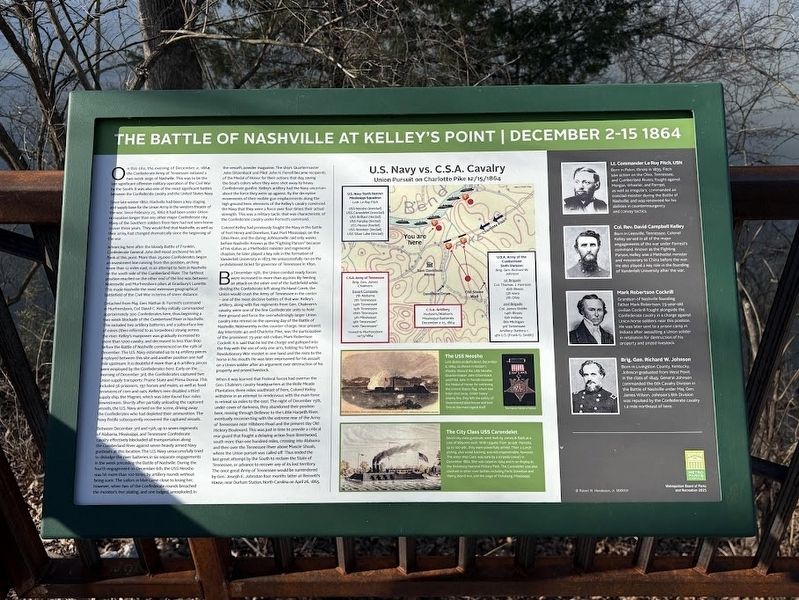
1. The Battle of Nashville at Kelley's Point Marker
Inscription.
The Battle of Nashville at Kelley's Point. December 2-15 1864. , On this site, the evening of December 2, 1864, the Confederate Army of Tennessee initiated a two-week siege of Nashville. This was to be the last significant offensive military operation of the Civil War by the South. It was also one of the most significant battles between the Confederate cavalry and the United States Navy., Since late winter 1862, Nashville had been a key staging and supply base for the Union Army in the western theater of the war. Since February 25, 1862 it had been under Union occupation longer than any other major Confederate city. Many of the Southern soldiers from here had not seen home in over three years. They would find that Nashville, as well as their army, had changed dramatically since the beginning of the war., Advancing here after the bloody Battle of Franklin, Confederate General John Bell Hood anchored his left lank at this point. More than 25,000 Confederates began an investment line running from this position, arching more than 12 miles east, in an attempt to hem in Nashville on the south side of the Cumberland River. The farthest position reached on the other end of the line was between Nolensville and Murfreesboro pikes at Granbury's Lunette. This made Nashville the most extensive geographical battlefield of the Civil War in terms of sheer distance., Detached from Maj. Gen. Nathan B. Forrest's command in Murfreesboro, Col. David C. Kelley initially commanded approximately 300 Confederates here, thus beginning a two-week blockade of the Cumberland River in Nashville. This included two artillery batteries and a subsurface line of mines (then referred to as torpedoes) strung across the river. Kelley's manpower was gradually increased to more than 1200 cavalry, and decreased to less than 800 before the Battle of Nashville commenced on the 15th of December. The US. Navy estimated up to 14 artillery pieces employed between this site and another position one half mile upstream. It is doubtful if more than 4-6 artillery pieces were employed by the Confederates here. Early on the morning of December 3rd, the Confederates captured two Union supply transports: Prairie State and Prima Donna. This Included 56 prisoners, 197 horses and mules, as well as food provisions of corn and oats. Kelley's men disabled a third supply ship, the Magnet, which was later found four miles downstream. Shortly after partially unloading the captured vessels, the US. Navy arrived on the scene, driving away the Confederates who had depleted their ammunition. The Navy flotilla subsequently recovered the captured vessels., Between December 3rd and 15th, up to seven regiments of Alabama, Mississippi, and Tennessee Confederate cavalry effectively blockaded all transportation along the Cumberland River against seven heavily armed Navy gunboats at this location. The U.S. Navy unsuccessfully tried to dislodge the river batteries in six separate engagements in the week preceding the Battle of Nashville. During the fourth engagement on December 6th, the USS Neosho was hit more than 100 times by artillery rounds without being sunk. The sailors in blue came close to losing her, however, when two of the Confederate rounds breached the monitor's iron plating, and one lodged, unexploded, in the vessel's powder magazine. The ship's Quartermaster John Ditzenback and Pilot John H. Farrell become recipients of the Medal of Honor for their actions that day, saving the boat's colors when they were shot away by heavy Confederate gunfire. Kelley's artillery had the Navy uncertain about the force they were up against. By the deceptive movements of their mobile gun emplacements along the high ground here, elements of the Kelley's cavalry convinced the Navy that they were a force over four-times their actual strength. This was a military tactic that was characteristic of the Confederate cavalry under Forrest's command., Colonel Kelley had previously fought the Navy in the battle of Fort Henry and Donelson, East Port Mississippi, on the Ohio River, and the daring Johnsonville raid only weeks before Nashville. Known as the "Fighting Parson" because of his status as a Methodist minister and regimental chaplain, he later played a key role in the formation of Vanderbilt University in 1873. He unsuccessfully ran on the prohibitionist ticket for governor of Tennessee in 1890., By December 15th, the Union combat-ready forces were increased to more than 49,000. By feinting an attack on the other end of the battlefield while dividing the Confederate left along Richland Creek, the Union would crush the Army of Tennessee in the center one of the most decisive battles of that war. Kelley's artillery, along with five regiments from Gen. Chalmers's cavalry, were one of the few Confederate units to hold their ground and force the overwhelmingly larger Union cavalry into retreat on the opening day of the Battle of Nashville. Noteworthy in this counter-charge, near present day interstate 40 and Charlotte Pike, was the participation of the prominent 75-year-old civilian, Mark Robertson Cockrill. It is said that he led the charge and galloped into the fray with the use of only one arm, holding his father's Revolutionary War musket in one hand and the reins to the horse in his mouth. He was later imprisoned for his assault on a Union soldier after an argument over destruction of his property and prized livestock., When it was learned that Federal forces had overrun the Gen. Chalmers cavalry headquarters at the Belle Meade Plantation, three miles southeast of here, Colonel Kelley withdrew in an attempt to rendezvous with the main force in retreat six miles to the east. The night of December 15th, under cover of darkness, they abandoned their position here, moving through Bellevue to the Little Harpeth River, eventually reconnecting with the extreme rear of the Army of Tennessee near Hillsboro Road and the present day Old Hickory Boulevard. This was just in time to provide a critical rear guard that fought a delaying action from Brentwood, south more than one hundred miles, crossing into Alabama and then over the Tennessee River above Muscle Shoals, where the Union pursuit was called off. Thus ended the last great attempt by the South to reclaim the State of Tennessee, or advance to recover any of its lost territory. The once great Army of Tennessee would be surrendered by Gen. Joseph E. Johnston four months latter at Bennett's House, near Durham Station, North Carolina on April 26, 1865., The USS Neosho , Left: Battle of Bell's Bend, December 6, 1864, as shown in Harper's Weekly. Aboard the USS Neosho, Quartermaster John Ditzenback and Pilot John H. Ferrell received the Medal of Honor for retrieving the United States flag, which had been shot away. Under heavy enemy fire, they left the safety of the armored pilot-house and tied first to the main signal staff., The City Class USS Carondelet , Seven city class gunboats were built by James B. Eads at a cost of $89,000 each. With 13 guns, from 30-pdr. Parrotts, up to 100-pdr, they were powerfully armed. Their 2.5 inch plating, plus wood backing, was not impenetrable, however. The sister ship Cairo was sunk by a torpedo (mine) in December 1862. She was raised in 1964 and is on display at the Vicksburg National Military Park. The Carondelet was also involved in other river battles including Forts Donelson and Henry, Island #10, and the siege of Vicksburg, Mississippi., Lt. Commander Le Roy Fitch, USN , Born in Pekin, Illinois in 1835, Fitch saw action on the Ohio, Tennessee, and Cumberland Rivers; fought against Morgan, Wheeler, and Forrest, as well as irregulars; commanded an ironclad monitor during the Battle of Nashville, and was renowned for his abilities in counterinsurgency and convoy tactics , Col. Rev. David Campbell Kelley , Born in Leesville, Tennessee, Colonel Kelley served in all of the major engagements of the war under Forrest's command. Known as the Fighting Parson, Kelley was a Methodist minister and missionary to China before the war. He also played a key role in the founding of Vanderbilt University after the war. , Mark Robertson Cockrill , Grandson of Nashville founding father Mark Robertson, 75-year-old civilian Cockrill fought alongside the Confederate cavalry in a charge against Union horse soldiers near this position. He was later sent to a prison camp in Indiana after assaulting a Union solider in retaliation for destruction of his property and prized livestock. , Brig. Gen. Richard W. Johnson , Born in Livingston County, Kentucky. Johnson graduated from West Point in the class of 1849. General Johnson commanded the 6th Cavalry Division in the Battle of Nashville under Maj. Gen. James Wilson. Johnson's 6th Division was repulsed by the Confederate cavalry 1.2 mile northeast of here.
On this site, the evening of December 2, 1864, the Confederate Army of Tennessee initiated a two-week siege of Nashville. This was to be the last significant offensive military operation of the Civil War by the South. It was also one of the most significant battles between the Confederate cavalry and the United States Navy.
Since late winter 1862, Nashville had been a key staging and supply base for the Union Army in the western theater of the war. Since February 25, 1862 it had been under Union occupation longer than any other major Confederate city. Many of the Southern soldiers from here had not seen home in over three years. They would find that Nashville, as well as their army, had changed dramatically since the beginning of the war.
Advancing here after the bloody Battle of Franklin, Confederate General John Bell Hood anchored his left lank at this point. More than 25,000 Confederates began an investment line running from this position, arching more than 12 miles east, in an attempt to hem in Nashville on the south side of the Cumberland River. The farthest position reached on the other end of the line was
Click or scan to see this page online
between Nolensville and Murfreesboro pikes at Granbury's Lunette. This made Nashville the most extensive geographical battlefield of the Civil War in terms of sheer distance.
Detached from Maj. Gen. Nathan B. Forrest's command in Murfreesboro, Col. David C. Kelley initially commanded approximately 300 Confederates here, thus beginning a two-week blockade of the Cumberland River in Nashville. This included two artillery batteries and a subsurface line of mines (then referred to as torpedoes) strung across the river. Kelley's manpower was gradually increased to more than 1200 cavalry, and decreased to less than 800 before the Battle of Nashville commenced on the 15th of December. The US. Navy estimated up to 14 artillery pieces employed between this site and another position one half mile upstream. It is doubtful if more than 4-6 artillery pieces were employed by the Confederates here. Early on the morning of December 3rd, the Confederates captured two Union supply transports: Prairie State and Prima Donna. This Included 56 prisoners, 197 horses and mules, as well as food provisions of corn and oats. Kelley's men disabled a third
Photographed by Darren Jefferson Clay, March 2, 2025
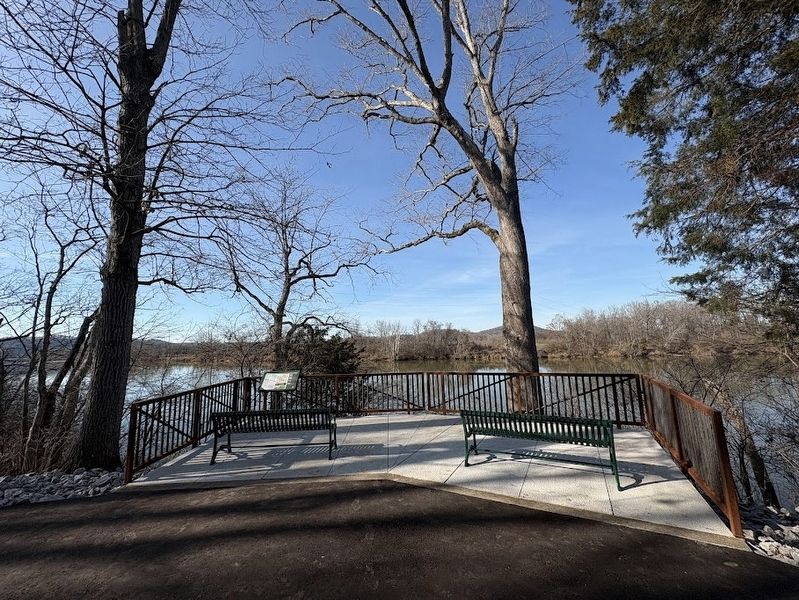
2. The Battle of Nashville at Kelley's Point Marker
supply ship, the Magnet, which was later found four miles downstream. Shortly after partially unloading the captured vessels, the US. Navy arrived on the scene, driving away the Confederates who had depleted their ammunition. The Navy flotilla subsequently recovered the captured vessels.
Between December 3rd and 15th, up to seven regiments of Alabama, Mississippi, and Tennessee Confederate cavalry effectively blockaded all transportation along the Cumberland River against seven heavily armed Navy gunboats at this location. The U.S. Navy unsuccessfully tried to dislodge the river batteries in six separate engagements in the week preceding the Battle of Nashville. During the fourth engagement on December 6th, the USS Neosho was hit more than 100 times by artillery rounds without being sunk. The sailors in blue came close to losing her, however, when two of the Confederate rounds breached the monitor's iron plating, and one lodged, unexploded, in the vessel's powder magazine. The ship's Quartermaster John Ditzenback and Pilot John H. Farrell become recipients of the Medal of Honor for their actions that day, saving the boat's colors
Photographed by Darren Jefferson Clay, March 2, 2025
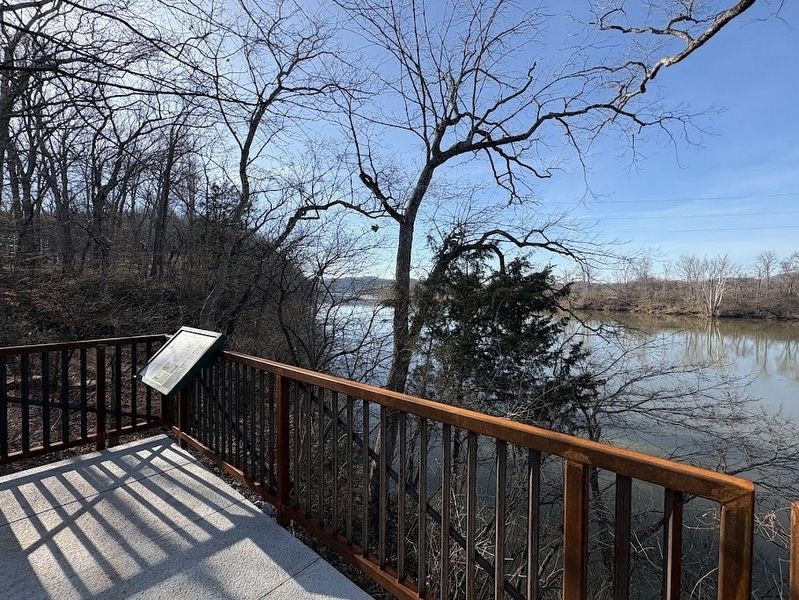
3. Looks downstream on the Cumberland River
when they were shot away by heavy Confederate gunfire. Kelley's artillery had the Navy uncertain about the force they were up against. By the deceptive movements of their mobile gun emplacements along the high ground here, elements of the Kelley's cavalry convinced the Navy that they were a force over four-times their actual strength. This was a military tactic that was characteristic of the Confederate cavalry under Forrest's command.
Colonel Kelley had previously fought the Navy in the battle of Fort Henry and Donelson, East Port Mississippi, on the Ohio River, and the daring Johnsonville raid only weeks before Nashville. Known as the "Fighting Parson" because of his status as a Methodist minister and regimental chaplain, he later played a key role in the formation of Vanderbilt University in 1873. He unsuccessfully ran on the prohibitionist ticket for governor of Tennessee in 1890.
By December 15th, the Union combat-ready forces were increased to more than 49,000. By feinting an attack on the other end of the battlefield while dividing the Confederate left along Richland Creek, the Union would crush the Army of Tennessee in
Photographed by Darren Jefferson Clay, March 2, 2025
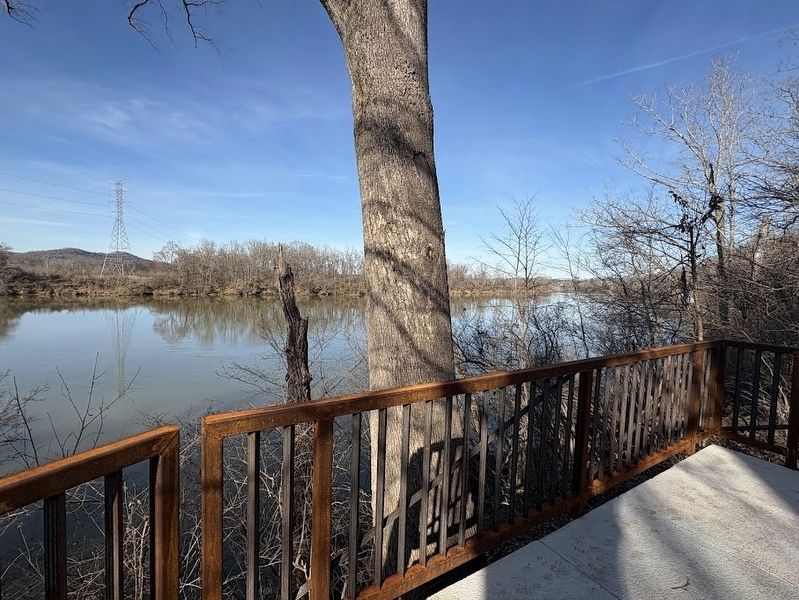
4. Looking upstream on the Cumberland River. The gunboats approached Kelley's Point from upstream.
the center one of the most decisive battles of that war. Kelley's artillery, along with five regiments from Gen. Chalmers's cavalry, were one of the few Confederate units to hold their ground and force the overwhelmingly larger Union cavalry into retreat on the opening day of the Battle of Nashville. Noteworthy in this counter-charge, near present day interstate 40 and Charlotte Pike, was the participation of the prominent 75-year-old civilian, Mark Robertson Cockrill. It is said that he led the charge and galloped into the fray with the use of only one arm, holding his father's Revolutionary War musket in one hand and the reins to the horse in his mouth. He was later imprisoned for his assault on a Union soldier after an argument over destruction of his property and prized livestock.
When it was learned that Federal forces had overrun the Gen. Chalmers cavalry headquarters at the Belle Meade Plantation, three miles southeast of here, Colonel Kelley withdrew in an attempt to rendezvous with the main force in retreat six miles to the east. The night of December 15th, under cover of darkness, they abandoned their position here, moving through Bellevue to the Little Harpeth River, eventually reconnecting with the extreme rear of the Army of Tennessee near Hillsboro Road and the present day Old Hickory Boulevard. This was just in time to provide a critical rear guard that fought a delaying action from Brentwood, south more than one hundred miles, crossing into Alabama and then over the Tennessee River above Muscle Shoals, where the Union pursuit was called off. Thus ended the last great attempt by the South to reclaim the State of Tennessee, or advance to recover any of its lost territory. The once great Army of Tennessee would be surrendered by Gen. Joseph E. Johnston four months latter at Bennett's House, near Durham Station, North Carolina on April 26, 1865.
The USS Neosho
Left: Battle of Bell's Bend, December 6, 1864, as shown in Harper's Weekly. Aboard the USS Neosho, Quartermaster John Ditzenback and Pilot John H. Ferrell received the Medal of Honor for retrieving the United States flag, which had been shot away. Under heavy enemy fire, they left the safety of the armored pilot-house and tied first to the main signal staff.
The City Class USS Carondelet
Seven city class gunboats were built by James B. Eads at a cost of $89,000 each. With 13 guns, from 30-pdr. Parrotts, up to 100-pdr, they were powerfully armed. Their 2.5 inch plating, plus wood backing, was not impenetrable, however. The sister ship Cairo was sunk by a torpedo (mine) in December 1862. She was raised in 1964 and is on display at the Vicksburg National Military Park. The Carondelet was also involved in other river battles including Forts Donelson and Henry, Island #10, and the siege of Vicksburg, Mississippi.
Lt. Commander Le Roy Fitch, USN
Born in Pekin, Illinois in 1835, Fitch saw action on the Ohio, Tennessee, and Cumberland Rivers; fought against Morgan, Wheeler, and Forrest, as well as irregulars; commanded an ironclad monitor during the Battle of Nashville, and was renowned for his abilities in counterinsurgency and convoy tactics
Col. Rev. David Campbell Kelley
Born in Leesville, Tennessee, Colonel Kelley served in all of the major engagements of the war under Forrest's command. Known as the Fighting Parson, Kelley was a Methodist minister and missionary to China before the war. He also played a key role in the founding of Vanderbilt University after the war.
Mark Robertson Cockrill
Grandson of Nashville founding father Mark Robertson, 75-year-old civilian Cockrill fought alongside the Confederate cavalry in a charge against Union horse soldiers near this position. He was later sent to a prison camp in Indiana after assaulting a Union solider in retaliation for destruction of his property and prized livestock.
Brig. Gen. Richard W. Johnson
Born in Livingston County, Kentucky. Johnson graduated from West Point in the class of 1849. General Johnson commanded the 6th Cavalry Division in the Battle of Nashville under Maj. Gen. James Wilson. Johnson's 6th Division was repulsed by the Confederate cavalry 1.2 mile northeast of here.
Erected 2025 by Metropolitan Board of Parks and Recreation.
Topics. This historical marker is listed in these topic lists: War, US Civil • Waterways & Vessels. A significant historical date for this entry is December 2, 1864.
Location. 36° 8.083′ N, 86° 54.355′ W. Marker is in Nashville, Tennessee, in Davidson County. It is in Bellevue. It can be reached from Charlotte Pike (U.S. 70) west of Davidson Drive, on the right when traveling west. Located 0.4 miles north of the Brookmeade Greenway Trailhead. Touch for map. Marker is at or near this postal address: 6949 Charlotte Pike, Nashville TN 37209, United States of America. Touch for directions.
Regionally, this marker is in Middle Tennessee. It is also in the American South and specifically in the Upper South. Globally, it is in North America, the Western Hemisphere, the Western World, and the Anglosphere. Historically, it finds itself in what was once the territory of the Mississippian Culture, one of the Confederate States of America, and the Antebellum South.
Credits. This page was last revised on August 11, 2025. It was originally submitted on March 2, 2025, by Darren Jefferson Clay of Duluth, Georgia. This page has been viewed 508 times since then and 73 times this year. Last updated on August 10, 2025, by Mike McKeown of Baltimore, Maryland. Photos:1, 2, 3, 4. submitted on March 2, 2025, by Darren Jefferson Clay of Duluth, Georgia. • Devry Becker Jones was the editor who published this page.