Ostia Antica in Città metropolitana di Roma Capitale, Latium, Rome, Italy — Central Italy (Tyrrhenian Coast)
Capitolium
(Reg. 1)
Photographed by Sean P. Flynn, August 5, 2025
1. Capitolium Marker
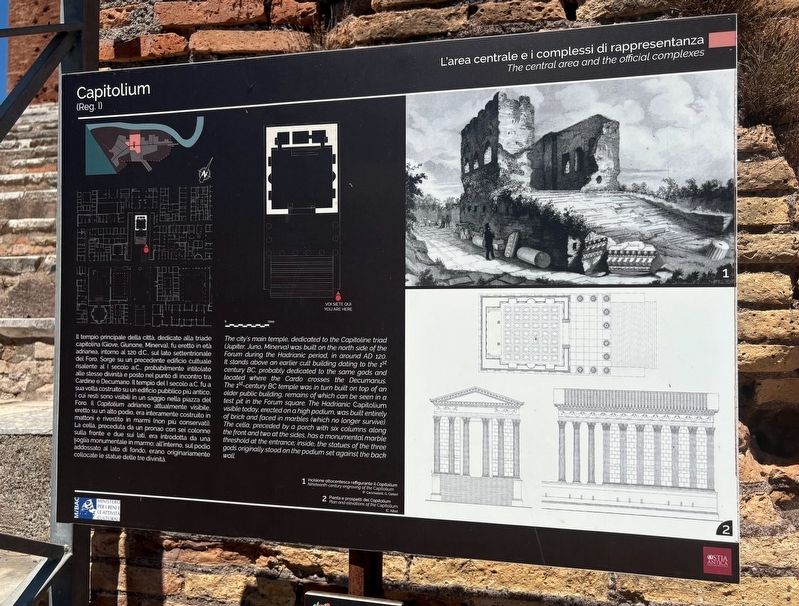
Il tempio principale della città, dedicato alla triade capitolina (Giove, Giunone, Minerva), fu eretto in età adrianea, intorno al 120 d.C., sul lato settentrionale del Foro. Sorge su un precedente edificio cultuale risalente al I secolo a.C., probabilmente intitolato alle stesse divinità e posto nel punto di incontro tra Cardine e Decumano. Il tempio del I secolo a.C. fu a sua volta costruito su un edificio pubblico più antico, i cui resti sono visibili in un saggio nella piazza del Foro. Il Capitolium adrianeo attualmente visibile, eretto su un alto podio, era interamente costruito in mattoni e rivestito in marmi (non più conservati). La cella, preceduta da un pronao con sei colonne sulla fronte e due sui lati, era introdotta da una soglia monumentale in marmo; all'interno, sul podio addossato al lato di fondo, erano originariamente collocate le statue delle tre divinità.
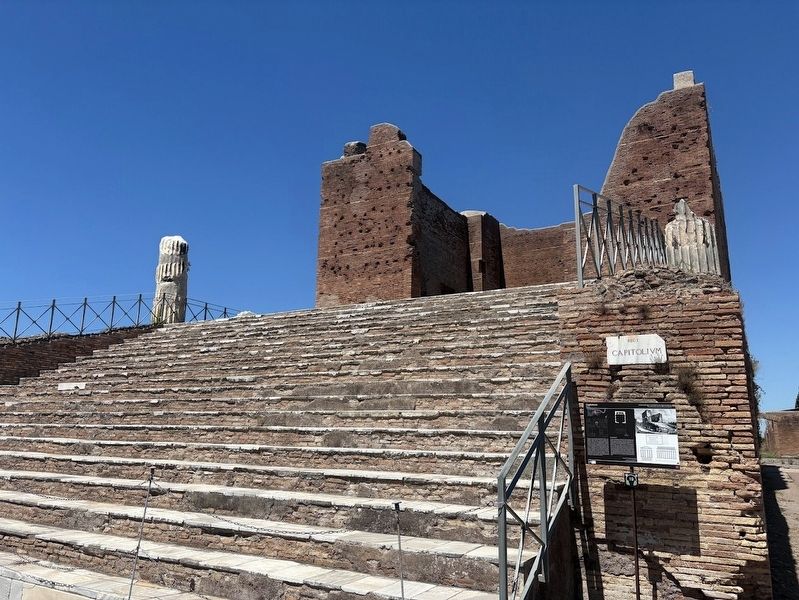
The city's main temple, dedicated to the Capitoline triad (Jupiter, Juno, Minerva) was built on the north side of the Forum during the Hadrianic period, in around AD 120. It stands above an earlier cult building dating to the 1st century BC, probably dedicated to the same gods and located where the Cardo crosses the Decumanus. The 1st-century BC temple was in turn built on top of an older public building, remains of which can be seen in a test pit in the Forum square. The Hadrianic Capitolium visible today, erected on a high podium, was built entirely of brick and faced in marbles (which no longer survive). The cella, preceded by a porch with six columns along the front and two at the sides, has a monumental marble threshold at the entrance; inside, the statues of the three gods originally stood on the podium set against the back wall.
Erected by Italian
this page online
Topics. This historical marker is listed in these topic lists: Anthropology & Archaeology • Architecture • Religion & Religious Structures • Roads & Vehicles. A significant historical year for this entry is 120 CE.
Location. 41° 45.259′ N, 12° 17.294′ E. Marker is in Ostia Antica, Lazio (Latium, Rome), in Città metropolitana di Roma Capitale. It is on Viale degli Scavi. The marker is in Ostia Antica Archaeological Park, in front of the ruins of the Capitolium. Touch for map. Marker is in this post office area: Ostia Antica, Lazio 00121, Italy. Touch for directions.

Regionally, it is in Europe, the European Union, the Schengen Area, a coastal Mediterranean country, and the Western World. Historically, it finds itself in what was once the Roman Empire.
Other nearby markers. At least 8 other markers are within walking distance of this marker: L'Area Centrale e i Complessi di Rappresentanza / The Central Area and the Official Complexes (within shouting distance of this marker); Thermopolium di Via di Diana (within shouting distance of this marker); Tempio di Roma e Augusto / Temple of Rome and Augustus
Photographed by Sean P. Flynn, August 5, 2025
2. Capitolium Marker
Also see . . . Capitolium.
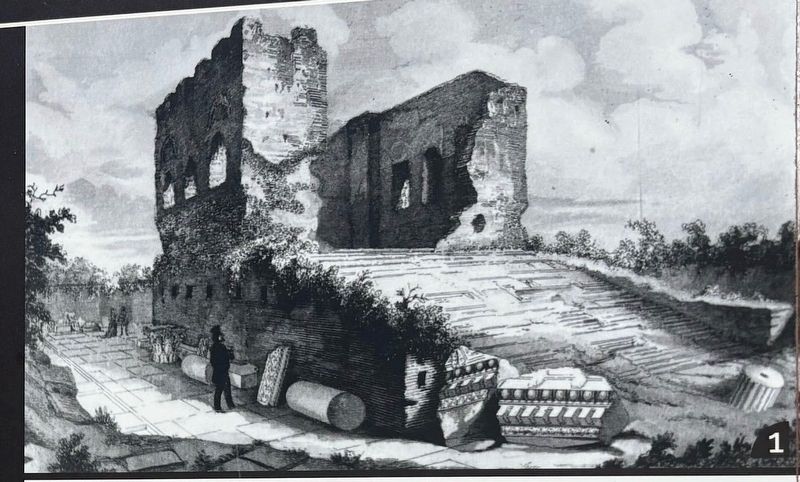
Excerpt: "At the north end of the Forum are the remains of a very large temple. The podium measures 34.40 x 16.80 m., the cella 19 x 16 m. The preserved height is 17 m., the original height may have been over 20. It was built during the reign of Hadrian, around 120 AD. It has been argued that Hadrian himself and certain people close to the Imperial court contributed to the building of this important temple. The ruins must always have been visible. Records of the removal of marble from its walls date back to the 15th century. The destruction continued(Submitted on August 11, 2025, by Sean P. Flynn of Oak Park, Illinois.)until the early 19th century."Photographed by Sean P. Flynn, August 5, 20253. Close-up of the drawing on the markerThe 19th-century engraving depicts the ruins of the Capitolium, which had been looted over the previous several centuries.
Photographed by Sean P. Flynn, August 5, 2025
4. Capitolium area
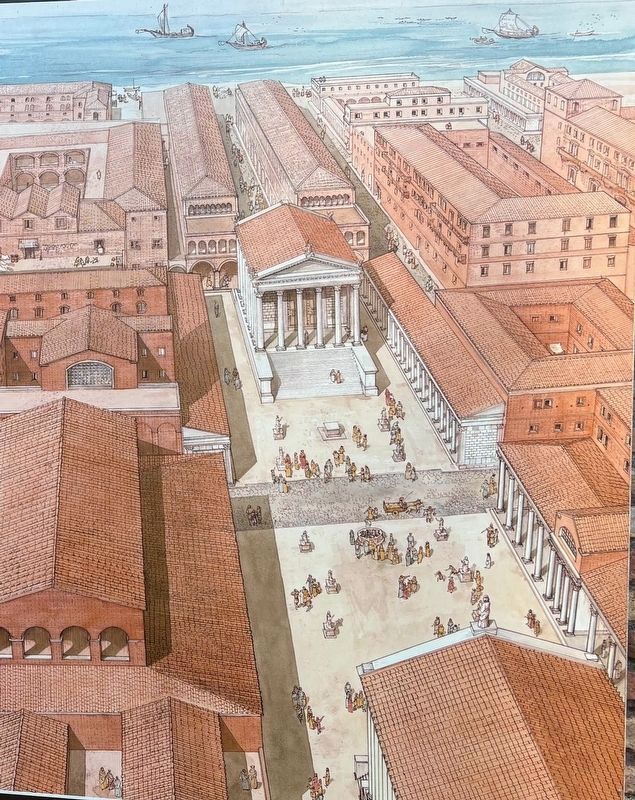
A different marker nearby includes this rendering of what the Capitolium area may have looked like during Ostia's peak.
Photographed by Sean P. Flynn, August 5, 2025
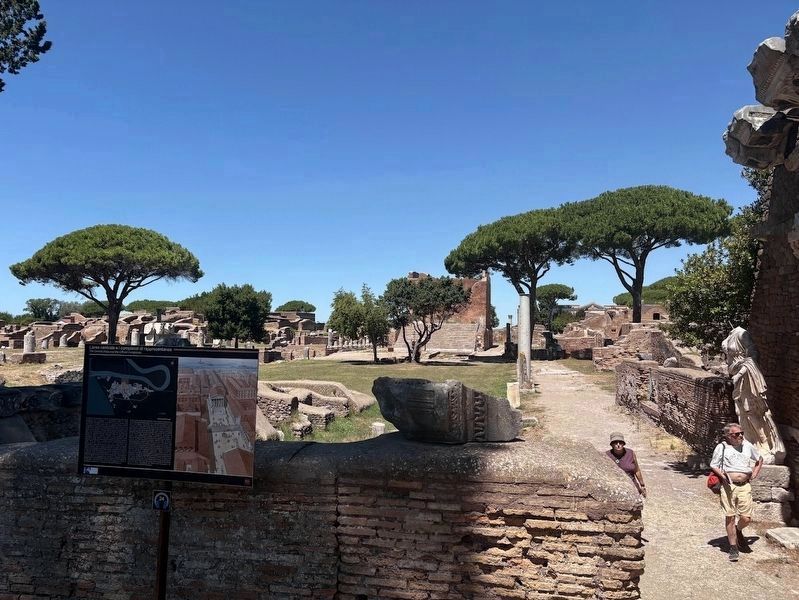
5. The forum and Capitolium
A view of the forum and capitolium near a different historical marker that is farther south.
Credits. This page was last revised on August 12, 2025. It was originally submitted on August 11, 2025, by Sean P. Flynn of Oak Park, Illinois. This page has been viewed 108 times since then and 18 times this year. Photos: 1, 2, 3, 4. submitted on August 11, 2025, by Sean P. Flynn of Oak Park, Illinois. 5. submitted on August 12, 2025, by Sean P. Flynn of Oak Park, Illinois.
