Hillsborough in Orange County, North Carolina — The American South (South Atlantic)
Lynching In America ⎯⎯⎯ The Lynching of Washington, Thomas Jefferson, and Daniel Morrow
Community Remembrance Project
Photographed by Richard Hawkins, August 2, 2025
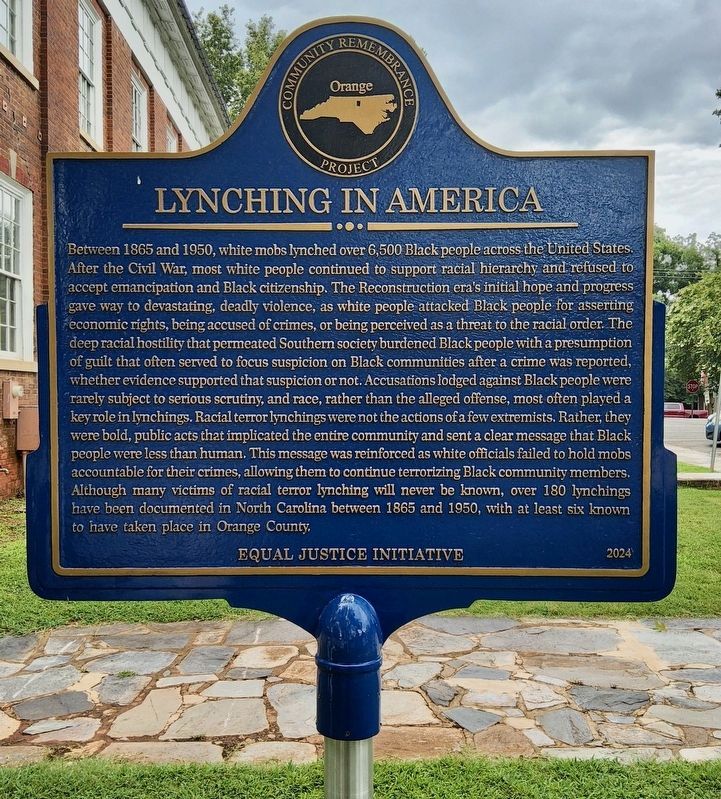
1. Lynching In America Marker
Inscription.
Lynching in America
Between 1865 and 1950, white mobs lynched over 6,500 black people across the United states. After the Civil war, most white people continue to support racially hierarchy and refuse to accept emancipation and black citizenship. The Reconstruction era's initial hope and progress gave way to devastating, deadly violence, as white people attacked black people for ascertaining economic rights, being accused of crimes, or being perceived as a threat to the racial order. The deep racial hostility that terminated Southern Society burdened black people with a presumption of guilt that often serve to focus suspicion on black communities after a crime was reported, whether evidence supported that suspicion or not. Accusations lodged against black people were rarely subject to serious scrutiny, and race, rather than the alleged defense, most often played a key role in the lynchings. Racial error lynchings were not the actions of a few extremists. Rather, they were bold, public acts at implicated the entire community and sent a clear message that black people were less than human. This message was reinforced as
Click or scan to see this page online
white officials failed to hold mobs accountable for their crimes, allowing them to continue terrorizing black community members. Although many victims of racial Terror lynchings will never be known, over 180 lynchings have been documented in North Carolina between 1865 and 1950, with at least six known to have taken place in Orange county.
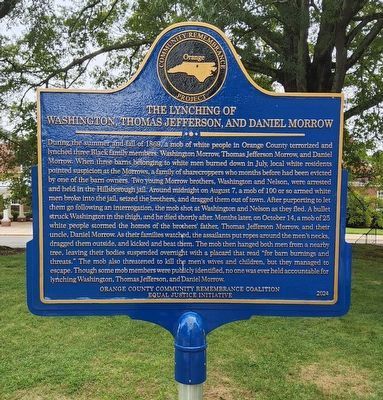
The Lynching of Washington, Thomas Jefferson, and Daniel Morrow
During the summer and fall of 1869 a mob of white people in Orange County terrorized and lynched three black family members: Washington Morrow, Thomas Jefferson Morrow, and Daniel Morrow. When three barns belonging to white men burned down in July, local white residents pointed suspicion at the Morrows, a family of sharecroppers who months before had been evicted by one of the barn owners. Two young Morrow brothers, Washington and Nelson, were arrested and held in the Hillsborough jail. Around midnight on August 7, a mob of 100 or so armed white men broke into the jail, seized the brothers, and dragged them out of town. After purporting to let them go following an interrogation, the mob shot at Washington and Nelson as they fled.
Photographed by Richard Hawkins, August 2, 2025
2. The Lynching of Washington, Thomas Jefferson, and Daniel Morrow Marker
A bullet struck Washington in the thigh, and he died shortly after. Months later, on October 14, a mob of 25 white people stormed the homes of the brothers' father, Thomas Jefferson Morrow, and their uncle, Daniel Morrow. As their families watched, the assailants put ropes around the men's necks, dragged them outside, and kicked and beat them. The mob then hanged both men from a nearby tree, leaving their bodies suspended overnight with a placard that read "for barn burnings and threats." The mob also threatened to kill the men's wives and children, but they managed to escape. Though some mob members were publicly identified, no one was ever held accountable for lynching Washington, Thomas Jefferson, and Daniel Morrow.
Erected 2025 by Orange County Community Remembrance Coalition, Equal Justice Initiative.
Topics and series. This historical marker is listed in these topic lists: African Americans • Civil Rights • Law Enforcement. In addition, it is included in the Lynching in America series list. A significant historical date for this entry is October 14, 1869.
Location. 36° 4.491′ N, 79° 5.938′ W. Marker is in Hillsborough, North
Photographed by Richard Hawkins, August 2, 2025
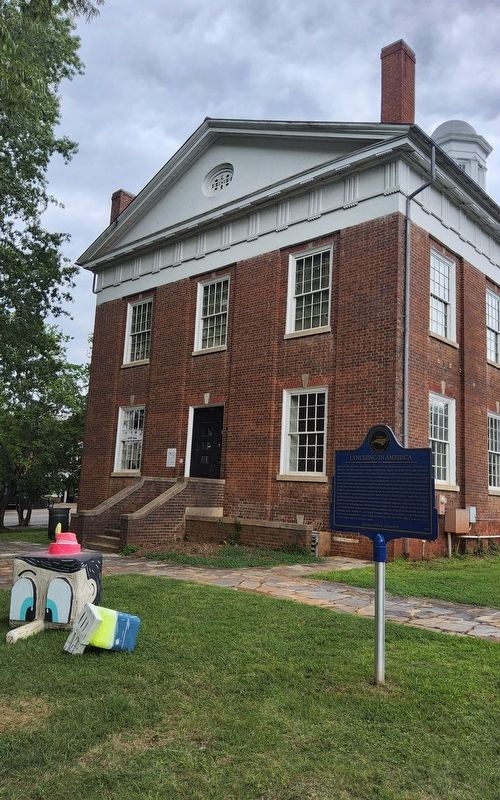
3. The lynching of Washington, Thomas Jefferson and Daniel Morrow Marker
Carolina, in Orange County. It is on Court Street north of East Margaret Lane, on the left when traveling north. Located on the grounds of the Orange County Historical Courthouse. Touch for map. Marker is at or near this postal address: 104 E King St, Hillsborough NC 27278, United States of America. Touch for directions.
Regionally, this marker is in the Piedmont and in the Research Triangle. It is also in the American South and specifically in the Upper South. Globally, it is in North America, the Western Hemisphere, the Western World, and the Anglosphere. Historically, it finds itself in what was once the territory of the Mississippian Culture, one of the original Thirteen Colonies, one of the Confederate States of America, and the Antebellum South.
Another marker is no longer nearby. Edmund Fanning (was within shouting distance of this marker but has been replaced with another marker now near it).
Credits. This page was last revised on March 22, 2026. It was originally submitted on August 2, 2025, by Richard Hawkins of Phelan, California. This page has been viewed 327 times since then and 69 times this year. Last updated on August 12, 2025, by Gianluca De Fazio of Harrisonburg, Virginia. Photos:1, 2, 3. submitted on August 2, 2025, by Richard Hawkins of Phelan, California. • Bernard Fisher was the editor who published this page.