Trinidad in Las Animas County, Colorado — The American Mountains (Southwest)
Mountain Route of the Santa Fe Trail
Photographed by Cosmos Mariner, July 10, 2025
1. Mountain Route of the Santa Fe Trail Marker
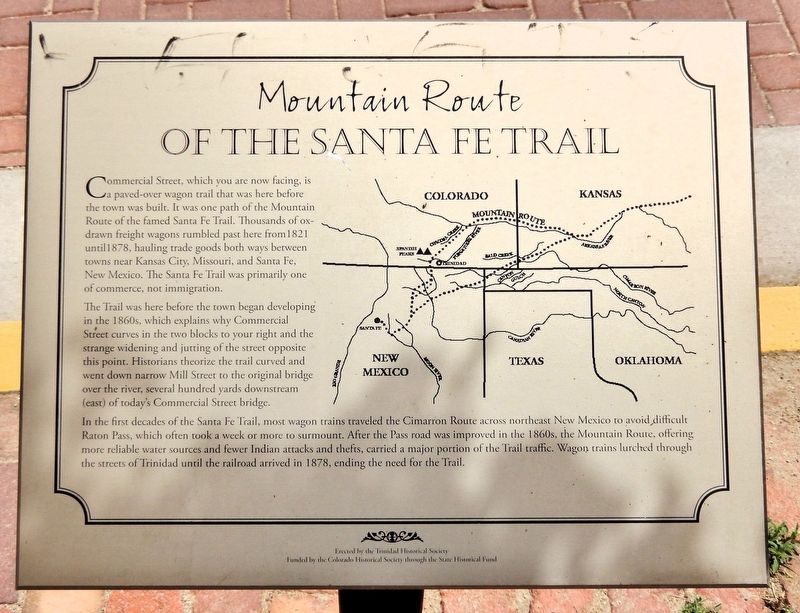
Commercial Street, which you are now facing, is a paved-over wagon trail that was here before the town was built. It was one path of the Mountain Route of the famed Santa Fe Trail. Thousands of ox-drawn freight wagons rumbled past here from 1821 until 1878, hauling trade goods both ways between towns near Kansas City, Missouri, and Santa Fe, New Mexico. The Santa Fe Trail was primarily one of commerce, not immigration.
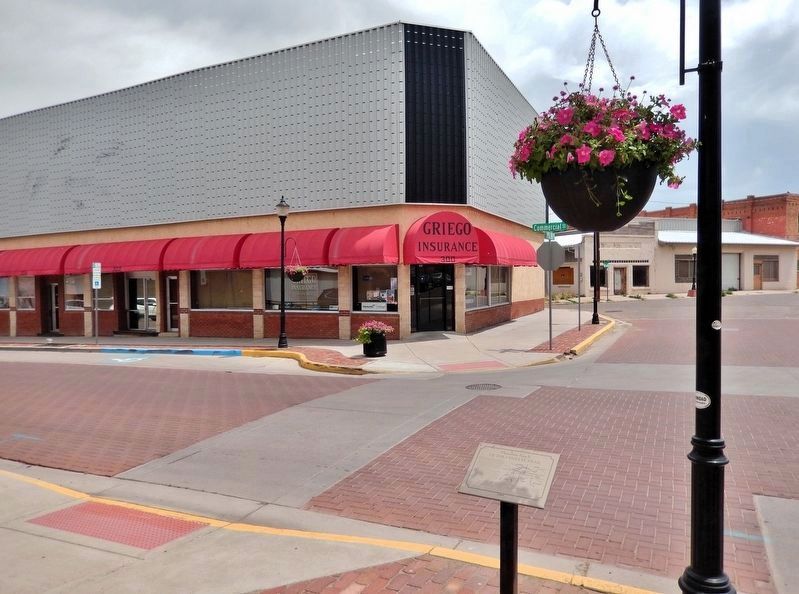
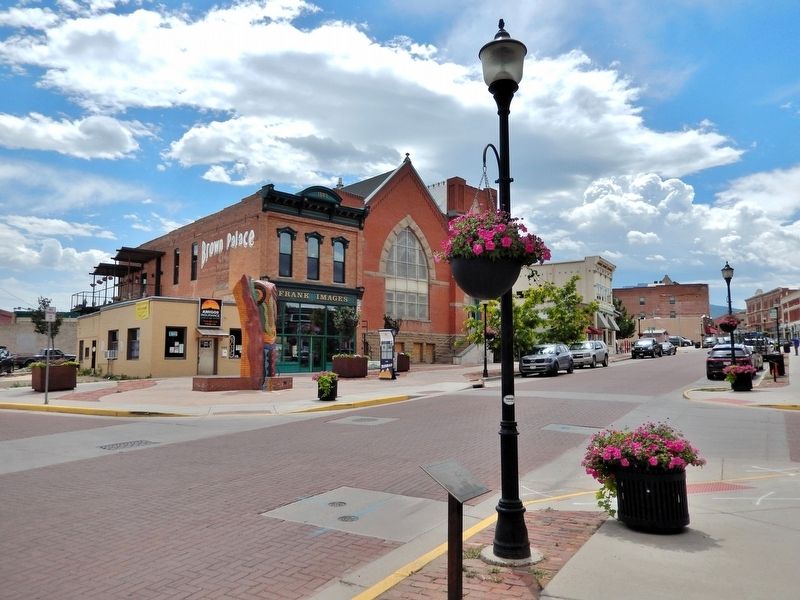
The Trail was here before the town began developing in the 1860s, which explains why Commercial Street curves in the two blocks to your right and the strange widening and jutting of the street opposite this point. Historians theorize the trail curved and went down narrow Mill Street to the original bridge over the river, several hundred yards downstream (east) of today's Commercial Street bridge.
In the first decades of the Santa Fe Trail, most wagon trains traveled the Cimarron Route across northeast New Mexico to avoid difficult Raton Pass, which often took a week or more to surmount. After the Pass road was improved in the 1860s, the Mountain Route, offering more reliable water sources and fewer Indian
this page online
Erected by Trinidad Historical Society.
Topics and series. This historical marker is listed in these topic lists: Indigenous Peoples and Communities • Industry & Commerce • Railroads & Streetcars • Roads & Vehicles. In addition, it is included in the Santa Fe Trail series list. A significant historical year for this entry is 1821.
Location. 37° 10.226′ N, 104° 30.395′ W. Marker is in Trinidad, Colorado, in Las Animas County. It is at the intersection of North Commercial Street and West Plum Street, on the right when traveling south on North Commercial Street. Touch for map. Marker is at or near this postal address: 301 North Commercial Street, Trinidad CO 81082, United States of America. Touch for directions.

Regionally, this marker is in the American Mountain West, on the Great Plains, on the Southern Plains, and on the Santa Fe Trail Corridor. Globally, it is in North America, the Western Hemisphere, the Western World, and
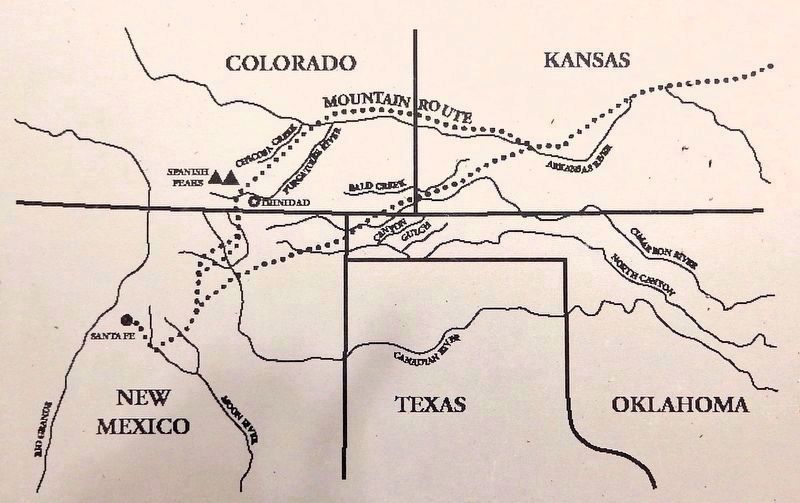
2. Marker detail: Santa Fe Trail map
Other nearby markers. At least 8 other markers are within walking distance of this marker: The Barela Building (within shouting distance of this marker); Trinidad's First City Building (within shouting distance of this marker); The Mountain Called Fisher's Peak (about 400 feet away, measured in a direct line); Invasion by the United States Army (about 500 feet away); Dedicated to Catholic World War II Veterans of Las Animas County (about 600 feet away); Trinidad Schools and the Sisters of Charity (about 700 feet away); The Aultman Studio (about 700 feet away); A Capital of Open Range Ranching (about 700 feet away). Touch for a list and map of all markers in Trinidad.
Also see . . .
1. Santa Fe Trail (Wikipedia).
Excerpt: West of Garden City in southwestern Kansas the trail splits into two branches. One of the branches, called the Mountain Route or the Upper Crossing continues up the Arkansas River to the confluence with the Purgatoire River near La Junta continuing along the Purgatoire(Submitted on August 15, 2025, by Cosmos Mariner of Cape Canaveral, Florida.)River to Trinidad, then south through the Raton Pass into New Mexico.Photographed by Cosmos Mariner, July 10, 20253. Mountain Route of the Santa Fe Trail MarkerLooking east across Commercial Street.
The other main branch, called the Cimarron Cutoff or Cimarron Crossing or Middle Crossing, cut southwest across the Cimarron Desert to the valley of the Cimarron River then continued toward Boise City, Oklahoma, to Clayton, New Mexico, joining up with northern branch at Fort Union. This route was generally very hazardous because it had very little water.
2. The Santa Fe Trail in Colorado – The Mountain Route (Legends of America).
(By Kathy Alexander) Excerpt: The Santa Fe Trail is significant to the history of what became the State of Colorado. When legal trade began in 1821, over half of Colorado’s land was under Mexican ownership; the other half was unorganized territory. Southeastern Colorado’s dramatic landscape inspired the name for one of the main routes of the trail — The Mountain Route. The Mountain and Cimarron Routes of the Santa Fe Trail crossed the southeastern corner of Colorado, though the Cimarron Route traversed only 14 miles of Baca County. In contrast, the(Submitted on August 15, 2025, by Cosmos Mariner of Cape Canaveral, Florida.)Colorado segment of the Mountain Route was much longer, totaling 181 miles. Before entering New Mexico, this route crossed present Prowers, Bent, Otero, and Las Animas counties.Photographed by Cosmos Mariner, July 10, 20254. Mountain Route of the Santa Fe Trail MarkerLooking south along Commercial Street. Commercial Street curves in the blocks ahead (to the south).Raton Pass sits astride the existing Colorado-New Mexico border near Trinidad. Although the Mountain Route of the Santa Fe Trail had been in use since the 1830s, its terrain provided many obstacles to wagon movement. One such obstacle was the tortuous 8,000-foot, axle-breaking Raton Pass. Both a barrier and a gateway, the Raton Ridge symbolized the Mountain Route of the Santa Fe Trail. This pass was difficult to cross until the Army made improvements during the Mexican-American War.
Credits. This page was last revised on August 15, 2025. It was originally submitted on August 14, 2025, by Cosmos Mariner of Cape Canaveral, Florida. This page has been viewed 166 times since then and 49 times this year. Photos: 1, 2, 3, 4. submitted on August 15, 2025, by Cosmos Mariner of Cape Canaveral, Florida.
