Punxsutawney in Jefferson County, Pennsylvania — The American Northeast (Mid-Atlantic)
Birth of a Coal Mining Empire
Pennsylvania Wilds

Photographed by William Fischer, Jr., August 11, 2025
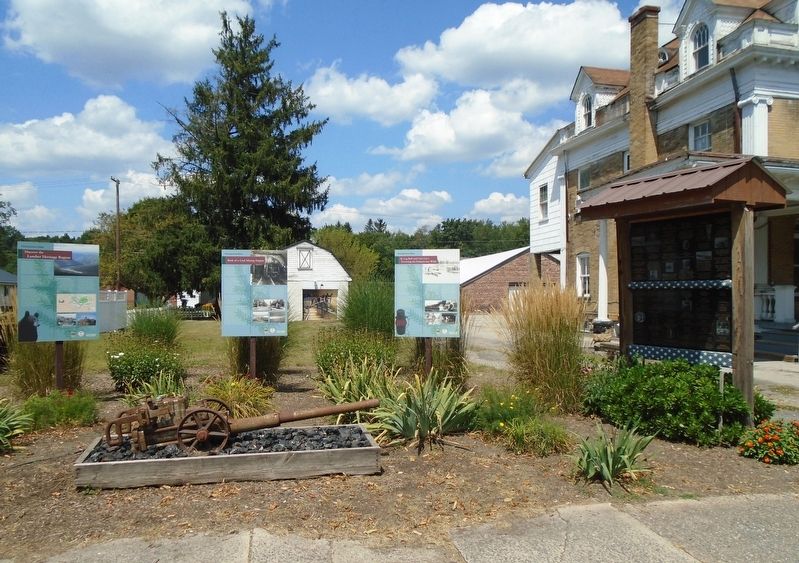
1. Birth of a Coal Mining Empire Marker
Settled in the early 1800s, Punxsutawney remained a quiet farming and lumbering community until 1883. That year, the Rochester and Pittsburgh Coal and Iron Company opened coal mines just north of Punxsutawney, launching an industry that would transform the region.
By 1900, thousands of men and boys labored in the mines, excavating coal deposits that surrounded the town, including one unbroken stretch from Reynoldsville to Punxsutawney. Their muscle and grit extracted an average of 25,000 tons of coal per day from each mine. Most coal was shipped out of the region to fuel the steam-driven engines used in factories, locomotives and ships. The rest was processed locally to produce coke used in iron furnaces.
The commercial center of the mining region, Punxsutawney drew many new industries, including foundries, a silk mill, brick factories, and glass plants. In the early 1900s, more than 70 trains a day brought goods and people to and from Punxsutawney.
Changing Times, Changing Industry
By 1920, declining yields and changing economics ended the rein of deep-pit mining. Some mining towns, like
this page online
From Coal to Coke
Mines in the Punxsutawney region yield bituminous coal, which burns cool and smoky compared to anthracite coal. "Coking" turned the bituminous coal into a hotter and cleaner burning fuel. Beehive-shaped coke ovens burned crushed coal in the near-absence of air, a process that released noxious gas and coal tar and left pure carbon coke. Walston housed the world's longest string of coke ovens, stretching 1.25 miles. Smoke from the town's 700 ovens blackened the air and killed vegetation throughout the valley. In 1900, the region's coke ovens produced 100 train cars of coke daily.
[Photo captions, top to bottom, read]
• Miners at the bottom of the Onanbaga Mine, circa 1912.
Photographed by William Fischer, Jr., August 11, 2025
2. Birth of a Coal Mining Empire Marker
• The Rochester and Pittsburgh Coal and Iron Company built the town of Adrian in 1888 and operated the coal mine until 1941.
• The 700 coke ovens in Walston cast a red glow in the sky at night.
Erected by PA DCNR, PA Wilds, and PA Lumber Heritage Region.
Topics. This historical marker is listed in these topic lists: Environment • Immigration • Industry & Commerce • Settlements & Settlers. A significant historical year for this entry is 1883.
Location. 40° 56.576′ N, 78° 58.574′ W. Marker is in Punxsutawney, Pennsylvania, in Jefferson County. It is on Mahoning Street (Colonel Drake Hwy) (Route 36) west of Morrison Avenue, on the right when traveling west. Marker is at the future site of the Punxsutawney Area Coal Memorial. Touch for map. Marker is at or near this postal address: 404 West Mahoning Street, Punxsutawney PA 15767, United States of America. Touch for directions.

Regionally, this marker is in the Pennsylvania Wilds. It is also in the American Northeast, in the Mid-Atlantic, in Appalachia,
Photographed by William Fischer, Jr., August 11, 2025
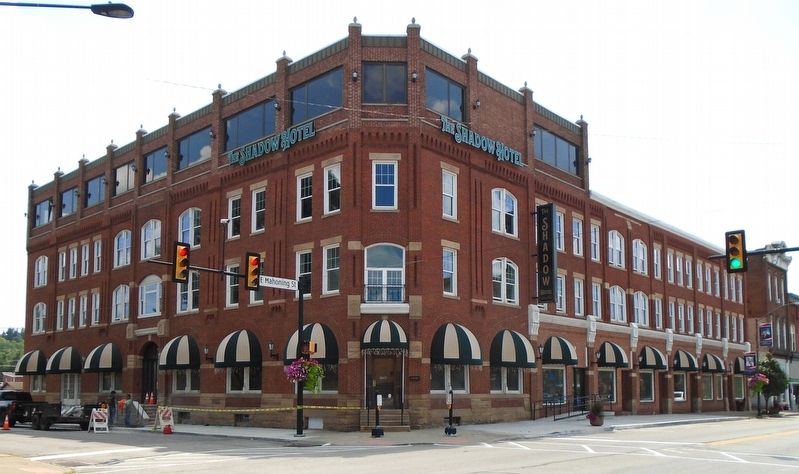
3. The Shadow Hotel (former Pantall Hotel) at Mahoning and Jefferson Sts
Other nearby markers. At least 8 other markers are within walking distance of this marker: Discover the Lumber Heritage Region (here, next to this marker); First Walston Miners (here, next to this marker); Dorothy Kovalchick (here, next to this marker); The Mine Mule's Job (here, next to this marker); Railroad Y.M.C.A. (here, next to this marker); Punxsutawney Area Coal Miner & Railroader Memorial (here, next to this marker); By Log Raft and Coal Car - Traversing the Pennsylvania Wilds (here, next to this marker); Christian Miller House (about 600 feet away, measured in a direct line). Touch for a list and map of all markers in Punxsutawney.
Also see . . .
1. ADRIAN MINES: Adrian Mines & Coke Works, Young Twp., Jefferson Co. PA (Washlaski). (Submitted on August 16, 2025, by William Fischer, Jr. of Reynoldsburg, Ohio.)
2. Lumber Heritage Region. (Submitted on August 16, 2025, by William Fischer, Jr. of Reynoldsburg, Ohio.)
3. Pennsylvania Wilds. (Submitted on August 16, 2025, by William Fischer, Jr. of Reynoldsburg, Ohio.)
Credits. This page was last revised on August 16, 2025. It was originally submitted on August 16, 2025, by William Fischer, Jr. of Reynoldsburg, Ohio. This page has been viewed 333 times since then and 170 times this year. Photos: 1, 2, 3. submitted on August 16, 2025, by William Fischer, Jr. of Reynoldsburg, Ohio.
