Near Berlin in Worcester County, Maryland — The American Northeast (Mid-Atlantic)
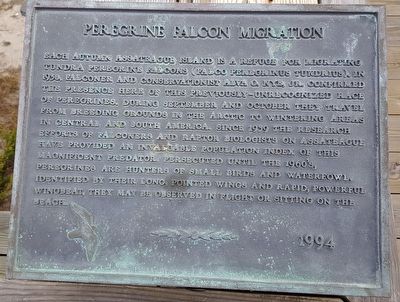
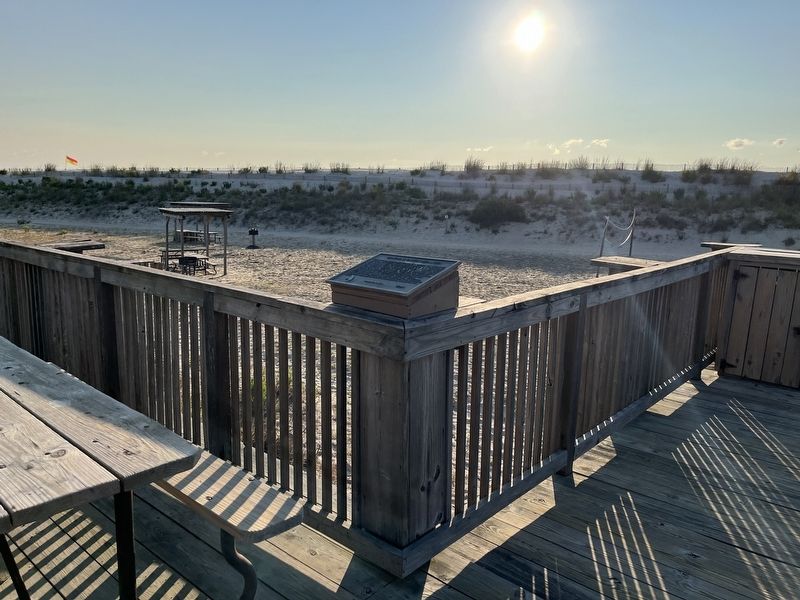
Peregrine Falcon Migration
Photographed by Michael Yates, October 19, 2019
1. Peregrine Falcon Migration Marker
Each autumn Assateague Island is a refuge for migrating tundra peregrine falcons (Falco peregrinus tundrius). In 1938, falconer and conservationist Alva G. Nye, Jr. confirmed the presence here of this previously-unrecognized race of peregrines. During September and October they travel from breeding grounds in the Arctic to wintering areas in Central and South America. Since 1939 the research efforts of falconers and raptor biologists on Assateague have provided an invaluable population index of the magnificent predator. Persecuted until the 1960’s, peregrines are hunters of small birds and waterfowl. Identified by their long, pointed wings and rapid, powerful wingbeat, they may be observed in flight or sitting on the beach.
Erected 1994 by Michael Yates.
Topics. This historical marker is listed in these topic lists: Animals • Environment • Science & Medicine. A significant historical year for this entry is 1938.
Location. 38° 14.166′ N, 75° 8.246′ W. Marker is near Berlin, Maryland, in Worcester County. It can be reached from Stephen Decatur Highway half a mile east of Verrazano Bridge (U.S. 611), on the
this page online

Regionally, this marker is on the Eastern Shore. It is also in the American Mid-Atlantic, on the Delmarva Peninsula, in the Tidewater, and on the Eastern Seaboard. Globally, it is in the North Atlantic Region, North America, the Western Hemisphere, the Western World, and the Anglosphere. Historically, it finds itself in what was once one of the original Thirteen Colonies and also the Antebellum South.
Other nearby markers. At least 8 other markers are within 2 miles of this marker, measured as the crow flies: Wild and Free (within shouting distance of this marker); Stephen Tyng Mather (approx. 1.1 miles away); Verrazano Bridge (approx. 1.1 miles away); Berlin / Snow Hill / Wallops Flight Facility / Chincoteague (approx. 1.2 miles away); You're looking out over… A Productive Nursery (approx. 1.2 miles away); Sheltered Waters (approx. 1.2 miles away); Caring for the Bay
Also see . . .
1. Earthspan Foundation. Excerpt:
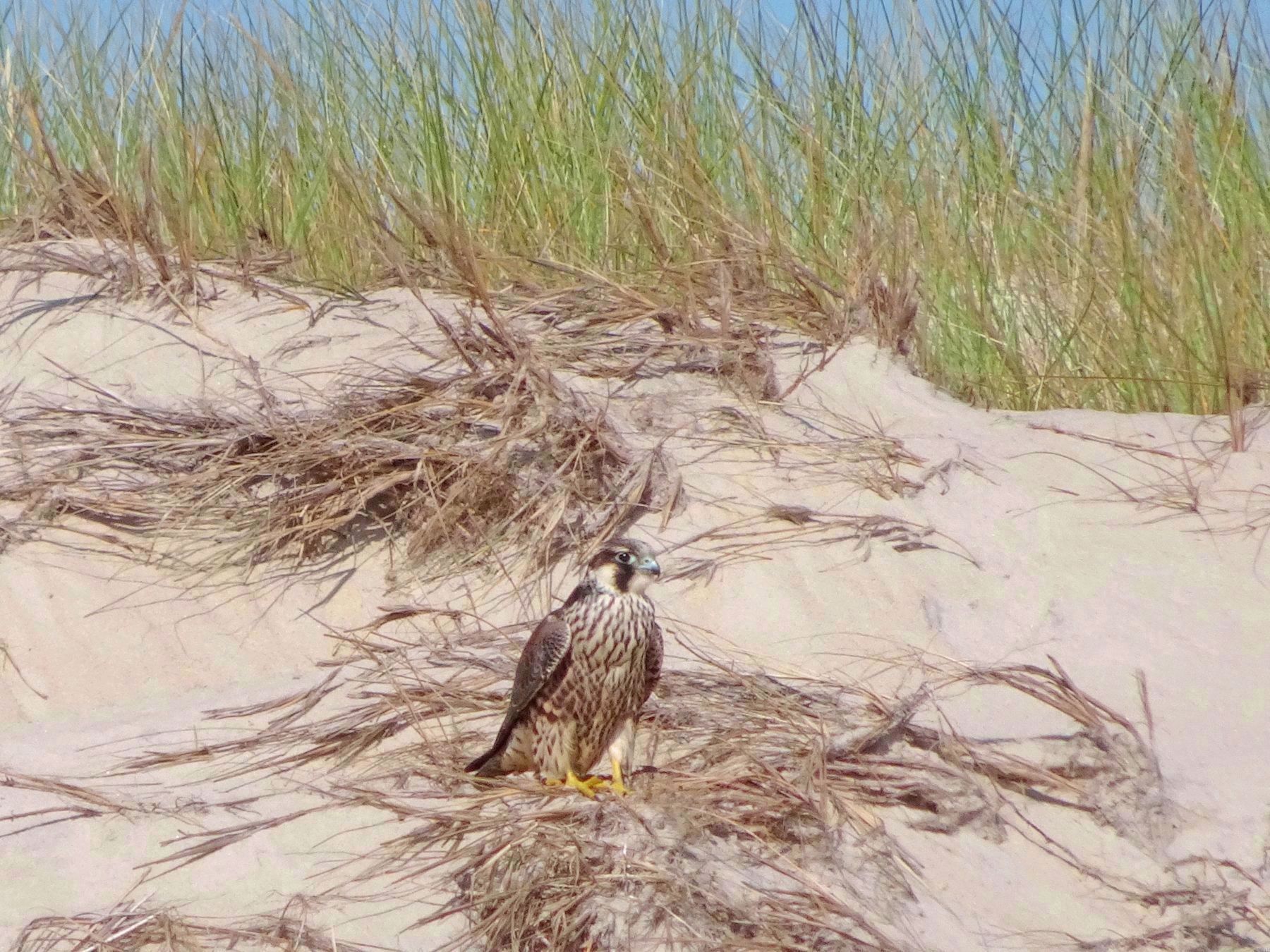
Formed in 1994 ... Earthspan’s initial focus was population studies of migrating tundra peregrine falcons that its principals had been conducting for many years. Thanks to those principals, satellite technology was just then assuming its now prominent role in tracking the falcons and other migrating species. We have monitored these migrants since 1970 through blood sampling to determine what, if any, exposure to contaminants and infectious diseases they encounter during migration and in their critical habitats. Earthspan has compiled and maintains a unique archive representing thousands of peregrine blood samples that may be analyzed to define the evolution and progression of emerging threats through these sentinel apex predators. Our long-term standardized data sets on migrating peregrines are unparalleled worldwide. In 2019 we formalized a collaborative partnership with longtime colleagues The Peregrine Fund (www.peregrinefund.org) to further our important(Submitted on August 27, 2025, by Michael Yates of Waynesboro, Pennsylvania.)research goals and theirs.Photographed by Michael Yates, October 8, 20223. Juvenile Tundra Peregrine Falcon (Falco peregrinus tundrius) on Assateague Island
2. Wikipedia entry for Peregrine falcon. Excerpt:
Falco peregrinus tundrius, described by C. M. White in 1968, was at one time included in F. p. leucogenys. It is found in the Arctic tundra of North America to Greenland, and migrates to wintering grounds in Central and South America. Most vagrants that reach western Europe belong to this subspecies, which was previously considered synonymous with F. p. anatum. It is the New World equivalent to F. p. calidus. It is smaller and paler than F. p. anatum; most have a conspicuous white forehead and white in ear region, but the crown and “moustache” are very dark, unlike in F. p. calidus. Juveniles are browner and less grey than in F. p. calidus and paler, sometimes almost sandy, than in F. p. anatum. Males weigh 1.1–1.5 lb, while females weigh 1.8–2.4 lb. Despite its current recognition as a valid subspecies, a population genetic study of both pre-decline (i.e., museum) and recovered contemporary populations failed to distinguish F. p. anatum and F. p. tundrius genetically.
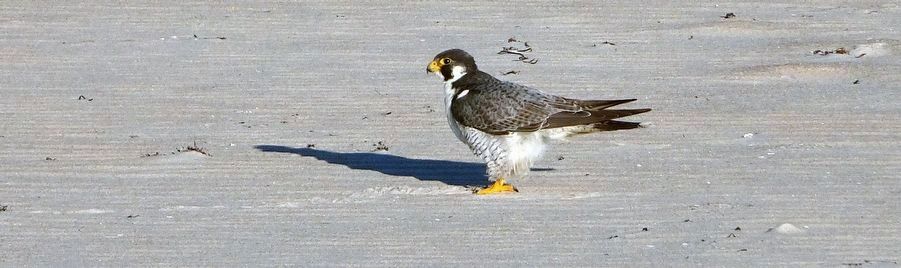
Photographed by Michael Yates, October 8, 2023
4. Tundra Peregrine Falcon (Falco peregrinus tundrius) in Adult Plumage on Assateague Island
Credits. This page was last revised on March 19, 2026. It was originally submitted on September 18, 2022, by Devry Becker Jones of Washington, District of Columbia. This page has been viewed 385 times since then and 28 times this year. Last updated on August 19, 2025, by Michael Yates of Waynesboro, Pennsylvania. Photos: 1. submitted on August 19, 2025, by Michael Yates of Waynesboro, Pennsylvania. 2. submitted on September 18, 2022, by Devry Becker Jones of Washington, District of Columbia. 3, 4. submitted on August 27, 2025, by Michael Yates of Waynesboro, Pennsylvania. • J. J. Prats was the editor who published this page.
