Niagara Falls in Niagara Region, Ontario — Central Canada (North America)
The Inukshuk
Photographed by J. J. Prats, October 15, 2014
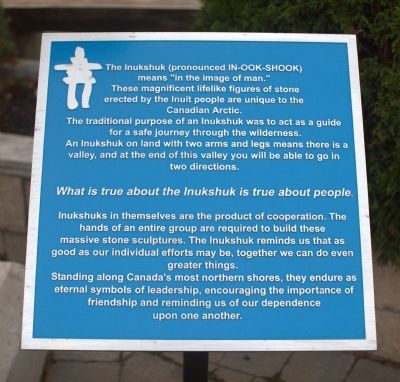
1. The Inukshuk Marker
The inukshuk (pronounced IN-OOK-SHOOK) means “in the image of man.” These magnificent lifelike figures of stone erected by the Inuit people are unique to the Canadian Arctic.
The traditional purpose of an Inukshuk was to act as a guide for a safe journey through the wilderness. An Inukshuk on land with two arms and legs means there is a valley, and at the end of the valley you will be able to go in two directions.
What is true about the Inukshuk is true about people.
Inukshuks in themselves are the product of cooperation. The hands of an entire group are required to build these massive stone sculptures. The Inukshuk reminds us that as good as our individual efforts may be, together we can do even greater things.
Standing along Canada’s most northern shores, they endure as eternal symbols of leadership, encouraging the importance of friendship and reminding us of our dependence on one another.
Topics. This historical marker is listed in these topic lists: Anthropology & Archaeology • Indigenous Peoples and Communities.
Location. 43° 6.78′ N, 79° 3.711′ W. Marker
this page online

Regionally, this marker is on the Golden Horseshoe and in Niagara Canada. It is also in Central Canada. Globally, it is in North America, on the Great Lakes, in the Western Hemisphere, in the Western World, and in the Anglosphere. Historically, it finds itself in what was once a British colony, the Viceroyalty of New France, the Haudenosaunee (Iroquois) Confederacy, and Rupert’s Land.
Other nearby markers. At least 8 other markers are within walking distance of this marker: The Buttery Elevators (approx. 0.3 kilometers away in the U.S.); Pastimes and Parkways (approx. 0.4 kilometers away in the U.S.); Railways In Niagara (approx. half a kilometer away); First Niagara Suspension Bridge (approx. 0.6 kilometers away in the U.S.); United States Custom House (approx.
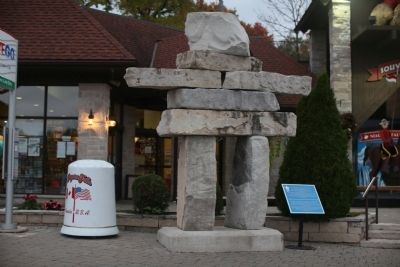
Photographed by J. J. Prats, October 15, 2014
2. The Inukshuk Marker
Also see . . . Wikipedia entry for Inuksuk. “These structures are found from Alaska to Greenland. This region, above the Arctic Circle, is dominated by the tundra biome and has areas with few natural landmarks. The inuksuk may have been used for navigation, as a point of reference, a marker for travel routes, fishing places, camps, hunting grounds, places of veneration, drift fences used in hunting or to mark a food cache.The Inupiat in northern Alaska used inuksuit to assist in the herding of caribou into contained areas for slaughter. Varying in shape and size, the inuksuit have ancient roots in Inuit culture.” (Submitted on November 20, 2014.)
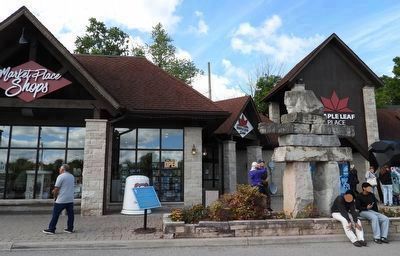
Photographed by Kevin Westell, August 18, 2025
3. The Inukshuk - Marker in context, 2025
Compared to 2014 photo, the business branding has changed; the stone garden planter and the marker were re-arranged; but the inukshuk appears unmoved.

Photographed by Nicolas M. Perrault, January 9, 2011
4. Inukshuk and Sunset near Kuujjuaraapik in January
The largest inukshuk in the vicinity of the village of Kuujjuaraapik, Quebec (alternate spelling: Kuujjuarapik; Cree name: Whapmagoostui; French name: Poste-de-la-Baleine; English name: Great Whale River).
Credits. This page was last revised on September 26, 2025. It was originally submitted on November 20, 2014, by J. J. Prats of Powell, Ohio. This page has been viewed 1,195 times since then and 112 times this year. Last updated on August 19, 2025, by Kevin Westell of St. Catharines, Ontario. Photos: 1, 2. submitted on November 20, 2014, by J. J. Prats of Powell, Ohio. 3. submitted on August 19, 2025, by Kevin Westell of St. Catharines, Ontario. 4. submitted on November 20, 2014, by J. J. Prats of Powell, Ohio. • Devry Becker Jones was the editor who published this page.
