Grassy Butte in McKenzie County, North Dakota — The American Midwest (Upper Plains)
Work in Progress
⎯⎯⎯
Better Together
Theodore Roosevelt National Park
| — | National Park Service, U.S. Department of the Interior | — |
Photographed by Susan Van Den Bosch, August 12, 2025
1. Work in Progress - Better Together Marker
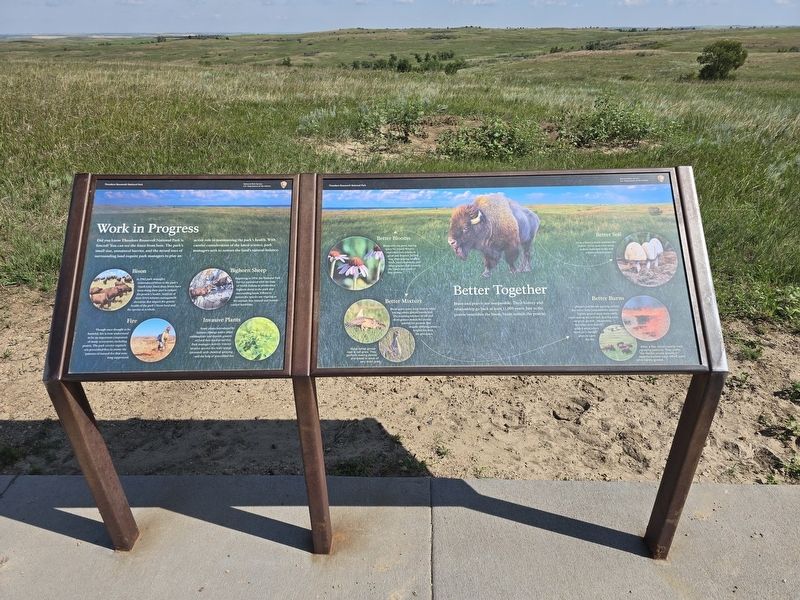
Work in Progress
Did you know Theodore Roosevelt National Park is fenced? You can see the fence from here. The park's small size, unnatural barrier, and the mixed uses of surrounding land require park managers to play an active role in maintaining the park's health. With careful consideration of the latest science, park managers seek to restore the land's natural balance.
Bison
In 1962 park managers reintroduced bison to the park's North Unit. Since then, bison have been doing their part to restore the prairie's health. Analysis of their DNA informs management decisions that impact the genetic health of the park's bison herd and the species as a whole.
Bighorn Sheep
Beginning in 1954, the National Park Service partnered with the state of North Dakota to reintroduce bighorn sheep to the park and surrounding lands. Efforts to sustain the species are ongoing as the animals face natural and human caused hardships.
Fire
Though once thought to be harmful, fire is now understood to be an important component of many ecosystems, including prairie. The park service regularly sets prescribed fires to mimic the patterns
this page online
Invasive Plants
Some plants introduced by humans damage native plant communities and deprive grazers of food they need to survive. Park mangers actively remove invasive species like leafy spurge (picture) with chemical spraying and the help of prescribed fire.
Better Together
Better Blooms
Bison only eat grass, leaving space for prairie flowers and other leafy plants to grow and flourish. In this way, their grazing benefits birds, small mammals, and other grazers that consume the leaves and seeds of non-grasses.
Better Mixture
Bison graze some areas heavily while leaving others almost untouched. The resulting mixture of tall and short grasses makes the prairie suitable for animals that require differing plant heights for their life processes.
Sharp-tailed grouse nest in tall grass. They perform mating dances and breed in areas of very short grass.
Better Burns
Bison's patchwork grazing ensures fire never fully consumes the prairie. Lightly grazed areas burn easily, rejuvenating the soil and clearing away old plant growth. Meanwhile, fire skips over heavily grazed areas where
Photographed by Susan Van Den Bosch, August 12, 2025
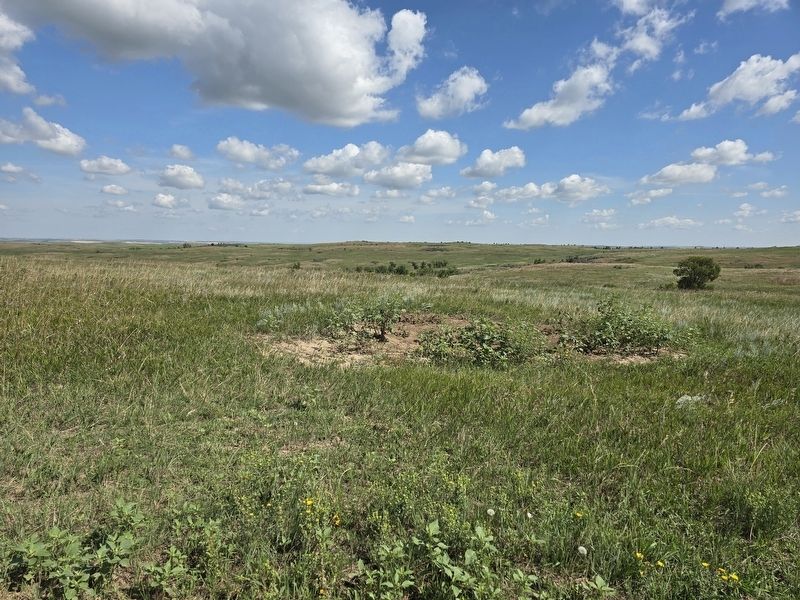
2. Surrounding Grass Land
After a fire, bison reverse their grazing patterns. They prefer the tender young grasses in recently burned areas which were once lightly grazed.
Better Soil
Even a bison's waste sustains the prairie. Urine and solid waste restore nutrients to the soil wherever bison graze.
Erected by National Park Service, U.S. Department of the Interior.
Topics. This historical marker is listed in these topic lists: Animals • Natural Features • Parks & Recreational Areas. A significant historical year for this entry is 1962.
Location. 47° 37.582′ N, 103° 23.493′ W. Marker is in Grassy Butte, North Dakota, in McKenzie County. It is on Scenic Drive west of CanAm Highway (U.S. 85), on the left when traveling west. This marker stands in Theodore Roosevelt National Park North Unit on Scenic Drive at the Man and Grass Pullout. Touch for map. Marker is in this post office area: Grassy Butte ND 58634, United States of America. Touch for directions.

Regionally, this marker is in the Bakken Oil Patch. It is also in the American Lewis & Clark Corridor, on the prairies, and on the Northern Plains.
Photographed by Susan Van Den Bosch, August 12, 2025
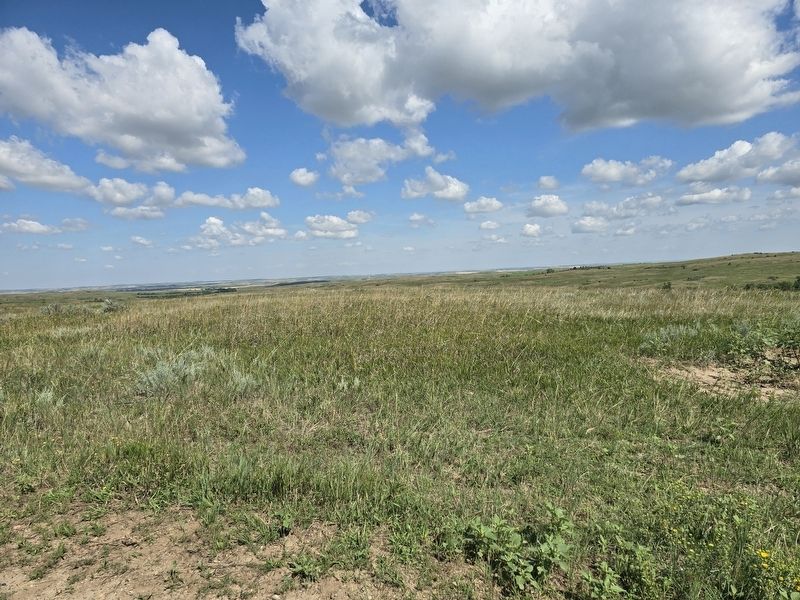
3. Surrounding Lands
Other nearby markers. At least 8 other markers are within 5 miles of this marker, measured as the crow flies: Bentonitic Clay (approx. 0.6 miles away); The View that Launched a Park (approx. 1.3 miles away); The Long X Trail: A Dusty Trail to Greener Pastures (approx. 2.1 miles away); North Dakota Badlands (approx. 2½ miles away); A Wild River / Growing Old / Cotton (approx. 2.8 miles away); Ox Bow Bend Overlook (approx. 2.9 miles away); Cannonball Mystery (approx. 3.4 miles away); Tilted (approx. 4.7 miles away).
Other markers no longer nearby. Man and Grass (was approx. 0.2 miles away but has been replaced with another marker now near it); Building From Hard Times (was approx. 1.3 miles away but has been replaced with another marker now near it); Edge of a Glacier (was approx. 2.2 miles away but has been permanently removed); Long X Cattle Trail (was approx. 2.7 miles away but has been permanently removed); Roosevelt and the Boat Thieves (was approx. 2.8 miles away but has been permanently removed); “Cannon Ball” Concretions (was approx. 3½ miles away but has been permanently removed).
Related marker. Click here for another marker that is related to this marker.
Credits. This page was last revised on September 8, 2025. It was originally submitted on August 20, 2025, by Susan Van Den Bosch of Almond, Wisconsin. This page has been viewed 73 times since then and 23 times this year. Photos: 1, 2, 3. submitted on August 20, 2025, by Susan Van Den Bosch of Almond, Wisconsin. • Devry Becker Jones was the editor who published this page.
Editor’s want-list for this marker. A wide shot of the marker in context. • Can you help?
