
Crane Township near Cecil in Paulding County, Ohio — The American Midwest (Great Lakes)
Voices of the Maumee:
Native Life and Legacy in Crane Township
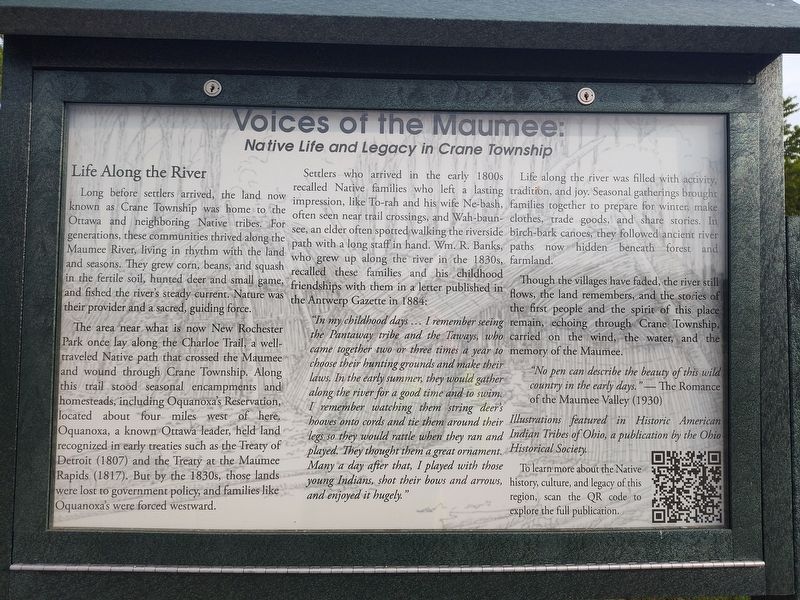
Photographed by Craig Doda, August 17, 2025
1. Voices of the Maumee: Marker
Life Along the River
Long before settlers arrived, the land now known as Crane Township was home to the Ottawa and neighboring Native tribes. For generations, these communities thrived along the Maumee River, living in rhythm with the land and seasons. They grew corn, beans, and squash in the fertile soil, hunted deer and small game, and fished the river's steady current. Nature was their provider and a sacred, guiding force.
The area near what is now New Rochester Park once lay along the Charloe Trail, a well- traveled Native path that crossed the Maumee and wound through Crane Township. Along this trail stood seasonal encampments and homesteads, including Oquanoxa's Reservation, located about four miles west of here. Oquanoxa, a known Ottawa leader, held land recognized in early treaties such as the Treaty of Detroit (1807) and the Treaty at the Maumee Rapids (1817). But by the 1830s, those lands were lost to government policy, and families like Oquanoxa's were forced westward.
Settlers who arrived in the early 1800s recalled Native families who left a lasting impression, like To-rah and his wife Ne-bash, often seen
this page online
"In my childhood days … I remember seeing the Pantaway tribe and the Taways, who came together two or three times a year to choose their hunting grounds and make their laws. In the early summer, they would gather along the river for a good time and to swim. I remember watching them string deer's hooves onto cords and tie them around their legs so they would rattle when they ran and played. They thought them a great ornament. Many a day after that, I played with those young Indians, shot their bows and arrows, and enjoyed it hugely."
Life along the river was filled with activity, tradition, and joy. Seasonal gatherings brought families together to prepare for winter, make clothes, trade goods, and share stories. In birch-bark canoes, they followed ancient river paths now hidden beneath forest and farmland.
Though the villages have faded, the
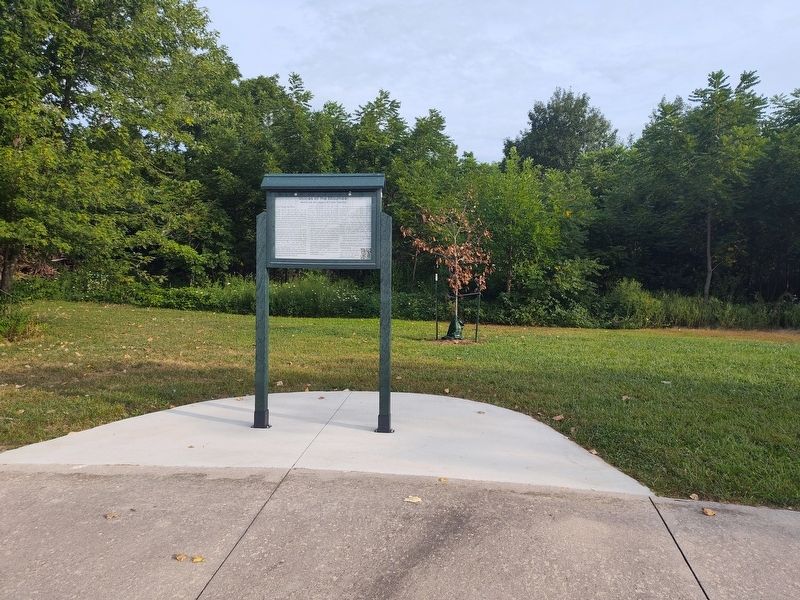
Photographed by Craig Doda, August 17, 2025
2. Voices of the Maumee: Marker
— The Romance of the Maumee Valley (1930)
Erected 2025 by Friends of Paulding County Parks.
Topics. This historical marker is listed in these topic lists: Indigenous Peoples and Communities • Settlements & Settlers • Waterways & Vessels. A significant historical year for this entry is 1884.
Location. 41° 13.931′ N, 84° 35.79′ W. Marker is near Cecil, Ohio, in Paulding County. It is in Crane Township. It is at the intersection of County Road 424 and County Road 105, on the right when traveling west on County Road 424. Touch for map. Marker is at or near this postal address: 11827 County Rd 424, Cecil OH 45821, United States of America. Touch for directions.

Regionally, this marker is in Ohio’s Black Swamp and in the Till Plains. It is also in the American Midwest and in the Corn Belt. Globally, it is in North America, the Western Hemisphere, the Western World, and the Anglosphere. Historically, it finds itself in what was once the Haudenosaunee (Iroquois) Confederacy, the territory of the Mississippian Culture, and the Northwest Territory.
Other nearby markers. At least 8 other markers are within 4 miles of this marker, measured as the crow flies: Maumee River: Lifeblood Then and Now (here, next to this marker); Horatio Nelson Curtis (1802-1874) (within shouting distance of this marker); Oliver Crane (1791-1854) (within shouting distance of this marker); New Rochester (within shouting distance of this marker); Look to the Skies - Bald Eagles at New Rochester Park (about 400 feet away, measured in a direct line); About New Rochester Park (about 400 feet away); a different marker also named New Rochester (about 400 feet away); Forder Bridge (approx. 3.9 miles away). Touch for a list and map of all markers in Cecil.
Credits. This page was last revised on August 21, 2025. It was originally submitted on August 20, 2025, by Craig Doda of Napoleon, Ohio. This page has been viewed 85 times since then and 25 times this year. Photos: 1, 2. submitted on August 20, 2025, by Craig Doda of Napoleon, Ohio. • Devry Becker Jones was the editor who published this page.
