Dover Township in Higginsville in Lafayette County, Missouri — The American Midwest (Upper Plains)
Missouri's Confederate Home
Confederate Memorial State Historic Site
| — | Missouri State Parks | — |
Photographed by Mark Parker, July 5, 2025
1. Missouri's Confederate Home Marker
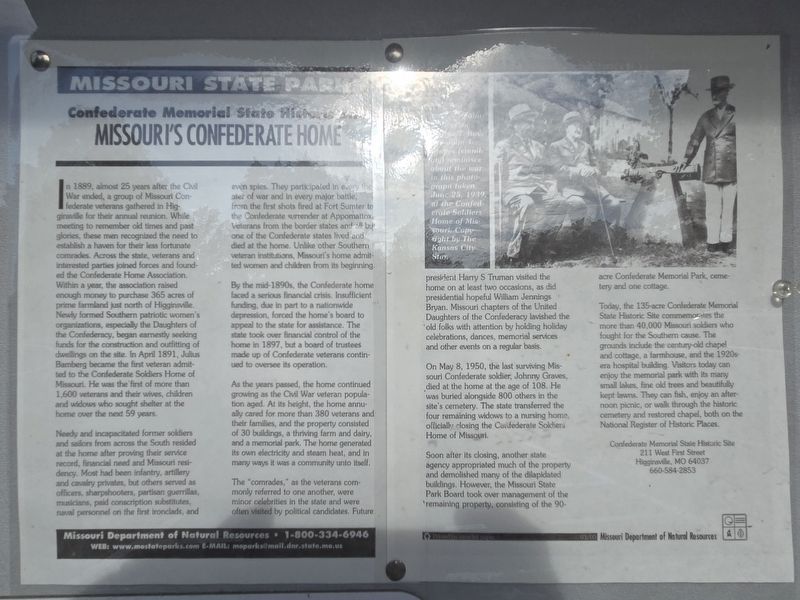
Needy and incapacitated former soldiers and sailors from across the South resided at the home after proving their service record, financial need and Missouri residency. Most had been
this page online
By the mid-1890s, the Confederate home faced a serious financial crisis. Insufficient funding, due in part to a nationwide depression, forced the home's board to appeal to the state for assistance. The state took over financial control of the home in 1897, but a board of trustees made up of Confederate veterans continued to oversee its operation.
As the years passed, the home continued growing as the Civil War veteran population aged. At its height, the home annually cared for more than 380 veterans and their families, and the property consisted of 30 buildings, a thriving
Photographed by Mark Parker, July 5, 2025
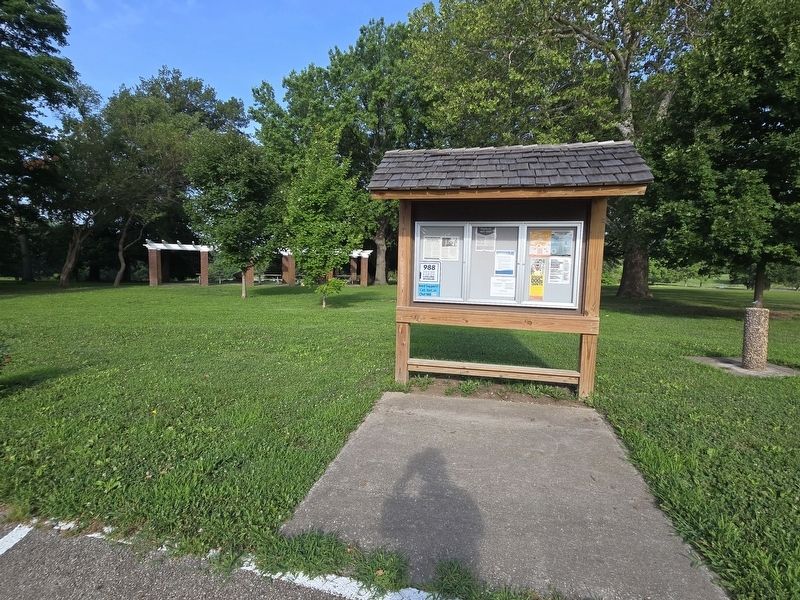
2. Missouri's Confederate Home Marker at the park's information kiosk
The "comrades," as the veterans commonly referred to one another, were minor celebrities in the state and were often visited by political candidates. Future president Harry S Truman visited the home on at least two occasions, as did presidential hopeful William Jennings Bryan. Missouri chapters of the United Daughters of the Confederacy lavished the old folks with attention by holding holiday celebrations, dances, memorial services and other events on a regular basis.
On May 8, 1950, the last surviving Missouri Confederate soldier, Johnny Graves, died at the home at the age of 108. He was buried alongside 800 others in the site's cemetery. The state transferred the four remaining widows to a nursing home, officially closing the Confederate Soldiers Home of Missouri.
Soon after its closing, another state agency appropriated much of the property and demolished many of the dilapidated buildings. However, the Missouri State Park Board took over management of the remaining property, consisting of the 90-acre Confederate Memorial Park, cemetery and one cottage.
Today, the 135-acre Confederate Memorial State Historic Site commemorates the more than 40,000 Missouri soldiers who fought for the Southern cause. The grounds include the century-old chapel and cottage, a farmhouse, and the 1920s-era hospital building. Visitors today can enjoy the memorial park with its many small lakes, fine old trees and beautifully kept lawns. They can fish, enjoy an afternoon picnic, or walk through the historic cemetery and restored chapel, both on the National Register of Historic Places.
Erected by Missouri Department of Natural Resources.
Topics. This historical marker is listed in these topic lists: Charity & Public Work • Parks & Recreational Areas • War, US Civil. A significant historical month for this entry is April 1891.
Location. 39° 5.873′ N, 93° 43.411′ W. Marker is in Higginsville, Missouri, in Lafayette County. It is in Dover Township. It is on Inner Loop Road north of Missouri Route 213, on the left when traveling north. Touch for map. Marker is at or near this postal address: 211 West 1st Street, Higginsville MO 64037, United States of America. Touch for directions.

Regionally, this marker is in the Missouri River Corridor. It is also in the American Midwest, in the Lewis & Clark Corridor, in the Corn Belt, and on the Santa Fe Trail Corridor. Globally, it is in North America, the Western Hemisphere, the Western World, and the Anglosphere. Historically, it finds itself in what was once the territory of the Mississippian Culture, the Louisiana Purchase, and the Antebellum South.
Other nearby markers. At least 8 other markers are within walking distance of this marker: Confederate Soldiers' Monument (within shouting distance of this marker); Confederate Home Chapel Restoration (approx. 0.3 miles away); Confederate Memorial State Historic Site (approx. 0.3 miles away); Confederate States of America - National Flags (approx. 0.3 miles away); Our Confederate Dead (approx. 0.3 miles away); Confederate States of America - Battle Flags (approx. 0.3 miles away); Lion of Lucerne (approx. 0.3 miles away); Honoring All Who Serve (approx. half a mile away). Touch for a list and map of all markers in Higginsville.
Other markers no longer nearby. Confederate Memorial Park (was here, next to this marker but has been permanently removed); Their Waning Years (was here, next to this marker but has been permanently removed); The Confederate Home of Missouri (was approx. 0.3 miles away but has been permanently removed); Cottage Row [and] The Confederate Home Chapel (was approx. 0.3 miles away but has been permanently removed).
More about this marker. The laminated marker at the park's information kiosk replaced previous markers that have been removed. The photo caption is illegible due to early morning sun glare.
Related marker. Click here for another marker that is related to this marker.
Also see . . . Confederate Memorial State Historic Site. Missouri State Parks website entry (Submitted on August 24, 2025.)
Credits. This page was last revised on December 15, 2025. It was originally submitted on August 21, 2025, by Mark Parker of Hickory, North Carolina. This page has been viewed 184 times since then and 70 times this year. Photos: 1, 2. submitted on August 21, 2025, by Mark Parker of Hickory, North Carolina. • Bernard Fisher was the editor who published this page.
