Downtown in Topeka in Shawnee County, Kansas — The American Midwest (Upper Plains)
Kansa Origins
| — | Ad Astra Plaza | — |

Photographed by Mark Parker, July 4, 2025
1. Kansa Origins Marker
Kansa Indians belong to the Dhegiha branch of the Siouan-speaking peoples. The Dhegiha Siouan group consists of the Kansa, Osage Ponca, Kwapa (Quapaw) and Omaha tribes. Kansa legends suggest that these five tribes once lived together as one nation, somewhere east of the Mississippi River. Some evidence suggests the Dhegihan tribes may have originated from as far south and east as the South Atlantic Coast.
Kansa legends describe a westward migration which took these five tribes to the mouth of the Ohio River. At this point, the Kwapa journeyed southward down the Mississippi River whereas the other four groups followed the Mississippi northward to its confluence with the Missouri near the present site of St. Louis. Eventually, the migration continued up the Missouri Valley. Later, at the mouth of the Osage River, a final separation took place. The Omahas and Poncas crossed the Missouri to continue in a northwesterly direction. The Osage ascended the Osage River to the southwest. The Kansas continued up the Missouri to the area just above the mouth of the Kansas River at its confluence with the Blue River (near present-day
this page online
The origin and meaning of the name Kansa remains unclear. By the nineteenth century, when serious efforts were made to inquire into the traditional meaning of the name, reliable information was no longer available. The name Kansa is known to be one of the older tribal names within the Dheoiha Siouan group. Despite this older status, the name may or may not have originated within the tribe. Possibly, the name stemmed from a tribal word that was later adapted into the European language.
The Kansa tribe maintained various clans, also known as gentes. in prehistoric times, the two main Kansa gentes consisted of "the keepers of the pipe" and "the wind people as a subdivision within the wind people." The Kansa tribe created a specific Kansa clan or gens which was further subdivided into "The Southwind People and "The Small Wind People" or "makes-a-breeze-near-the-ground." This Kansa gens performed
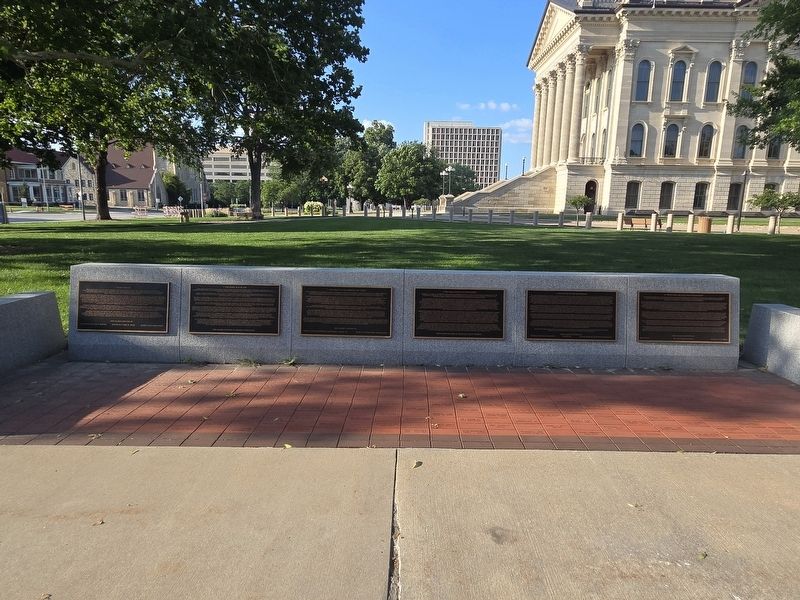
Photographed by Mark Parker, July 4, 2025
2. North wall of the Ad Astra Plaza. Kansa Origins Marker is the far left
West side of the Kansas State Capitol building is in the background.
Erected 2024 by Governor William P. Graves, Honorable Jack H. Brier, Kansas Bar Association. (Marker Number 1.)
Topics. This historical marker is listed in these topic lists: Anthropology & Archaeology • Indigenous Peoples and Communities • Settlements & Settlers.
Location. 39° 2.867′ N, 95° 40.752′ W. Marker is in Topeka, Kansas, in Shawnee County. It is in Downtown. It is on Southwest Harrison Street south of Southwest 9th Street, on the left when traveling south. Tthe marker is on the north wall of the Ad Astra Plaza, southwest of the Kansas State Capitol building. Touch for map. Marker is at or near this postal address: 201 Southwest 8th Avenue, Topeka KS 66626, United States of America. Touch for directions.

Regionally, this marker is in Eastern Kansas. It is also in the American Midwest, in the Corn Belt, on the prairies, and on the Southern Plains. Globally, it is in North America,
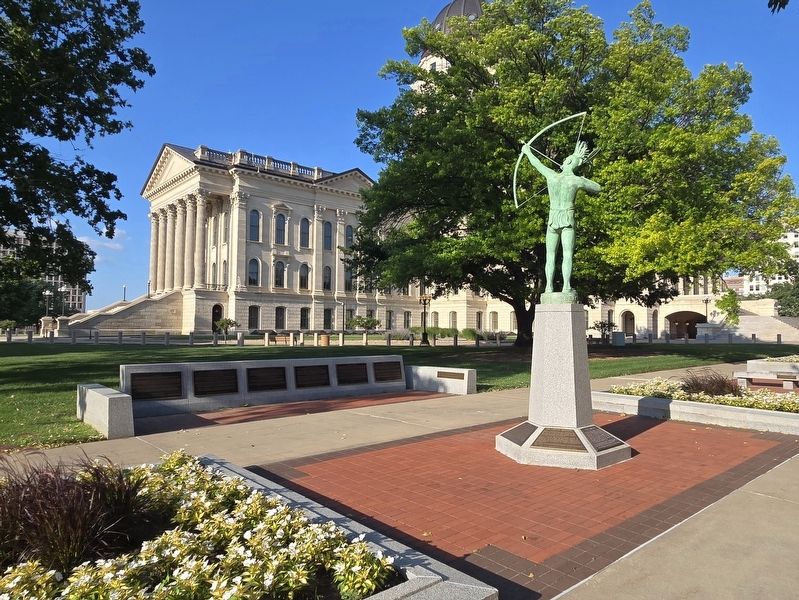
Photographed by Mark Parker, July 4, 2025
3. North side of the Ad Astra Plaza. Statue was placed in 2024
Other nearby markers. At least 8 other markers are within walking distance of this marker: The Kansa Way of Life (here, next to this marker); The Impact of the European Fur Trade (here, next to this marker); The Indian Policy of a New Nation (here, next to this marker); The Failure of the Missionaries (here, next to this marker); "What shall be done with the Kansas?" (here, next to this marker); The Capitol Building (a few steps from this marker); The Governor's Plaque (a few steps from this marker); Kansas Children (a few steps from this marker). Touch for a list and map of all markers in Topeka.
Credits. This page was last revised on October 31, 2025. It was originally submitted on August 21, 2025, by Mark Parker of Hickory, North Carolina. This page has been viewed 199 times since then and 90 times this year. Photos: 1, 2, 3. submitted on August 21, 2025, by Mark Parker of Hickory, North Carolina. • Devry Becker Jones was the editor who published this page.
