Downtown in Topeka in Shawnee County, Kansas — The American Midwest (Upper Plains)
The Kansa Way of Life
| — | Ad Astra Plaza | — |
Photographed by Mark Parker, July 4, 2025
1. The Kansa Way of Life Marker
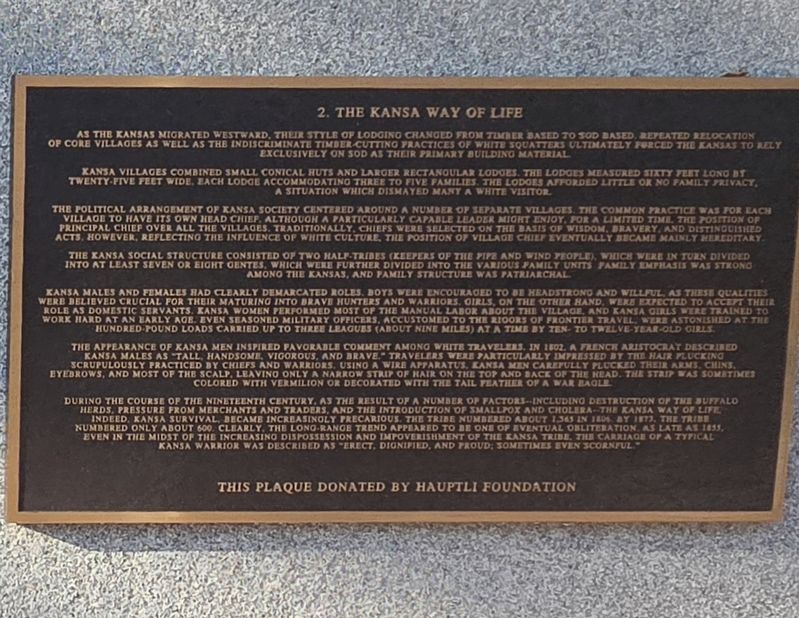
As the Kansas migrated westward, their style of lodging changed from timber based to sod based. Repeated relocation of core villages as well as the indiscriminate timber-cutting practices of white squatters ultimately forced the Kansas to rely exclusively on sod as their primary building material.
Kansa villages combined small conical huts and larger rectangular lodges. The lodges measured sixty feet long by twenty-five feet wide, each lodge accommodating three to five families. The lodges afforded little or no family privacy, a situation which dismayed many a white visitor.
The political arrangement of Kansa society centered around a number of separate villages. The common practice was for each village to have its own head chief, although a particularly capable leader might enjoy, for a limited time, the position of principal chief over all the villages. Rraditionally, chiefs were selected on the basis of wisdom, bravery, and distinguished acts. However, reflecting the influence of white culture, the position of village chief eventually became mainly hereditary.
The Kansa social structure consisted of two half-tribes
this page online
Kansa males and females had clearly demarcated roles. Boys were encouraged to be headstrong and willful, as these qualities were believed crucial for their maturing into brave hunters and warriors. Girls, on the other hand, were expected to accept their role as domestic servants. Kansa women performed most of the manual labor about the village, and Kansa girls were trained to work hard at an early age. Even seasoned military officers, accustomed to the rigors of frontier travel were astonished at the hundred-pound loads carried up to three leagues (about nine miles) at a time by ten-to twelve-year-old girls.
The appearance of Kansa men inspired favorable comment among white travelers. In 1802, a French aristocrat described Kansa males as "tall, handsome, vigorous, and brave." Travelers were particularly impressed by the hair plucking scrupulously practiced by chiefs and warriors. Using a
Photographed by Mark Parker, July 4, 2025
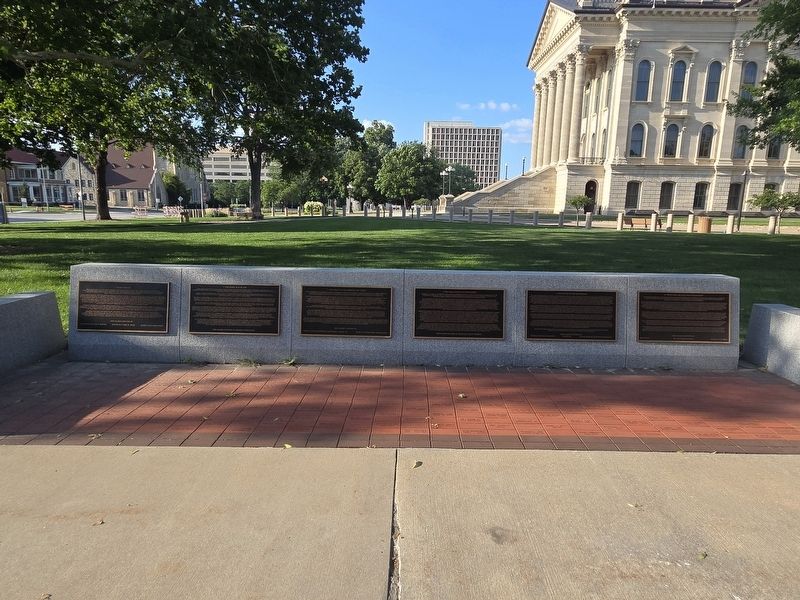
2. North wall of the Ad Astra Plaza. The Kansa Way of Life Marker is 2nd from the left.
West side of the Kansas State Capitol building is in the background.
During the course of the nineteenth century, as the result of a number of factors including destruction of the buffalo herds, pressure from merchants and traders, and the introduction of smallpox and cholera, the Kansa way of life indeed, Kansa survival, became increasingly precarious. The tribe numbered about 1365 in 1806. By 1873, the tribe numbered only about 600. Clearly, the long-range trend appeared to be one of eventual obliteration. As late as 1855, even in the midst of the increasing dispossession and impoverishment of the Kansa tribe, the carriage of a typical Kansa warrior was described as "erect, dignified, and proud; sometimes even scornful."
Erected 2024 by Hauptli Foundation. (Marker Number 2.)
Topics. This historical marker is listed in these topic lists: Anthropology & Archaeology • Indigenous Peoples and Communities. A significant historical year for this entry is 1806.
Location. 39° 2.867′ N,
Photographed by Mark Parker, July 4, 2025
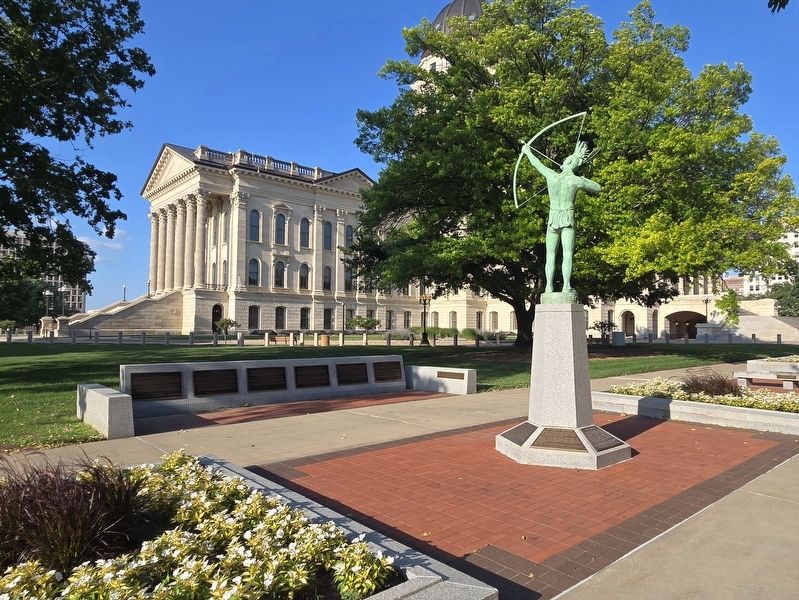
3. North side of the Ad Astra Plaza. Statue was placed in 2024

Regionally, this marker is in Eastern Kansas. It is also in the American Midwest, in the Corn Belt, on the prairies, and on the Southern Plains. Globally, it is in North America, the Western Hemisphere, the Western World, and the Anglosphere. Historically, it finds itself in what was once the Louisiana Purchase.
Other nearby markers. At least 8 other markers are within walking distance of this marker: The Impact of the European Fur Trade (here, next to this marker); Kansa Origins (here, next to this marker); The Indian Policy of a New Nation (here, next to this marker); The Failure of the Missionaries (here, next to this marker); "What shall be done with the Kansas?" (here, next to this marker); The Capitol Building (a few steps from this marker); The Governor's Plaque (a few steps from this marker); Kansas Children (a few steps from this marker). Touch for a list and map of all markers in Topeka.
Credits. This page was last revised on October 31, 2025. It was originally submitted on August 21, 2025, by Mark Parker of Hickory, North Carolina. This page has been viewed 122 times since then and 29 times this year. Photos: 1, 2, 3. submitted on August 21, 2025, by Mark Parker of Hickory, North Carolina. • Devry Becker Jones was the editor who published this page.
