Downtown in Topeka in Shawnee County, Kansas — The American Midwest (Upper Plains)
The Impact of the European Fur Trade
Photographed by Mark Parker, July 4, 2025
1. The Impact of the European Fur Trade Marker
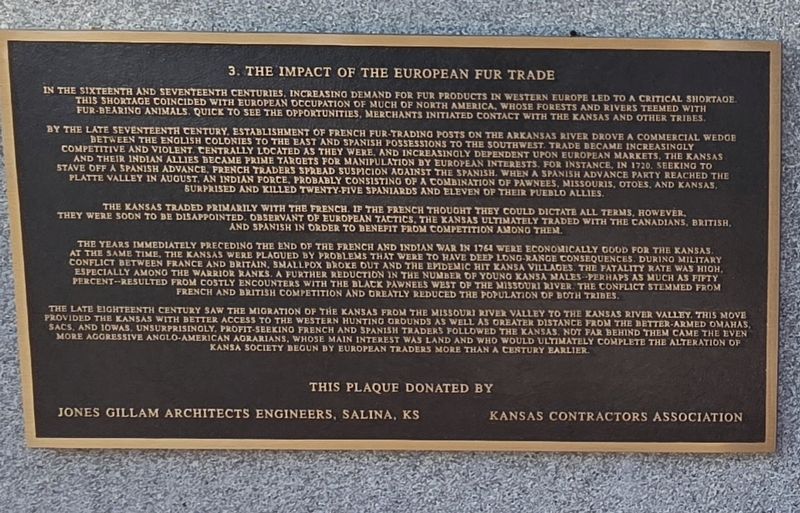
European fur trade in the sixteenth and seventeenth centuries, increasing demand for fur products in western europe led to a critical shortage. This shortage coincided with European occupation of much of North America, whose forests and rivers teemed with fur-bearing animals. Quick to see the opportunities, merchants initiated contact with the Kansas and other tribes.
By the late seventeenth century, establishment of French fur-trading posts on the Arkansas river drove a commercial wedge between the English colonies to the east and Spanish possessions to the southwest. Trade became increasingly competitive and violent centrally located as they were, and increasingly dependent upon european markets, The Kansas and their Indian allies became prime targets for manipulation by European interests. For instance, in 1720, seeking to stave off a Spanish advance, French traders spread suspicion against the Spanish. When a Spanish advance party reached the Platte Valley in August, an Indian force, probably consisting of a combination of Pawnees, Missouris, Otoes, and Kansas, surprised and killed twenty-five Spaniards and eleven
this page online
The Kansas traded primarily with the French. If the French thought they could dictate all terms, however, they were soon to be disappointed. Observant of European tactics, the Kansas ultimately traded with the Canadians, British, and Spanish in order to benefit from competition among them.
The years immediately preceding the end of the French and Indian war in 1764 were economically good for the Kansas. At the same time, the Kansas were plagued by problems that were to have deep long-range consequences. During military conflict between France and Britain, smallpox broke out and the epidemic hit Kansa villages. The fatality rate was high, especially among the warrior ranks. A further reduction in the number of young kansa males — perhaps as much as fifty percent — resulted from costly encounters with the Black Pawnees west of the Missouri River. The conflict stemmed from French and British competition and greatly reduced the population of both tribes.
The late eighteenth century saw the migration of the Kansas from the Missouri River Valley to the Kansas River Valley. This move provided the Kansas with
Photographed by Mark Parker, July 4, 2025
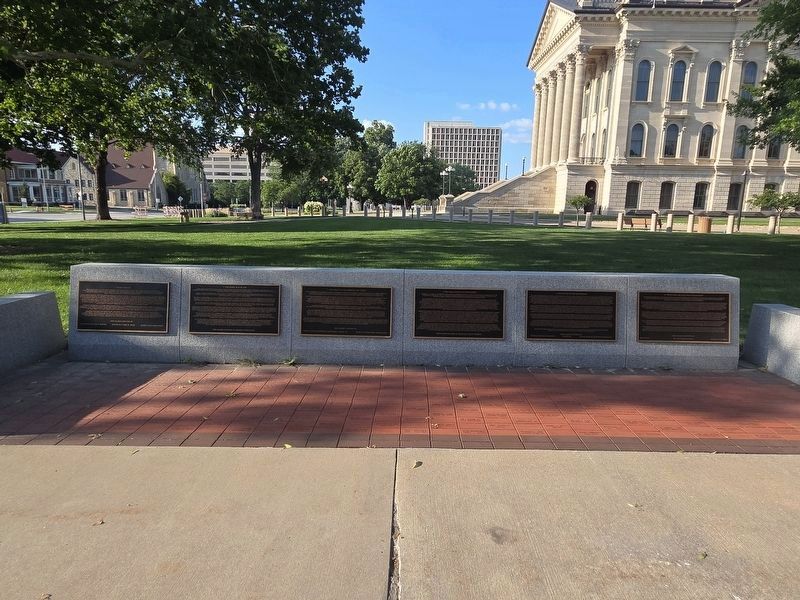
2. North wall of the Ad Astra Plaza. The Impact of the European Fur Trade Marker is 3rd from the left
West side of the Kansas State Capitol building is in the background.
Erected 2024 by Jones Gilliam Architects Engineers, Salina, KS, Kansas Contractors Association. (Marker Number 3.)
Topics. This historical marker is listed in these topic lists: Colonial Era • Exploration • Indigenous Peoples and Communities • Industry & Commerce. A significant historical year for this entry is 1720.
Location. 39° 2.867′ N, 95° 40.75′ W. Marker is in Topeka, Kansas, in Shawnee County. It is in Downtown. It is on Southwest Harrison Street south of Southwest 9th Street, on the left when traveling south. The marker is on the north wall of the Ad Astra Plaza, southwest of the Kansas State Capitol building. Touch for map. Marker is at or near this postal address: 201 Southwest 8th Avenue,
Photographed by Mark Parker, July 4, 2025
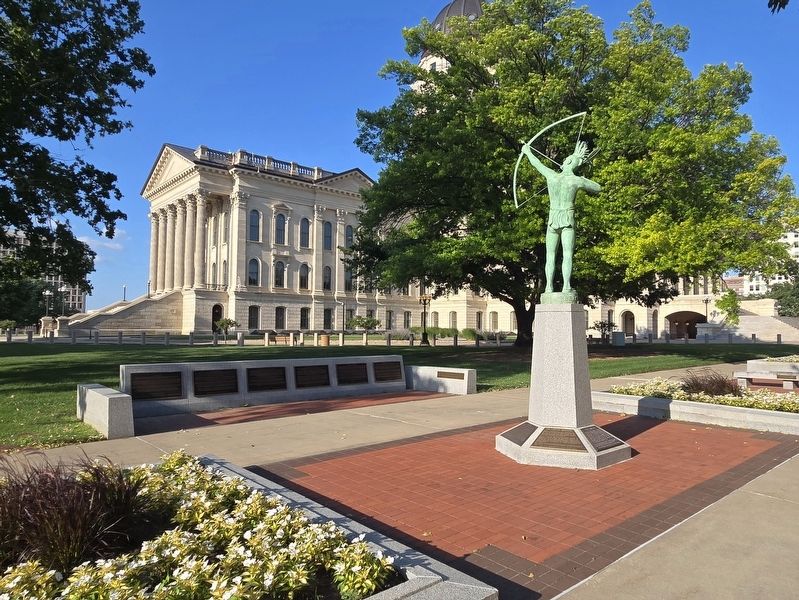
3. North side of the Ad Astra Plaza. Statue was placed in 2024

Regionally, this marker is in Eastern Kansas. It is also in the American Midwest, in the Corn Belt, on the prairies, and on the Southern Plains. Globally, it is in North America, the Western Hemisphere, the Western World, and the Anglosphere. Historically, it finds itself in what was once the Louisiana Purchase.
Other nearby markers. At least 8 other markers are within walking distance of this marker: The Indian Policy of a New Nation (here, next to this marker); The Kansa Way of Life (here, next to this marker); The Failure of the Missionaries (here, next to this marker); Kansa Origins (here, next to this marker); "What shall be done with the Kansas?" (here, next to this marker); The Capitol Building (here, next to this marker); The Governor's Plaque (here, next to this marker); Kansas Children (here, next to this marker). Touch for a list and map of all markers in Topeka.
Credits. This page was last revised on October 31, 2025. It was originally submitted on August 21, 2025, by Mark Parker of Hickory, North Carolina. This page has been viewed 89 times since then and 31 times this year. Photos: 1, 2, 3. submitted on August 21, 2025, by Mark Parker of Hickory, North Carolina. • Devry Becker Jones was the editor who published this page.
