Grandfield in Tillman County, Oklahoma — The American South (West South Central)
Big Pasture
Photographed by Cosmos Mariner, July 4, 2025
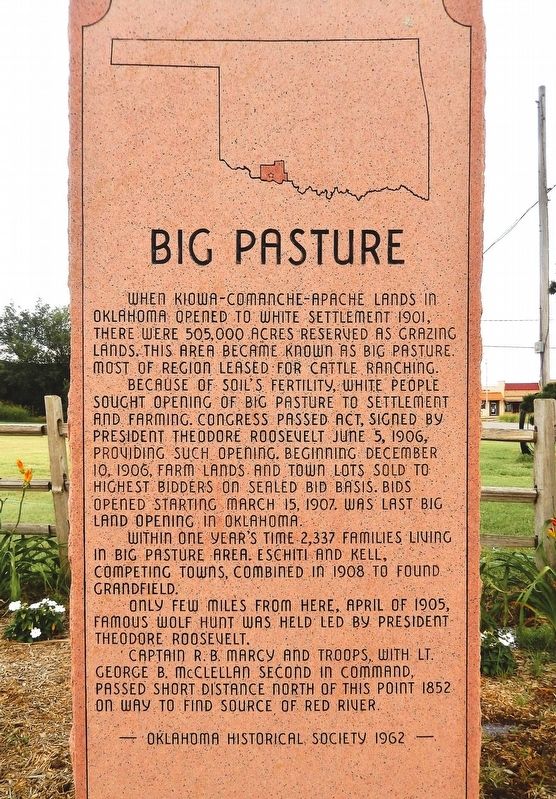
1. Big Pasture Marker
When Kiowa-Comanche-Apache lands in Oklahoma opened to white settlement 1901, there were 505,000 acres reserved as grazing lands. This area became known as Big Pasture. Most of region leased for cattle ranching.
Because of soil’s fertility, white people sought opening of Big Pasture to settlement and farming. Congress passed act, signed by President Theodore Roosevelt June 5, 1906, providing such opening. Beginning December 10, 1906, farm lands and town lots sold to highest bidders on sealed bid basis. Bids opened starting March 15, 1907. Was last big land opening in Oklahoma.
Within one year’s time 2,337 families living in Big Pasture area. Eschiti and Kell, competing towns, combined in 1908 to found Grandfield.
Only few miles from here, April of 1905, famous wolf hunt was held led by President Theodore Roosevelt.
Captain R. B. Marcy and troops, with Lt. George B. McClellan second in command, passed short distance north of this point 1852 on way to find source of Red River.
Erected 1962 by Oklahoma Historical Society.
Topics and series. This historical marker is listed in these topic lists: Agriculture •
this page online
Location. 34° 13.905′ N, 98° 40.994′ W. Marker is in Grandfield, Oklahoma, in Tillman County. It is at the intersection of East 1st Street (U.S. 70) and Main Street, on the left when traveling west on East 1st Street. Touch for map. Marker is in this post office area: Grandfield OK 73546, United States of America. Touch for directions.

Regionally, this marker is in Oklahoma’s Kiowa Tribe, in the Comanche Nation, in the Chickasaw Nation, and in Southwest Oklahoma. It is also in the American South, specifically on the prairies, and on the Southern Plains. Globally, it is in North America, the Western Hemisphere, the Western World, and the Anglosphere. Historically, it finds itself in what was once New Spain, the Comanchería, the territory of the Mississippian Culture, the Dust Bowl, and the Louisiana Purchase.
Other nearby markers. At least 8 other markers are within
Photographed by Cosmos Mariner, July 4, 2025
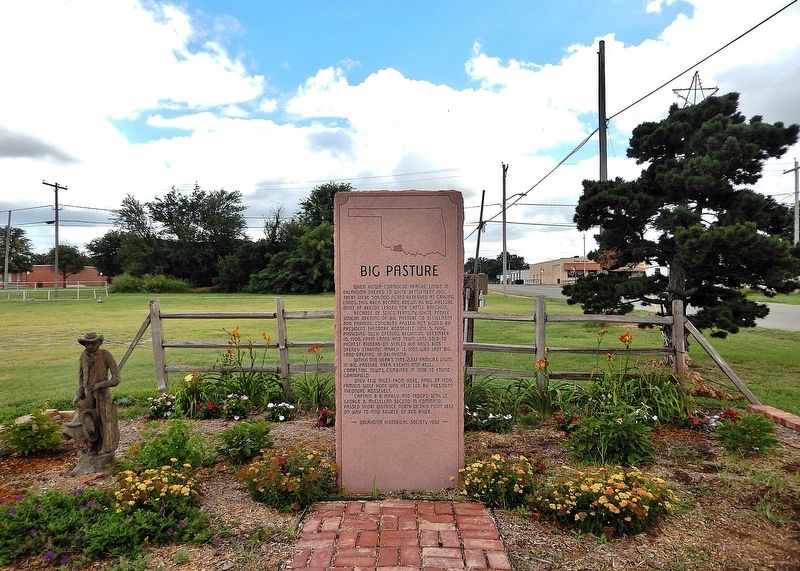
2. Big Pasture Marker
Looking south from Main Street.
Related markers. Click here for a list of markers that are related to this marker.
Also see . . .
1. Big Pasture (Wikipedia).
Excerpt: The land had been reserved for grazing use by the Kiowa, Comanche, and Apache tribes after their reserve was opened for settlement by a lottery conducted during June through August 1901. The tribes, however, leased most of the land out to large ranchers and it became known as Big Pasture. The Big Pasture was maintained for grazing until June 5, 1906, when Congress passed an act (Chapter 2580, 34 Stat. 213) requiring that it be disposed of by allotting 160 acres, in severalty, to each child born into the tribes after the act of 1900. The remaining land was sold by sealed bid in December 1906 and the proceeds placed in the U.S. Treasury for the tribes.(Submitted on August 21, 2025, by Cosmos Mariner of Cape Canaveral, Florida.)
The towns of Randlett, Devol, Grandfield, Loveland, and Hollister (from east to west) are located in what was the Big Pasture.
2. Grandfield, Oklahoma (Wikipedia).
Excerpt: By 1907, Eschiti had an official United States Post Office and Kell City had the railroad. Citizens from both towns were in heated competition for new settlers and businesses moving to the area. To try to settle the differences, Reverend Andrew J. Tant, a Baptist minister and homesteader, went into partnership with Frank Kell and offered free lots to businesses if they would relocate to the Tant farm, which would eventually become Grandfield. Since the Tant farm was only about a mile from Kell City, people willingly moved. Free lots were also promised to all churches and schools. Observers at that time wrote they could look through their windows and see lines of houses being moved.(Submitted on August 21, 2025, by Cosmos Mariner of Cape Canaveral, Florida.)
A committee appealed to the United States Post Office to establish a post office. Assistant Postmaster General Charles P. Grandfield was helpful in granting the request. Consequently, the town was named in his honor. On January 16, 1909, Grandfield citizens voted, almost unanimously, for incorporation, and the post office opened January 21, 1909. In 1910 the population stood at 830. The town's founders and early residents came from a variety of locations, backgrounds, cultures and religions; the States of Kentucky, Tennessee, Kansas, Missouri, Arkansas and Texas were well represented, and a substantial number of newly arrived European immigrants also made their homes in Grandfield.
3. Roosevelt's Wolf Hunt (Encyclopedia of Oklahoma History).
(by Matthew Rex Cox) Excerpt: On April 5, 1905, Roosevelt traveled through Indian Territory on his way to a Rough Riders reunion in San Antonio, Texas, making short speeches at several towns along the railroad between Vinita and Durant. After attending the reunion, Roosevelt returned to Oklahoma Territory, arriving in Frederick on Saturday, April 8. While giving a speech to the thousands gathered to greet him, he noticed Comanche Chief Quanah Parker and called him to the speaker's stand to shake his hand. Immediately after the speech, the hunting party left for the Big Pasture, an area of 480,000 acres of open range in present Tillman, Comanche, and Cotton counties. Members of the party included the president's personal physician, Dr. Alexander Lambert, several former Rough Riders, a number of cattle ranchers, and Quanah Parker.(Submitted on August 22, 2025, by Cosmos Mariner of Cape Canaveral, Florida.)
Credits. This page was last revised on August 22, 2025. It was originally submitted on August 21, 2025, by Cosmos Mariner of Cape Canaveral, Florida. This page has been viewed 198 times since then and 83 times this year. Photos: 1, 2. submitted on August 21, 2025, by Cosmos Mariner of Cape Canaveral, Florida.
