Lauber Hill in Fulton County, Ohio — The American Midwest (Great Lakes)
Lauber Hill Community
⎯⎯⎯
Lauber Hill Meeting House
Photographed by Craig Doda, August 22, 2025
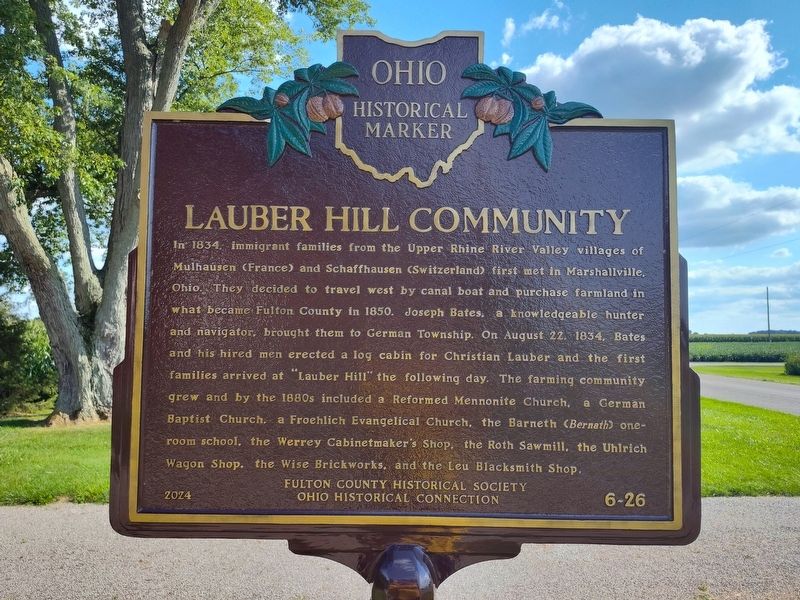
1. Lauber Hill Community Marker
Lauber Hill Community. In 1834, immigrant families from the Upper Rhine River Valley villages of Mulhausen (France) and Schaffhausen (Switzerland) first met in Marshallville, Ohio. They decided to travel west by canal boat and purchase farmland in what became Fulton County in 1850. Joseph Bates, a knowledgeable hunter and navigator, brought them to German Township. On August 22. 1834, Bates and his hired men erected a log cabin for Christian Lauber and the first families arrived at "Lauber Hill" the following day. The farming community grew and by the 1880s included a Reformed Mennonite Church, a German Baptist Church, a Froehlich Evangelical Church, the Barneth (Bernath) one-room school, the Werrey Cabinetmaker's Shop, the Roth Sawmill, the Uhlrich Wagon Shop, the Wise Brickworks, and the Leu Blacksmith Shop.
Lauber Hill Meeting House. Lauber Hill Meeting House and its cemetery are the physical remains of a unique community of Swiss-French-German-Anabaptist immigrants that once flourished in the area. In the fall of 1835, Minister Christian Beck led Alemannic German speaking worship at the Christian Lauber cabin.
this page online
Erected 2024 by Fulton County Historical Society; Ohio Historical Connection. (Marker Number 6-26.)
Topics and series. This historical marker is listed in these topic lists: Cemeteries & Burial Sites • Immigration • Religion & Religious Structures. In addition, it is included in the Ohio Historical Society / The Ohio History Connection series list. A significant historical date for this entry is August 22, 1834.
Location. 41° 34.415′ N, 84° 16.096′ W. Marker is in Lauber Hill, Ohio, in Fulton County. It is at the intersection of County Road 21 and U.S. 21A, on the right when

Photographed by Craig Doda, August 22, 2025
2. Lauber Hill Community - Lauber Hill Meeting House Marker

Regionally, this marker is in Ohio’s Black Swamp and in the Till Plains. It is also in the American Midwest and in the Corn Belt. Globally, it is in North America, the Western Hemisphere, the Western World, and the Anglosphere. Historically, it finds itself in what was once the Haudenosaunee (Iroquois) Confederacy, the territory of the Mississippian Culture, and the Northwest Territory.
Other nearby markers. At least 8 other markers are within 3 miles of this marker, measured as the crow flies: The Wabash Cannonball Trail (approx. 2 miles away); Saint Peter's Catholic Cemetery Veterans Memorial (approx. 2.4 miles away); Caboose (approx. 2.6 miles away); District 16 Schoolhouse (approx. 2.6 miles away); Erie J. Sauder (approx. 2.7 miles away); Peter Stucky's Wagon Shop (approx. 2.7 miles away); This Log House (approx. 2.7 miles away); Community Jail (approx. 2.7 miles away).
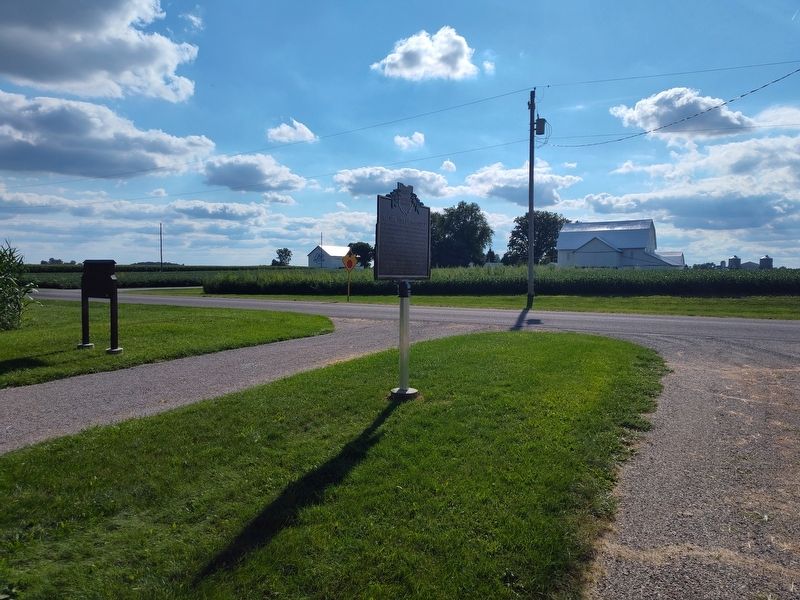
Photographed by Craig Doda, August 22, 2025
3. Lauber Hill Community - Lauber Hill Meeting House Marker
Facing Fulton County's Ohio Bicentennial Barn.

Photographed by Craig Doda, August 22, 2025
4. Lauber Hill Community - Lauber Hill Meeting House Marker

Photographed by Craig Doda, May 31, 2018
5. Lauber Hill Reformed Mennonite Church
Before the Historical Society gained control of the property.
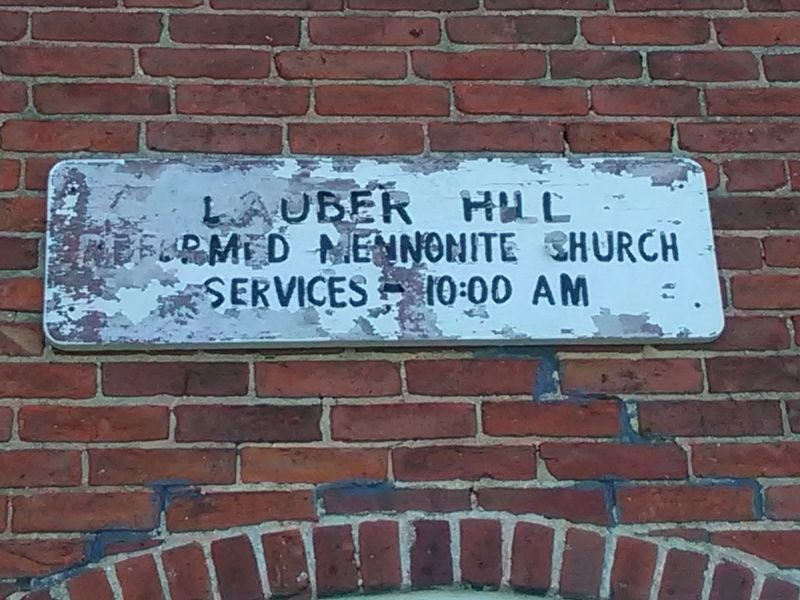
Photographed by Craig Doda, May 31, 2018
6. Lauber Hill Reformed Mennonite Church sign.
It's now been removed. Hopefully being resorted?
Credits. This page was last revised on August 28, 2025. It was originally submitted on August 22, 2025, by Craig Doda of Napoleon, Ohio. This page has been viewed 171 times since then and 98 times this year. Photos: 1, 2, 3, 4, 5, 6. submitted on August 22, 2025, by Craig Doda of Napoleon, Ohio. • Devry Becker Jones was the editor who published this page.
