River Arts District in Asheville in Buncombe County, North Carolina — The American South (South Atlantic)
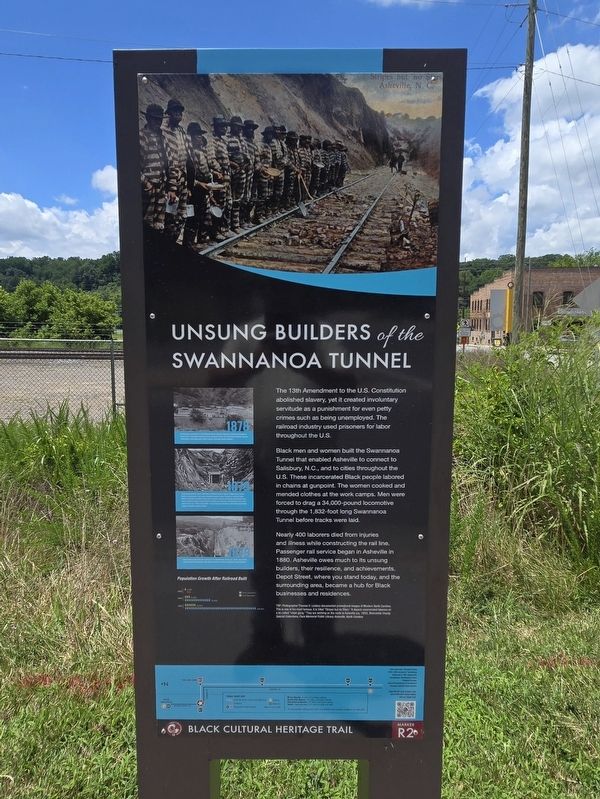
Unsung Builders of the Swannanoa Tunnel
| — | Black Cultural Heritage Trail | — |
Photographed by Mark Parker, July 18, 2025
1. Unsung Builders of the Swannanoa Tunnel Marker
Black men and women built the Swannanoa Tunnel that enabled Asheville to connect to Salisbury, NC, and to cities throughout the U.S. These incarcerated Black people labored in chains at gunpoint. The women cooked and mended clothes at the work camps. Men were forced to drag a 34,000-pound locomotive through the 1,832-foot long Swannanoa Tunnel before tracks were laid.
Nearly 400 laborers died from injuries and illness while constructing the rail line Passenger rail service began in Asheville in 1880. Asheville owes much to its unsung builders, their resilience, and achievements. Depot Street, where you stand today, and the surrounding area, became a hub for Black businesses and residences.
(captions)
Top: Photographer Thomas H. Lindsey documented promotional images of Western North Carolina. This is his most famous. It is titled "Stripes but no Stars". It depicts incarcerated laborers on a so-called "chain gang." They are working on the route to Asheville (ca. 1892) Buncombe County Special Collections Pack Memorial Public Library Asheville North Carolina
[Photo captions on the side are blurred in the photo and unable to be transcribed]
Erected by Black
this page online
Topics. This historical marker is listed in these topic lists: African Americans • Civil Rights • Law Enforcement • Railroads & Streetcars. A significant historical year for this entry is 1878.
Location. 35° 35.069′ N, 82° 33.908′ W. Marker is in Asheville, North Carolina, in Buncombe County. It is in the River Arts District. It is at the intersection of Depot Street and Lyman Street, on the right when traveling south on Depot Street. Touch for map. Marker is at or near this postal address: 270 Depot St, Asheville NC 28801, United States of America. Touch for directions.

Regionally, this marker is in North Carolina’s Mountains. It is also in the American South, specifically in the Upper South, in Appalachia, and specifically in Southern Appalachia. Globally, it is in North America, the Western Hemisphere, the Western World, and the Anglosphere. Historically, it finds itself in what was once the original Cherokee Nation, the territory of the Mississippian Culture, one of the original Thirteen Colonies, one of the Confederate States of America, and the Antebellum
Photographed by Mark Parker, July 18, 2025
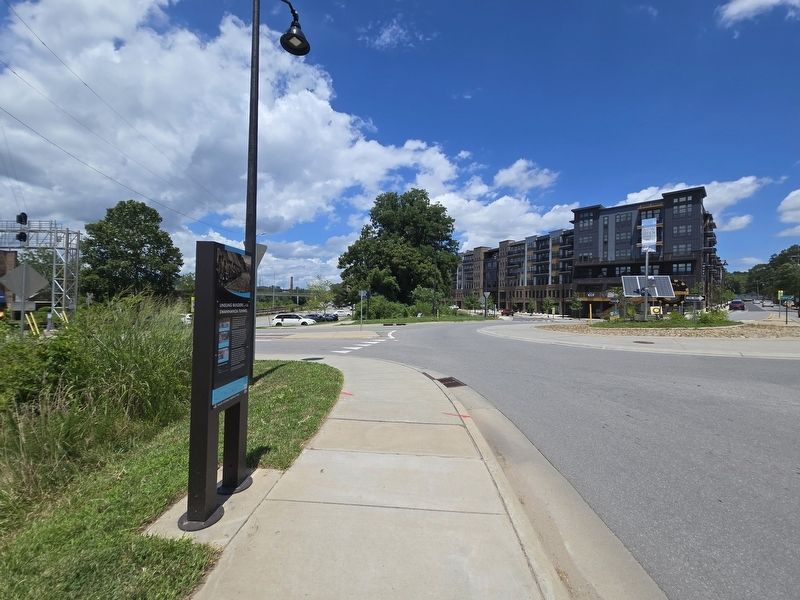
2. Wide view of Unsung Builders of the Swannanoa Tunnel Marker
Located on the Depot Street corner of the adjacent roundabout with Lyman and Roberts Street
Other nearby markers. At least 8 other markers are within walking distance of this marker: The Asheville Black Cultural Heritage Trail / Asheville's Black Newspapers / The Flood of 1916 (about 400 feet away, measured in a direct line); Welcome to the River Arts District (about 500 feet away); America's First Black Union Represents Ashevillians (about 700 feet away); William R. "Seaborn" Saxon (approx. ¼ mile away); Asheville's Southside (approx. 0.3 miles away); Electric Streetcars (approx. 0.4 miles away); Lynching in America / The Lynching of Hezekiah Rankin (approx. half a mile away); The Legacy of E.W. and Annis Pearson in Asheville (approx. 0.7 miles away). Touch for a list and map of all markers in Asheville.
Another marker is no longer nearby. Daniel K. Moore (was approx. 0.6 miles away but has been confirmed missing).
Also see . . .
1. A Musical Tribute to the Lives Lost in the Swannanoa Gap Tunnel.
“Swannanoa Tunnel,” also known as “Asheville Junction” and “Swannanoa Town,” is an American folk song that originated during the late 19th century as a work song. Thousands of incarcerated laborers—most of whom were Black men unjustly arrested under Jim Crow laws put in place as an extension of slavery—labored under deadly conditions to lay track and cut several tunnels through the mountains in the late 1870s. An estimated 125–300 convicts, many of whom were innocent of their crimes or minor offenders, died during the construction of these tunnels. White folklorists and banjo players adapted the song and kept it circulating through the 20th century, obscuring its African American origins.(Submitted on August 23, 2025, by Mark Parker of Hickory, North Carolina.)
2. A Tribute to Those Who Died in the Making of the Swannanoa Gap Tunnel. YouTube recording of "Swannanoa Tunnel" sung by Asheville native Leeda "Lyric" Jones (Submitted on August 23, 2025, by Mark Parker of Hickory, North Carolina.)
Credits. This page was last revised on August 24, 2025. It was originally submitted on August 23, 2025, by Mark Parker of Hickory, North Carolina. This page has been viewed 92 times since then and 11 times this year. Photos: 1, 2. submitted on August 23, 2025, by Mark Parker of Hickory, North Carolina. • Bernard Fisher was the editor who published this page.
