River Arts District in Asheville in Buncombe County, North Carolina — The American South (South Atlantic)
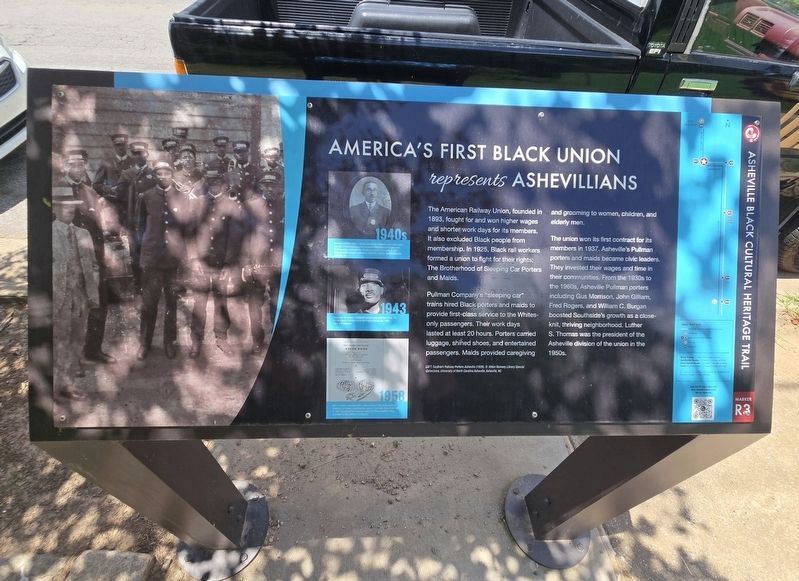
America's First Black Union Represents Ashevillians
| — | Black Cultural Heritage Trail | — |
Photographed by Mark Parker, July 18, 2025
1. America's First Black Union Represents Ashevillians Marker
Pullman Company's "sleeping car" trains hired Black porters and maids to provide first-class service to the White-only passengers. Their work days lasted at least 20 hours. Porters carried luggage, shined shoes, and entertained passengers. Maids provided caregiving and grooming to women, children, and elderly men.
The union won its first contract for its members in 1937. Asheville's Pulman porters and maids became civic leaders. They invested their wages and time in their communities. From the 1930s to the 1960s, Asheville Pullman porters including Gus Morrison, John Gilliam, Fred Rogers, and William C. Burgan boosted Southside's growth as a close-knit, thriving neighborhood. Luther S. Thomas was the president of the Asheville division of the union in the 1950s.
(captions)
1940s: William (Will) C. Burgan worked as a Pullman porter both before and after a collective bargaining agreement that successfully advocated living wages and work conditions for porters and maids. D. Hiden Ramsey Library Special Collections, University of North Carolina Asheville, Asheville, NC
1943: Passenger rail service in Asheville East available until the 1970s. The images shows a Pullman porter working on Chicago (ca. 1943) Library of Congress
Left: Southern Railway Porters, Asheville (1929). D. Hiden Ramsey Library Special Collections, University of North Carolina Asheville, Asheville, NC
[Bottom photo captioned is blurred]
Erected by Black
this page online
Topics. This historical marker is listed in these topic lists: African Americans • Civil Rights • Labor Unions • Railroads & Streetcars. A significant historical year for this entry is 1925.
Location. 35° 34.963′ N, 82° 33.884′ W. Marker is in Asheville, North Carolina, in Buncombe County. It is in the River Arts District. It is on Depot Street 0.1 miles south of Lyman Street, on the left when traveling south. Touch for map. Marker is at or near this postal address: 342-348 Depot St, Asheville NC 28801, United States of America. Touch for directions.

Regionally, this marker is in the Mountains. It is also in the American South, specifically in the Upper South, in Appalachia, and specifically in Southern Appalachia. Globally, it is in North America, the Western Hemisphere, the Western World, and the Anglosphere. Historically, it finds itself in what was once the original Cherokee Nation, the territory of the Mississippian Culture, one of the original Thirteen Colonies, one of the Confederate States of America, and the Antebellum South.
Other nearby markers. At least
Photographed by Mark Parker, July 18, 2025
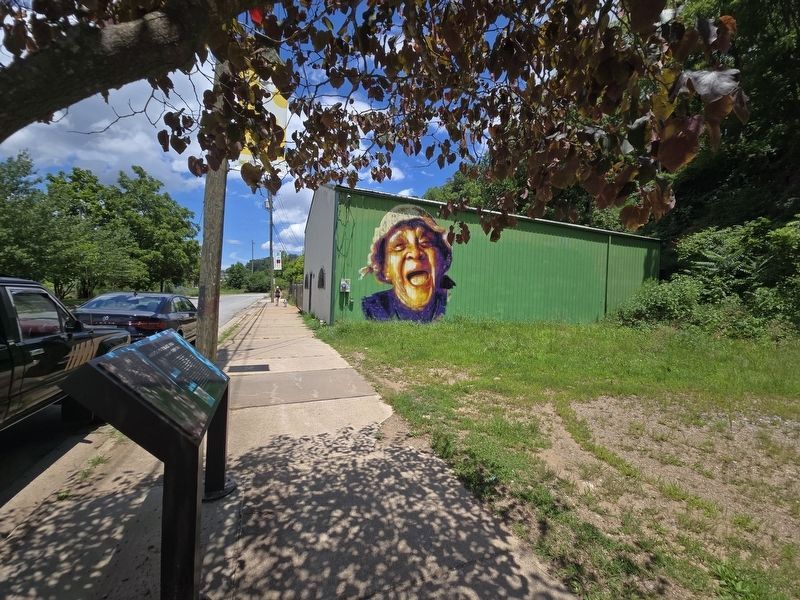
2. America's First Black Union Represents Ashevillians Marker looking north on Depot Street
Pink Dog Creative is in the background
Another marker is no longer nearby. Daniel K. Moore (was approx. 0.7 miles away but has been confirmed missing).

Photographed by Mark Parker, July 18, 2025
3. America's First Black Union Represents Ashevillians Marker looking south on Depot Street
Credits. This page was last revised on August 24, 2025. It was originally submitted on August 23, 2025, by Mark Parker of Hickory, North Carolina. This page has been viewed 110 times since then and 33 times this year. Photos: 1, 2, 3. submitted on August 23, 2025, by Mark Parker of Hickory, North Carolina. • Bernard Fisher was the editor who published this page.
