
Bloomingdale in DuPage County, Illinois — The American Midwest (Great Lakes)
Bloomingdale's Holstein Mill
Photographed by Sean P. Flynn, August 23, 2025
1. Bloomingdale's Holstein Mill Marker
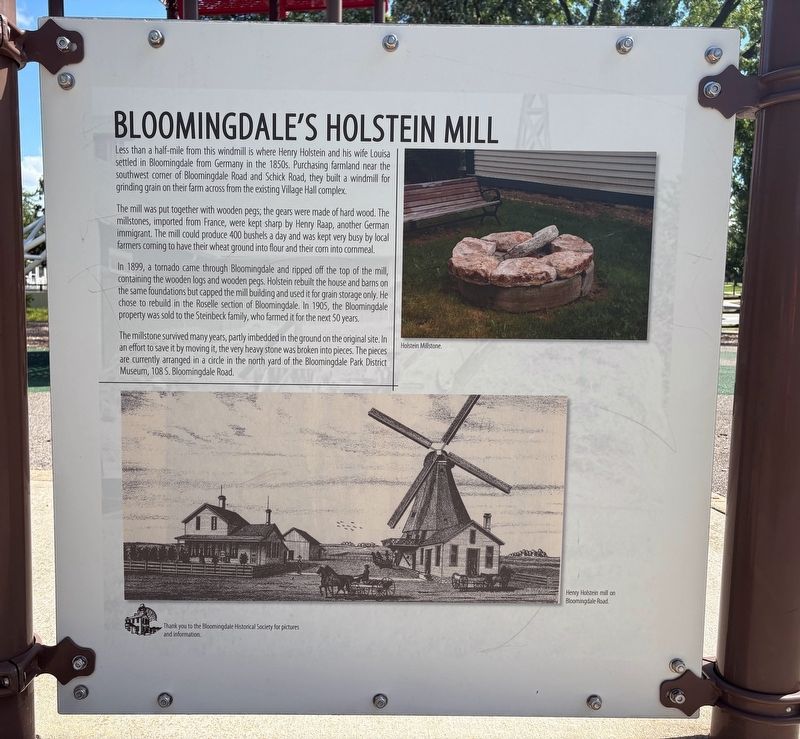
The mill was put together with wooden pegs; the gears were made of hard wood. The millstones, imported from France, were kept sharp by Henry Raap, another German immigrant. The mill could produce 400 bushels a day and was kept very busy by local farmers coming to have their wheat ground into flour and their corn into cornmeal.
In 1899, a tornado came through Bloomingdale and ripped off the top of the mill, containing the wooden logs and wooden pegs. Holstein rebuilt the house and barns on the same foundations but capped the mill building and used it for grain storage only. He chose to rebuild in the Roselle section of Bloomingdale. In 1905, the Bloomingdale property was sold to the Steinbeck family, who farmed it for the next 50 years.
The millstone survived many years, partly imbedded in the ground
this page online
Topics and series. This historical marker is listed in these topic lists: Agriculture • Immigration • Settlements & Settlers. In addition, it is included in the Windmills series list. A significant historical year for this entry is 1850.
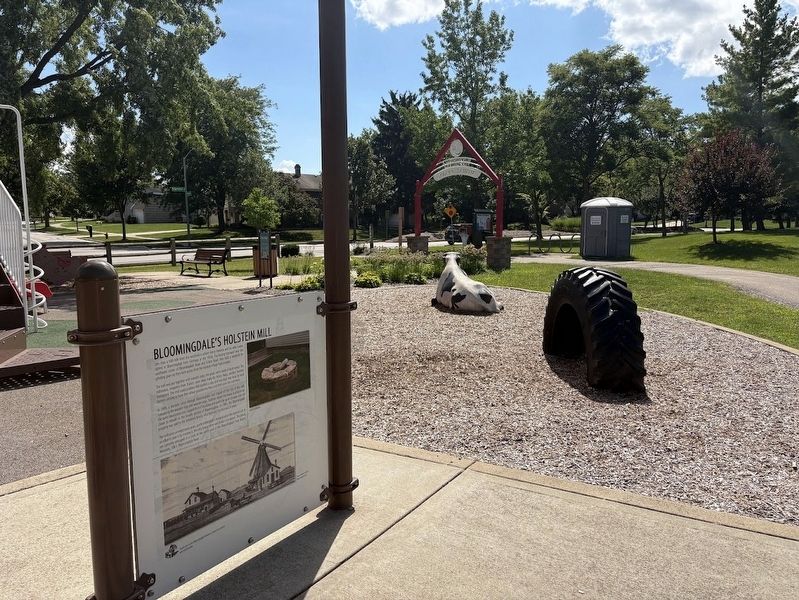
Location. 41° 56.747′ N, 88° 4.514′ W. Marker is in Bloomingdale, Illinois, in DuPage County. It is on Edgewater Drive near Cunningham Lane, on the right when traveling west. The marker is in the playground at Tompkins Park. Touch for map. Marker is in this post office area: Bloomingdale IL 60108, United States of America. Touch for directions.

Regionally, this marker is in Greater Chicago. It is also in the American Midwest and on the Great Lakes. Globally, it is in North America, the Western Hemisphere, the Western World, and the Anglosphere. Historically, it finds itself in what was once the territory of the Mississippian Culture and also the Northwest
Photographed by Sean P. Flynn, August 23, 2025
2. Bloomingdale's Holstein Mill Marker in Tompkins Park.
Other nearby markers. At least 8 other markers are within 3 miles of this marker, measured as the crow flies: Bloomingdale's Farming History (here, next to this marker); Labyrinth Fun Facts (approx. 0.4 miles away); Veterans Memorial (approx. 0.9 miles away); Heaven's Brigade Memorial (approx. 1.1 miles away); Maple Lake Makeover (approx. 1.1 miles away); Ukraine Holodomor Memorial (approx. 1.1 miles away); Holodomor (approx. 1.1 miles away); Roselle-Bochnia Sisters Cities Peace Pole (approx. 2½ miles away). Touch for a list and map of all markers in Bloomingdale.
More about this marker. Another marker about Bloomingdale's agricultural history is on the rear of this one.
Regarding Bloomingdale's Holstein Mill. The Holstein Mill was located on Roselle Road, about three miles north of here, in what is now the village of Roselle.
Also see . . . Henry Holstein and His Grist Mill in Bloomingdale, Illinois. The Digital Research Library of Illinois History Journal shares the history of the Holstein Mill.
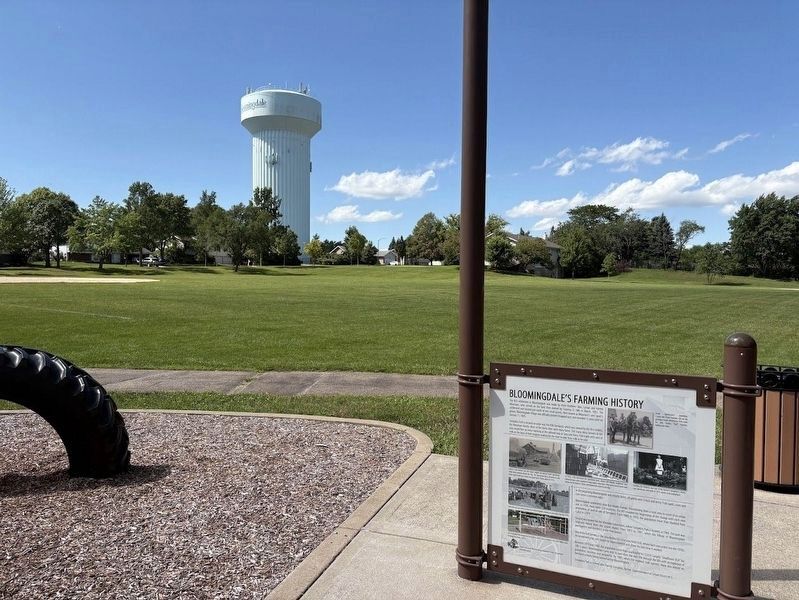
Excerpt: "The mill was one of the largest in the area and designed for large-scale production, built(Submitted on August 25, 2025, by Sean P. Flynn of Oak Park, Illinois.)with a wing building, presumably used for shipping or receiving. It was constructed with a foundation of stone, a wide base, and a self-governing tail fan to turn the cap."Photographed by Sean P. Flynn, August 23, 20253. Tompkins ParkThe Holstein Mill marker is on the rear side of the marker visible in this photo.
Credits. This page was last revised on August 25, 2025. It was originally submitted on August 25, 2025, by Sean P. Flynn of Oak Park, Illinois. This page has been viewed 85 times since then and 24 times this year. Photos: 1, 2. submitted on August 25, 2025, by Sean P. Flynn of Oak Park, Illinois. 3. submitted on August 24, 2025, by Sean P. Flynn of Oak Park, Illinois.
