
Greenville in Hunt County, Texas — The American South (West South Central)
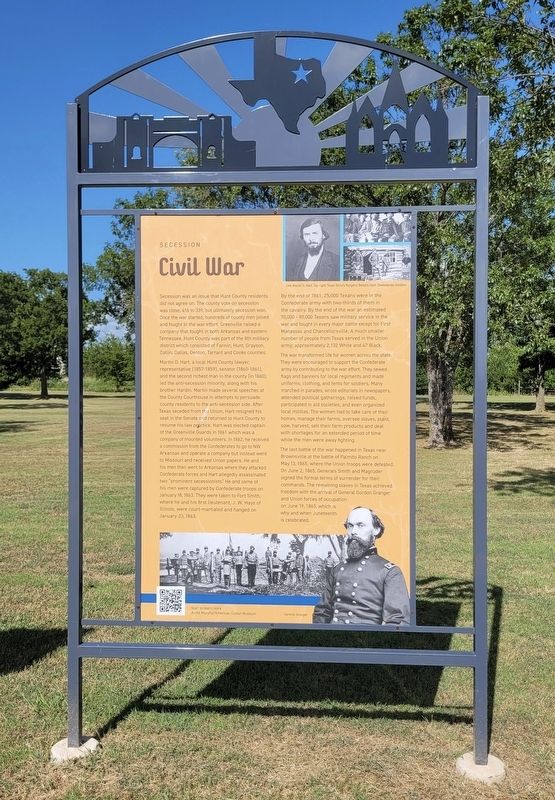
Civil War
Secession
Photographed by James Hulse, July 28, 2025
1. Civil War Marker
this page online
By the end of 1861, 25,000 Texans were in the Confederate army with two-thirds of them in the cavalry. By the end of the war an estimated 70,000-90,000 Texans saw military service in the war and fought in every major battle except for First Manassas and Chancellorsville. A much smaller number of people from Texas served in the Union army; approximately 2,132 White and 47 Black. The war transformed life for women across the state. They were encouraged to support the Confederate army by contributing to the war effort. They sewed flags and banners for local regiments and made uniforms, clothing, and tents for soldiers. Many marched in parades, wrote editorials in newspapers, attended political gatherings, raised funds, participated in aid
Photographed by James Hulse, July 28, 2025
2. Civil War Marker (right side)
Captions
(Photo #1) General Granger
(Photo #2) Left: Martin D. Hart; Top right: Texas Terry's Rangers; Bottom right: Confederate Soldiers
Erected by Audie Murphy / American Cotton Museum.
Topics. This historical marker is listed in these topic lists: African Americans • War, US Civil • Women. A significant historical date for this entry is January 18, 1863.
Location. 33° 7.497′ N, 96° 5.335′ W. Marker is in Greenville, Texas, in Hunt County. It is on Interstate 30 Frontage Road ¼ mile west of Division Street, on the right when traveling west. The marker is located on the grounds of the Audie Murphy / American Cotton Museum. Touch for map. Marker is at or near this postal address: 500 I-30, Greenville TX 75401, United States of America. Touch for directions.

Regionally, this marker is in the Prairies & Lakes Region and in the Dallas-Fort Worth Metropolitan Area. It is also in the American South. Globally, it is in North America, a Gulf of Mexico state, the Western Hemisphere, the Western World, and the Anglosphere. Historically, it finds itself in what was once New Spain, the Republic of Texas, one of the Confederate States of America, and the Antebellum South.
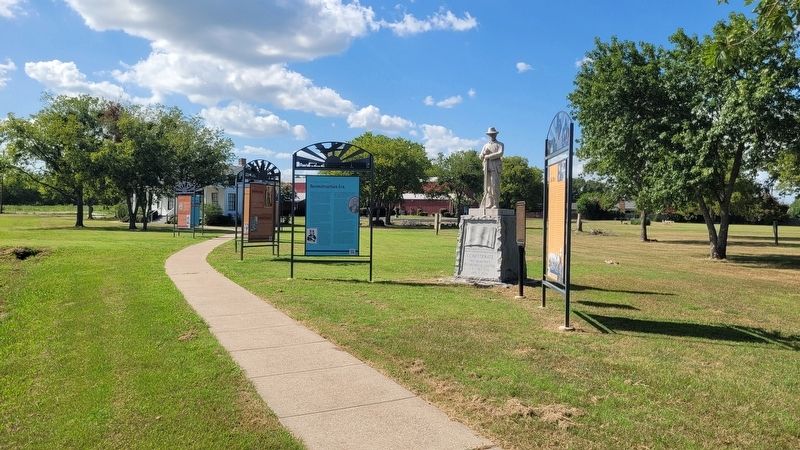
Other nearby markers. At least 8 other markers are within walking distance of this marker: 1926 Confederate Soldier Statue (here, next to this marker); Greenville Confederate Memorial (here, next to this marker); Reconstruction Era (here, next to this marker); Early Twentieth Century (a few steps from this marker); Aztec Eagles (a few steps from this marker); African American Community (within shouting distance of this marker); Black Education (within shouting distance of this marker); Early Industry & Business (within shouting distance of this marker). Touch for a list and map of all markers in Greenville.
Also see . . . Civil War. Audie Murphy / American Cotton Museum (Submitted on August 26, 2025, by James Hulse of Medina, Texas.)
Credits. This page was last revised on August 27, 2025. It was originally submitted on August 26, 2025, by James Hulse of Medina, Texas. This page has been viewed 107 times since then and 41 times this year. Photos: 1, 2. submitted on August 27, 2025, by James Hulse of Medina, Texas.
