
Greenville in Hunt County, Texas — The American South (West South Central)
Early Twentieth Century
Prohibition, First World War, 1920'S
⎯⎯⎯
People
Photographed by James Hulse, July 28, 2025
1. Early Twentieth Century Marker
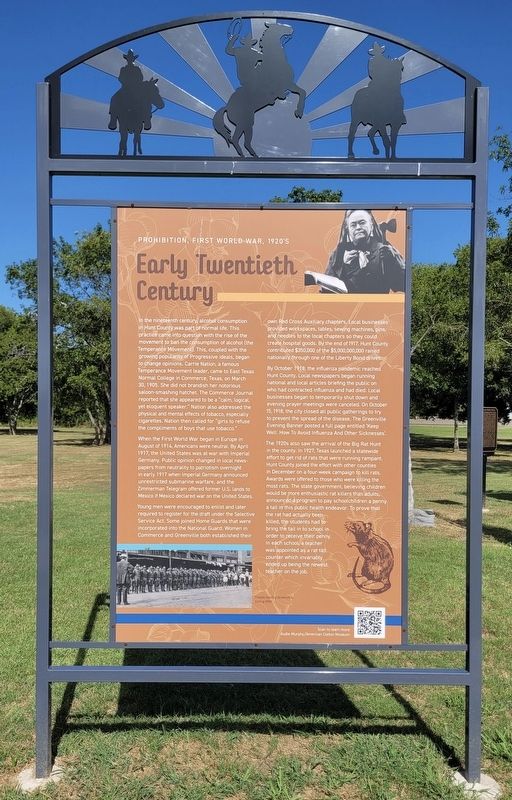
When the First World War began in Europe in August of 1914, Americans were neutral. By April 1917, the United States was at war with Imperial Germany. Public opinion changed in local newspapers from neutrality to patriotism overnight in early 1917 when Imperial Germany announced unrestricted submarine warfare, and the Zimmerman Telegram offered former U.S. lands to Mexico if Mexico declared war on the United States.
Young men were encouraged to enlist and later required to register for the draft under the Selective Service Act. Some joined Home Guards that were incorporated into the National Guard. Women in Commerce and Greenville both established their own Red Cross Auxiliary chapters. Local businesses provided workspaces, tables, sewing machines, pins, and needles to the local chapters so they could create hospital goods. By the end of 1917, Hunt County contributed $350,000 of the $5,000,000,000 raised nationally through one of the Liberty Bond drives.
By October 1918, the influenza pandemic reached Hunt County. Local newspapers began running national and
this page online
The 1920s also saw the arrival of the Big Rat Hunt in the county. In 1927, Texas launched a statewide effort to get rid of rats that were running rampant. Hunt County joined the effort with other counties in December on a four-week campaign to kill rats. Awards were offered to those who were killing the most rats. The state government, believing children would be more enthusiastic rat killers than adults, announced a program to pay schoolchildren a penny a tail in this public health endeavor. To prove that the rat had actually been killed, the students had to bring the tail in to school in order to receive their penny. In each school, a teacher was appointed as a rat tail counter which invariably ended up being the newest teacher on the job.
Captions
(Photo #1) Troops leaving Greenville during WWI
Reverse Side
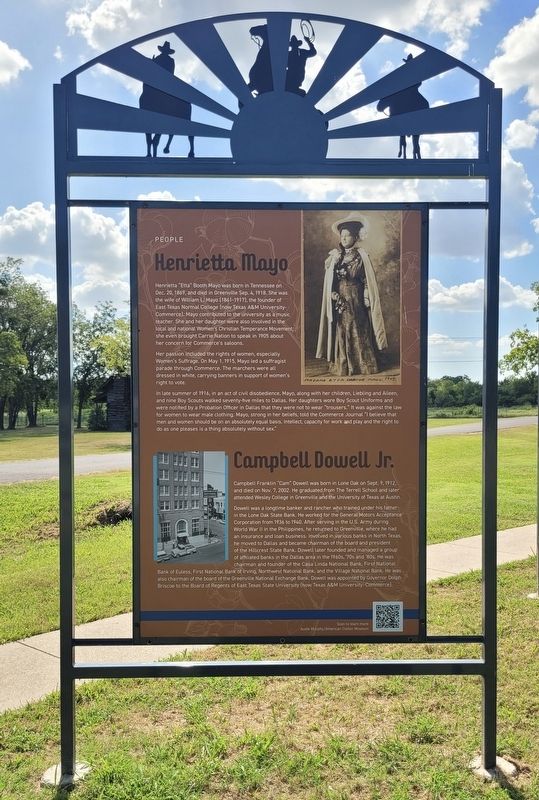
Henrietta Mayo
Henrietta
Photographed by James Hulse, July 28, 2025
2. Early Twentieth Century Marker - Reverse Side
Her passion included the rights of women, especially Women's Suffrage. On May 1, 1915, Mayo led a suffragist parade through Commerce. The marchers were all dressed in white, carrying banners in support of women's right to vote.
In late summer of 1916, in an act of civil disobedience, Mayo, along with her children, Liebling and Aileen, and nine Boy Scouts walked seventy-five miles to Dallas. Her daughters wore Boy Scout Uniforms and were notified by a Probation Officer in Dallas that they were not to wear "trousers." It was against the law for women to wear male clothing. Mayo, strong in her beliefs, told the Commerce Journal "I believe that men and women should be
Photographed by James Hulse, July 28, 2025
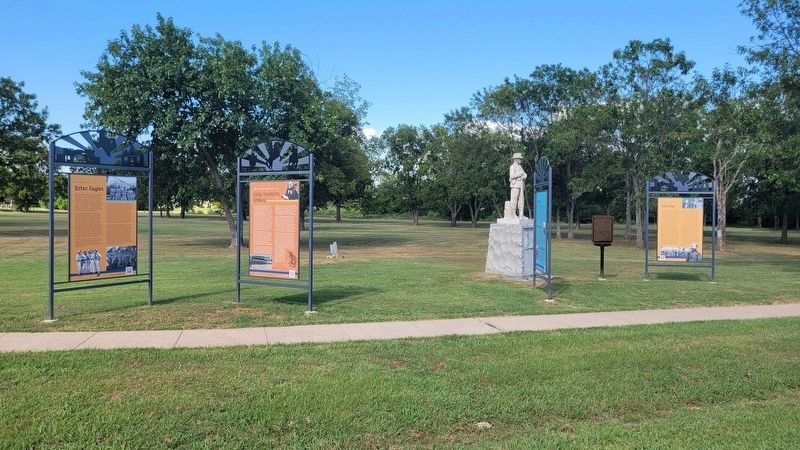
3. The view of the Early Twentieth Century Marker along the trail
The marker is the second marker from the left.
Campbell Dowell Jr.
Campbell Franklin "Cam" Dowell was born in Lone Oak on Sept. 9, 1912, and died on Nov. 7, 2002. He graduated from The Terrell School and later attended Wesley College in Greenville and the University of Texas at Austin.
Dowell was a longtime banker and rancher who trained under his father in the Lone Oak State Bank. He worked for the General Motors Acceptance Corporation from 1936 to 1940. After serving in the U.S. Army during World War II in the Philippines, he returned to Greenville, where he had an insurance and loan business. Involved in various banks in North Texas, he moved to Dallas and became chairman of the board and president of the Hillcrest State Bank. Dowell later founded and managed a group of affiliated banks in the Dallas area in the 1960s, '70s and '80s. He was chairman and founder of the Casa Linda National Bank, First National Bank of Euless, First National Bank of Irving, Northwest National Bank, and the Village National Bank. He was also chairman of
Photographed by James Hulse, July 28, 2025
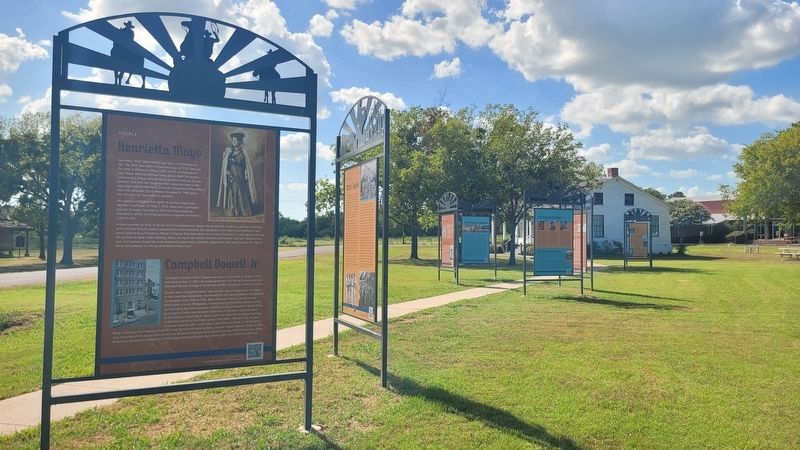
4. Early Twentieth Century Marker - Reverse Side (first marker on right side)
Captions
(Photo #1) Madame Etta Badthe Mayo, 1907.
Erected by Audie Murphy / American Cotton Museum.
Topics. This historical marker is listed in these topic lists: Civil Rights • Industry & Commerce • War, World I • Women. A significant historical date for this entry is March 30, 1905.
Location. 33° 7.501′ N, 96° 5.34′ W. Marker is in Greenville, Texas, in Hunt County. It is on Interstate 30 Frontage Road ¼ mile west of Division Street, on the right when traveling west. The marker is located on the grounds of the Audie Murphy / American Cotton Museum. Touch for map. Marker is at or near this postal address: 600 I-30 Frontage Rd, Greenville TX 75401, United States of America. Touch for directions.

Regionally, this marker is in the Prairies & Lakes Region and in the Dallas-Fort Worth Metropolitan Area. It is also in the American South. Globally, it is in North America, a Gulf of Mexico state, the Western Hemisphere, the Western World, and the Anglosphere. Historically, it finds itself in what was once New Spain, the Republic of Texas, one of the Confederate States of America, and the Antebellum South.
Other nearby markers. At least 8 other markers are within walking distance of this marker: Aztec Eagles (here, next to this marker); Reconstruction Era (here, next to this marker); Greenville Confederate Memorial (here, next to this marker); 1926 Confederate Soldier Statue (a few steps from this marker); Civil War (a few steps from this marker); African American Community (a few steps from this marker); Black Education (a few steps from this marker); Early Industry & Business (a few steps from this marker). Touch for a list and map of all markers in Greenville.
Also see . . .
1. Early Twentieth Century. Audie Murphy / American Cotton Museum (Submitted on August 26, 2025, by James Hulse of Medina, Texas.)
2. Henrietta Mayo And Campbell Dowell. Audie Murphy / American Cotton Museum (Submitted on August 26, 2025, by James Hulse of Medina, Texas.)
Credits. This page was last revised on August 27, 2025. It was originally submitted on August 26, 2025, by James Hulse of Medina, Texas. This page has been viewed 113 times since then and 31 times this year. Photos: 1, 2, 3, 4. submitted on August 27, 2025, by James Hulse of Medina, Texas.
