Greenville in Hunt County, Texas — The American South (West South Central)
Early Industry & Business
New Beginnings
⎯⎯⎯
Ahead Of Their Time
Photographed by James Hulse, July 28, 2025
1. Early Industry & Business Marker
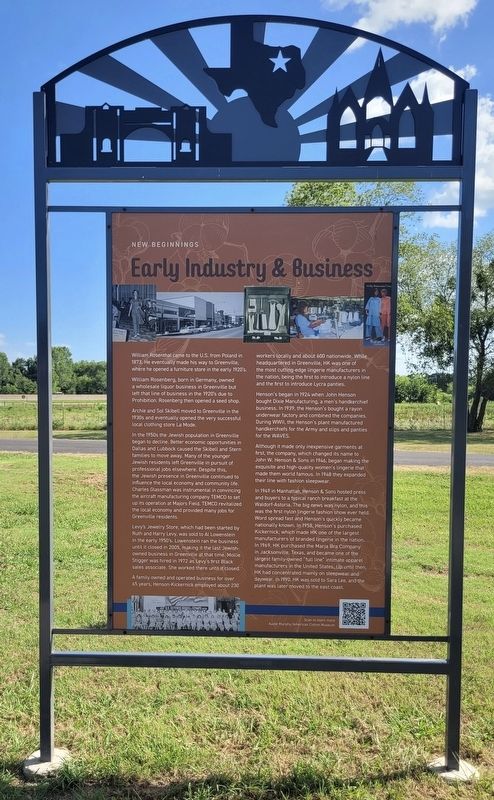
William Rosenberg, born in Germany, owned a wholesale liquor business in Greenville but left that line of business in the 1920's due to Prohibition. Rosenberg then opened a seed shop.
Archie and Sol Skibell moved to Greenville in the 1930s and eventually opened the very successful local clothing store La Mode.
In the 1950s the Jewish population in Greenville began to decline. Better economic opportunities in Dallas and Lubbock caused the Skibell and Stern families to move away. Many of the younger Jewish residents left Greenville in pursuit of professional jobs elsewhere. Despite this, the Jewish presence in Greenville continued to influence the local economy and community life. Charles Glassman was instrumental in convincing the aircraft manufacturing company TEMCO to set up its operation at Majors Field. TEMCO revitalized the local economy and provided many jobs for Greenville residents.
Levy's Jewelry Store, which had been started by Ruth and Harry Levy, was sold to Al Lowenstein in the early 1950's. Lowenstein ran the business until it closed in 2005, making it the last Jewish-owned business in Greenville at that time. Mollie Stigger was hired in 1972 as Levy's first Black sales associate. She worked there until it closed.
A family owned and operated business for over 65 years, Henson-Kickernick employed about 230 workers locally and about 600 nationwide. While headquartered in Greenville, HK was one of the most cutting-edge lingerie manufacturers in the nation, being the first to introduce a nylon line and the first to introduce Lycra panties.
Henson's began in 1924 when John Henson bought Dixie Manufacturing, a men's handkerchief business.
this page online
Although it made only inexpensive garments at first, the company, which changed its name to John W. Henson & Sons in 1946, began making the exquisite and high-quality women's lingerie that made them world famous. In 1948 they expanded their line with fashion sleepwear.
In 1949 in Manhattan, Henson & Sons hosted press and buyers to a typical ranch breakfast at the Waldorf-Astoria. The big news was nylon, and this was the first nylon lingerie fashion show ever held. Word spread fast and Henson's quickly became nationally known. In 1958, Henson's purchased Kickernick; which made HK one of the largest manufacturers of branded lingerie in the nation. In 1969, HK purchased the Marja Bra Company in Jacksonville, Texas, and became one of the largest family-owned "full line" intimate apparel manufacturers in the United States. Up until then, HK had concentrated mainly on sleepwear and daywear. In 1990, HK was sold to Sara Lee, and the plant was later
Photographed by James Hulse, July 28, 2025
2. Early Industry & Business Marker - Reverse Side
Reverse Side
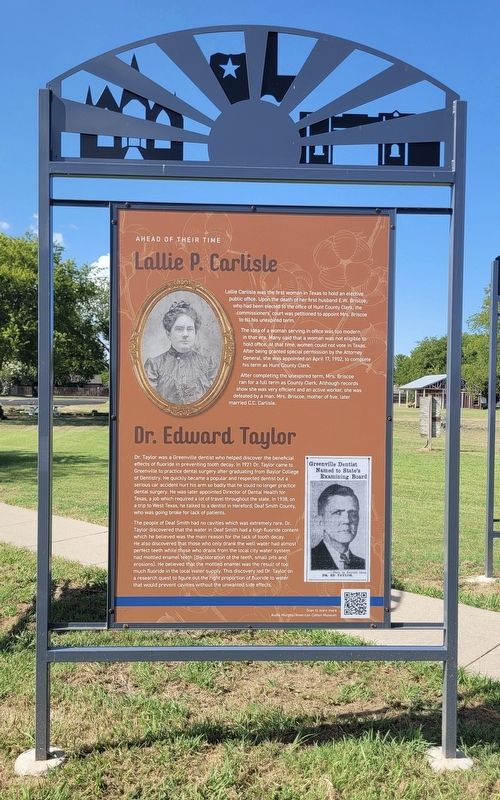
Lallie P. Carlisle
Lallie Carlisle was the first woman in Texas to hold an elective public office. Upon the death of her first husband E.W. Briscoe, who had been elected to the office of Hunt County Clerk, the commissioners' court was petitioned to appoint Mrs. Briscoe to fill his unexpired term.
The idea of a woman serving in office was too modern in that era. Many said that a woman was not eligible to hold office. At that time, women could not vote in Texas. After being granted special permission by the Attorney General, she was appointed on April 17, 1902, to complete his term as Hunt County Clerk.
After completing the unexpired term, Mrs. Briscoe ran for a full term as County Clerk. Although records show she was very efficient and an active worker, she was defeated by a man. Mrs. Briscoe, mother of five, later married C.C. Carlisle.
Dr. Edward Taylor
Dr. Taylor was a Greenville dentist who helped discover the beneficial effects of fluoride in preventing tooth decay. In 1921 Dr. Taylor came to Greenville to practice dental surgery after graduating from Baylor College of Dentistry.
Photographed by James Hulse, July 28, 2025
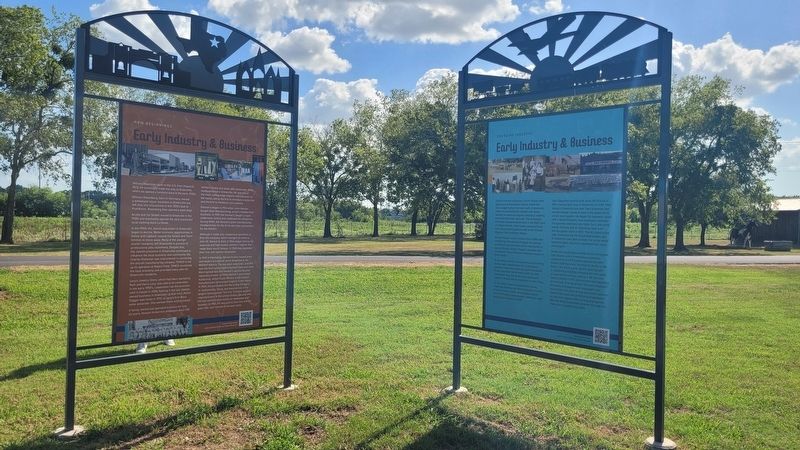
3. Early Industry & Business Marker (left side)
The people of Deaf Smith had no cavities which was extremely rare. Dr. Taylor discovered that the water in Deaf Smith had a high fluoride content which he believed was the main reason for the lack of tooth decay. He also discovered that those who only drank the well water had almost perfect teeth while those who drank from the local city water system had mottled enamel teeth (discoloration of the teeth, small pits and erosions). He believed that the mottled enamel was the result of too much fluoride in the local water supply. This discovery led Dr. Taylor on a research quest to figure out the right proportion of fluoride to water that would prevent cavities without the unwanted side effects.
Erected by Audie Murphy / American Cotton Museum.
Photographed by James Hulse, July 28, 2025
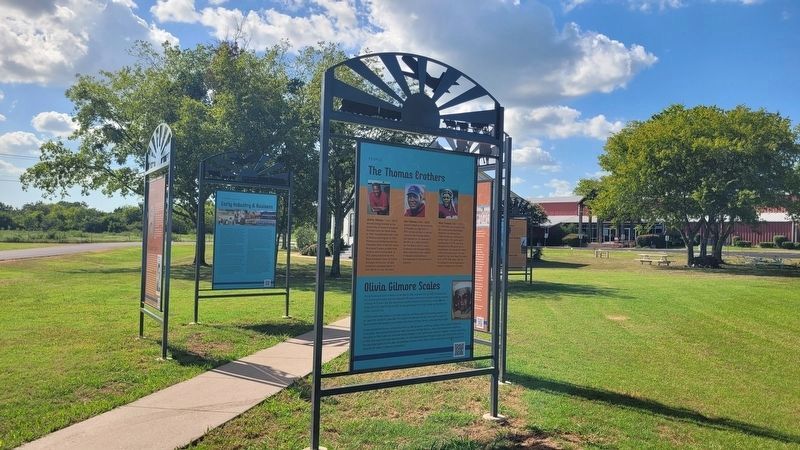
4. Early Industry & Business Marker - Reverse Side
The marker is the first marker on the left side of the markers.
Topics. This historical marker is listed in these topic lists: Industry & Commerce • Science & Medicine • Women. A significant historical date for this entry is April 17, 1902.
Location. 33° 7.51′ N, 96° 5.351′ W. Marker is in Greenville, Texas, in Hunt County. It is on Interstate 30 Frontage Road ¼ mile west of Division Street, on the right when traveling west. The marker is located on the grounds of the Audie Murphy / American Cotton Museum. Touch for map. Marker is at or near this postal address: 600 I-30 Frontage Rd, Greenville TX 75401, United States of America. Touch for directions.

Regionally, this marker is in the Prairies & Lakes Region and in the Dallas-Fort Worth Metropolitan Area. It is also in the American South. Globally, it is in North America, a Gulf of Mexico state, the Western Hemisphere, the Western World, and the Anglosphere. Historically, it finds itself in what was once New Spain, the Republic of Texas, one of the Confederate States of America, and the Antebellum South.
Other nearby markers. At least 8 other markers are within walking distance of this marker: A different marker also named Early Industry & Business (here, next to this marker); Black Education (here, next to this marker); African American Community (a few steps from this marker); Sports (a few steps from this marker); The Sixties (a few steps from this marker); Aztec Eagles (a few steps from this marker); Early Twentieth Century (a few steps from this marker); Reconstruction Era (within shouting distance of this marker). Touch for a list and map of all markers in Greenville.
Also see . . .
1. Early Industry And Business Part Two. Audie Murphy / American Cotton Museum (Submitted on August 26, 2025, by James Hulse of Medina, Texas.)
2. Ahead Of Their Time. Audie Murphy / American Cotton Museum (Submitted on August 26, 2025, by James Hulse of Medina, Texas.)
Credits. This page was last revised on August 28, 2025. It was originally submitted on August 26, 2025, by James Hulse of Medina, Texas. This page has been viewed 89 times since then and 32 times this year. Photos: 1, 2, 3, 4. submitted on August 28, 2025, by James Hulse of Medina, Texas.
