Staunton, Virginia — The American South (Mid-Atlantic)
Digging Into The Past
| — | The Long Road To Freedom | — |
Photographed by Bradley Owen, July 21, 2025
1. Digging Into The Past Marker
"Impressive plantation-era archaeological evidence has been documented..."
- Dr. Dennis Blanton, James Madison University archaeologist
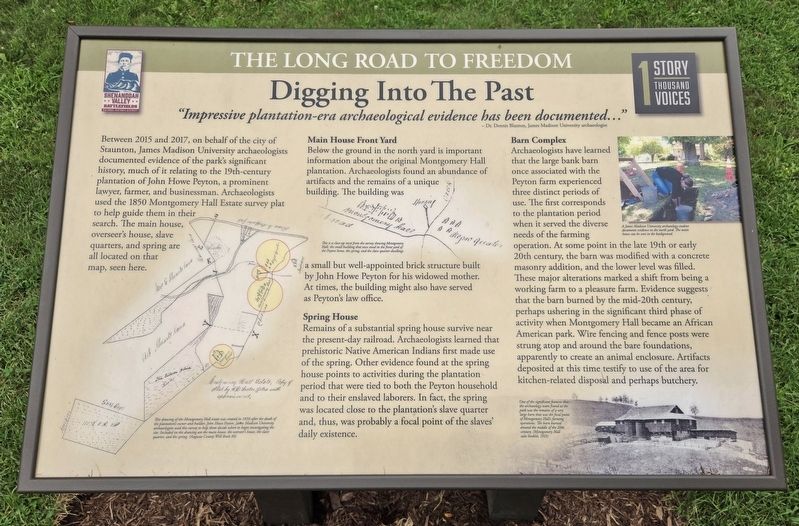
Between 2015 and 2017, on behalf of the city of Staunton, James Madison University archaeologists documented evidence of the park's significant history, much of it relating to the 19th-century plantation of John Howe Peyton, a prominent lawyer, farmer, and businessman. Archaeologists used the 1850 Montgomery Hall Estate survey plat to help guide them in their search. The main house, overseer's house, slave quarters, and spring are all located on that map, seen here.
Main House Front Yard
Below the ground in the north yard is important information about the original Montgomery Hall plantation. Archaeologists found an abundance of artifacts and the remains of a unique building. The building was a small but well-appointed brick structure built by John Howe Peyton for his widowed mother. At times, the building might also have served as Peyton's law office.
Spring House
Remains of a substantial spring house survive near the present-day railroad. Archaeologists learned that
this page online
Barn Complex
Archaeologists have learned that the large bank barn once associated with the Peyton farm experienced three distinct periods of use. The first corresponds to the plantation period when it served the diverse needs of the farming operation. At some point in the late 19th or early 20th century, the barn was modified with a concrete masonry addition, and the lower level was filled. These major alterations marked a shift from being a working farm to a pleasure farm. Evidence suggests that the barn burned by the mid-20th century, perhaps ushering in the significant third phase of activity when Montgomery Hall became an African American park. Wire fencing and fence posts were strung atop and around the bare foundations, apparently to create an animal enclosure.
Photographed by Bradley Owen, July 21, 2025
2. Digging Into The Past Marker
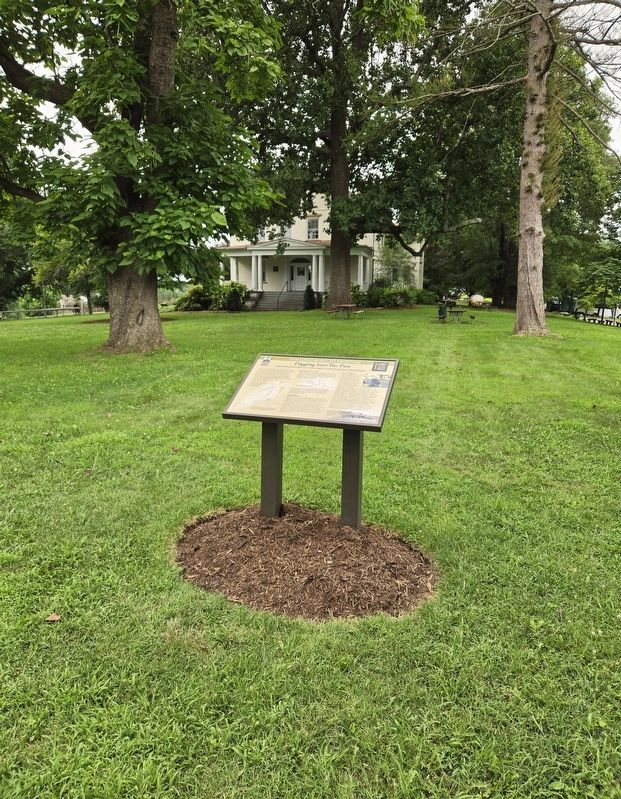
Montgomery Hall can be seen in the background.
(Captions):
This drawing of the Montgomery Hall estate was created in 1850 after the death of the plantation's owner and builder, John Howe Peyton. James Madison University archaeologists used this survey to help them decide where to begin investigating the site. Included on the drawing are the main house, the overseer's house, the slave quarter, and the spring. (Augusta County Will Book 30)
This is a close-up inset from the survey showing Montgomery Hall, the small building that once stood in the front yard of the Peyton home, the spring, and the slave quarter dwellings.
A James Madison University archaeology student documents evidence in the north yard. The main house can be seen in the background.
One of the significant features that the archaeology team found at the park was the remains of a very large barn that was the focal point of Montgomery Hall's farming operations. The barn burned around the middle of the 20th century. (Montgomery Hall sales booklet, 1913)
Erected 2025 by Shenandoah Valley Battlefields Foundation. (Marker Number 11.)
Topics. This historical marker is listed in these topic lists: African Americans • Agriculture • Anthropology & Archaeology • Notable Places. A significant historical year for this entry is 2015.
Location. 38° 8.767′ N, 79° 5.491′ W. Marker is in Staunton, Virginia. It can be reached from Kenneth Jones Drive 0.1 miles west of Montgomery Avenue, on the left when traveling west. Marker is located in Montgomery Hall Park. Touch for map. Marker is at or near this postal address: 1100 Montgomery Avenue, Staunton VA 24401, United States of America. Touch for directions.

Regionally, this marker is in the Shenandoah Valley. It is also in the American South and specifically in the Upper South. Globally, it is in North America, the Western Hemisphere, the Western World, and the Anglosphere. Historically, it finds itself in what was once the territory of the Mississippian Culture, one of the original Thirteen Colonies, one of the Confederate States of America, and the Antebellum South.
Other nearby markers. At least 8 other markers are within walking distance of this marker: Montgomery Hall Park Today (within shouting distance of this marker); The Montgomery Hall Park Recreation Committee (within shouting distance of this marker); A Beacon of Light Across Virginia (within shouting distance of this marker); A Bowling Alley and a Swimming Pool (within shouting distance of this marker); Farming and Freedom at Montgomery Hall (within shouting distance of this marker); Montgomery Hall (about 300 feet away, measured in a direct line); A Mansion in the New Republic: (about 300 feet away); Held in Bondage (about 300 feet away). Touch for a list and map of all markers in Staunton.
Credits. This page was last revised on August 30, 2025. It was originally submitted on August 27, 2025, by Bradley Owen of Morgantown, West Virginia. This page has been viewed 100 times since then and 25 times this year. Photos: 1, 2. submitted on August 30, 2025, by Bradley Owen of Morgantown, West Virginia.
