South Slope Brewing District in Asheville in Buncombe County, North Carolina — The American South (South Atlantic)
Black Doctors, Nurses, and Hospitals
⎯⎯⎯
Robert McMorris and Wendell Charles Blair, Sr.
The Asheville Black Cultural Heritage Trail
| — | Black Cultural Heritage Trail | — |
Photographed by Mark Parker, July 18, 2025
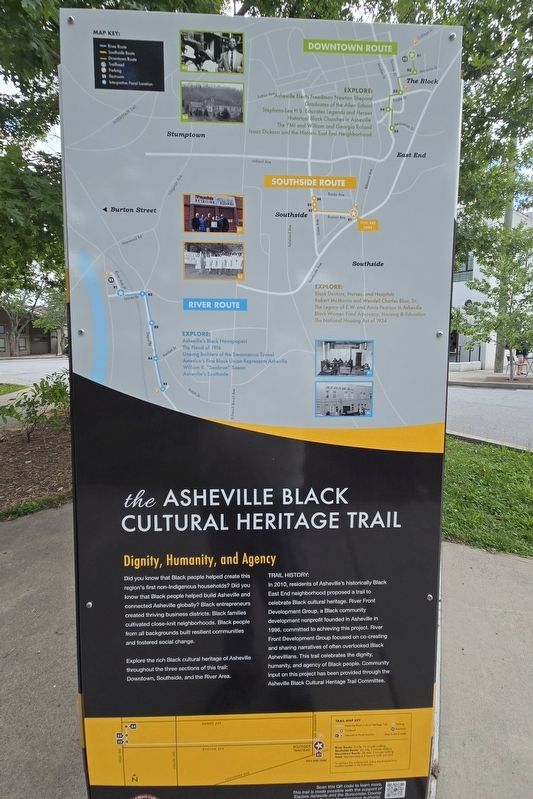
1. The Asheville Black Cultural Heritage Trail side of marker
The Asheville Black Cultural Heritage Trail
Dignity, Humanity, and Agency
Did you know that Black people helped create this region's first non-Indigenous households? Did you know that Black people helped build Asheville and connected Asheville globally? Black entrepreneurs created thriving business districts: Black families cultivated close-knit neighborhoods. Black people from all backgrounds built resilient communities and fostered social change.
Explore the rich Black cultural heritage of Asheville throughout the three sections of this trail: Downtown, Southside, and the River Area.
Trail History:
In 2010, residents of Asheville's historically Black East End neighborhood proposed a trail to celebrate Black cultural heritage. River Front Development Group, a Black community development nonprofit founded in Asheville in 1996, committed to achieving this project. River Front Development Group focused on co-creating and sharing narratives of often overlooked Black Ashevillians. This trail celebrates the dignity, humanity, and agency of Black people. Community input on this project has been provided through the Asheville Black Cultural Heritage Trail Committee.
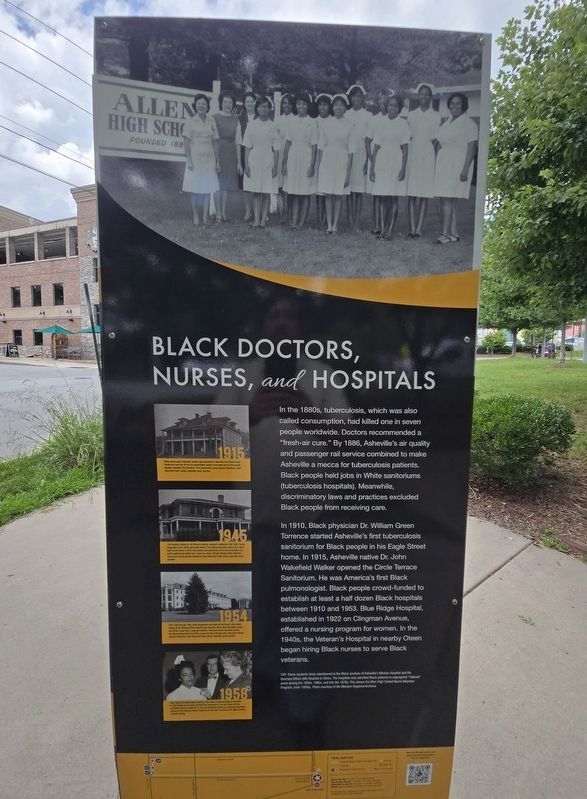
Black Doctors, Nurses, and Hospitals
In the 1880s, tuberculosis, which was also called consumption, had killed one in seven people worldwide. Doctors recommended a "fresh-air cure.” By 1886, Asheville's air quality and passenger rail service combined to make Asheville a mecca for tuberculosis patients. Black people held jobs in White sanitoriums (tuberculosis hospitals). Meanwhile, discriminatory laws and practices excluded Black people from receiving care.
In 1910, Black physician Dr. William Green Torrence started Asheville's first tuberculosis sanitorium for Black people in his Eagle Street home. In 1915, Asheville native Dr. John
this page online
(captions)
Top: These students likely volunteered in the Black sections or Asheville's Mission Hospital and the Veterans Affairs (VA) Hospital in Oteen. The hospitals only admitted Black patients to segregated "Colored" areas during the 1950s, 1960s, and into the 1970s. This shows the Allen High School Nurse Volunteer Program, (mid-1950s). Photo courtesy of the Western Regional Archives
1915 While tuberculosis treatment centers were abundant in Asheville, the Circle Terrace Sanitorium was one of the only places Black people could seek care for this deadly disease. Directory, 1915, Buncombe County Special Collections, Pack Memorial Public Library, Asheville, North Carolina
1945 This hospital at 186 Biltmore Avenue, open for patients in Fall 1943. During integration in the 1950s, the facility closed. The building was taken over by the Jesse Ray funeral home. In 2015, the building was destroyed, and is now the location of a public parking area visible from where you stand. Richard Hensley State Collection, Buncombe County Special Collections, Pack Memorial Public Library, Asheville, North Carolina
1954 From 1896 through 1964, racial segregation was legal and enforced in the United States. At the Veterans Affairs Hospital near Asheville, that meant Black and White nurses lived in separate facilities. This photo shows the Black nurses dormitory (background) and White nurses dormitory (foreground). Buncombe County Special Collections, Pack Memorial Public Library, Asheville, North Carolina
1958 Mary Roberts McMillan (left) receiving a Red Cross Enrollment Badge in Asheville in 1958. Black nurses were prohibited from enrollment in the Red Cross until the worldwide influenza epidemic of 1918. Ms. McMillan worked as a nurse serving Black veterans at the Veterans Affairs Hospital near Asheville. Courtesy of the State Archives of North Carolina
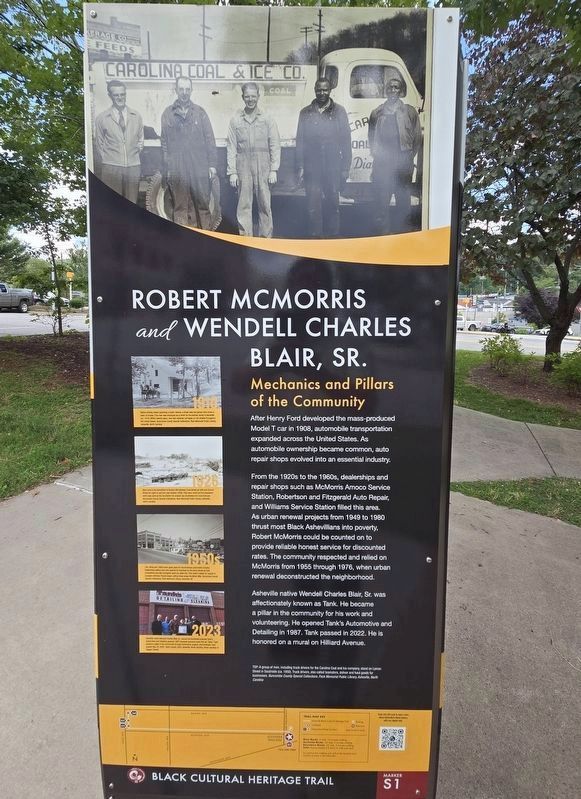
Robert McMorris and Wendell Charles Blair, Sr.
Mechanics and Pillars of the Community
After
Photographed by Mark Parker, July 18, 2025
2. Black Doctors, Nurses, and Hospitals side of the marker
From the 1920s to the 1960s, dealerships and repair shops such as McMorris Amoco Service Station, Robertson and Fitzgerald Auto Repair, and Williams Service Station filled this area. As urban renewal projects from 1949 to 1980 thrust most Black Ashevillians into poverty, Robert McMorris could be counted on to provide reliable honest service for discounted rates. The community respected and relied on McMorris from 1955 through 1976, when urban renewal deconstructed the neighborhood.
Asheville native Wendell Charles Blair, Sr. was affectionately known as Tank. He became a pilar in the community for his work and volunteering. He opened Tank's Automotive and Detailing in 1987. Tank passed in 2022. He is honored on a mural on Hilliard Avenue.
(captions)
Top: A group of men, including truck drivers for the Carolina Coal and Ice Company, stand on Lyman Street in Southside (ca. 1950). Truck drivers, also called teamsters, deliver and haul goods for businesses.Buncombe County Special Collections, Pack Memorial Public Library, Asheville, North Carolina
1910 before driving meant operating a motor vehicle, a driver was the person who drove a team of horses. This man was employed as a driver for the Ambler family in Asheville (ca. 1910). Within 20 years, cars had replaced carriages on city streets throughout the United States. Buncombe County Special Collections, Pack Memorial Library, Asheville North Carolina.
1926 same here is the demolition of Buxton Hill between Coxe Street (on right) to add two new streets (1926). Hills were razed and the displaced earth was used for the foundation for present day Southside and Coxe Avenues. Buncombe County Special Collections, Pack Memorial Library, Asheville North Carolina
1950s The 1950s and 1960s were peak years for the American automobile industry. Dealerships selling new cars opened for business on the same street as their competitors and alongside used car sale lots. This made it easier for people to compare vehicles. People began calling these areas the Motor Mile. Buncombe County Special Collections, Pack Memorial Library, Asheville North Carolina
2023 Asheville Native Wendell Charles Blair, Sr. Named his Southside business Tank's Automotive and Detailing (opened 1987) because everyone knew him as "Tank". Tank became a pillar in the community through mentorship, support, and kindness. Tank passed May 23, 2022. Tank's family, 2023, Asheville, North Carolina. Photo courtesy of Reggie Tidwell
Erected by Asheville
Photographed by Mark Parker, July 18, 2025
3. Robert McMorris and Wendell Charles Blair Sr side of the marker
Topics. This historical marker is listed in these topic lists: African Americans • Civil Rights • Industry & Commerce • Science & Medicine.
Location. 35° 35.305′ N, 82° 33.131′ W. Marker is in Asheville, North Carolina, in Buncombe County. It is in the South Slope Brewing District. It is at the intersection of Southside Avenue (U.S. 25) and South Lexington Avenue, on the right when traveling south on Southside Avenue. Touch for map. Marker is at or near this postal address: 11 Southside Ave, Asheville NC 28801, United States of America. Touch for directions.

Regionally, this marker is in the Mountains. It is also in the American South, specifically in the Upper South, in Appalachia, and specifically in Southern Appalachia. Globally, it is in North America, the Western Hemisphere, the Western World, and the Anglosphere. Historically, it finds itself in what was once the original Cherokee Nation, the territory of the Mississippian Culture, one of the original Thirteen Colonies, one of the Confederate
Photographed by Mark Parker, July 18, 2025
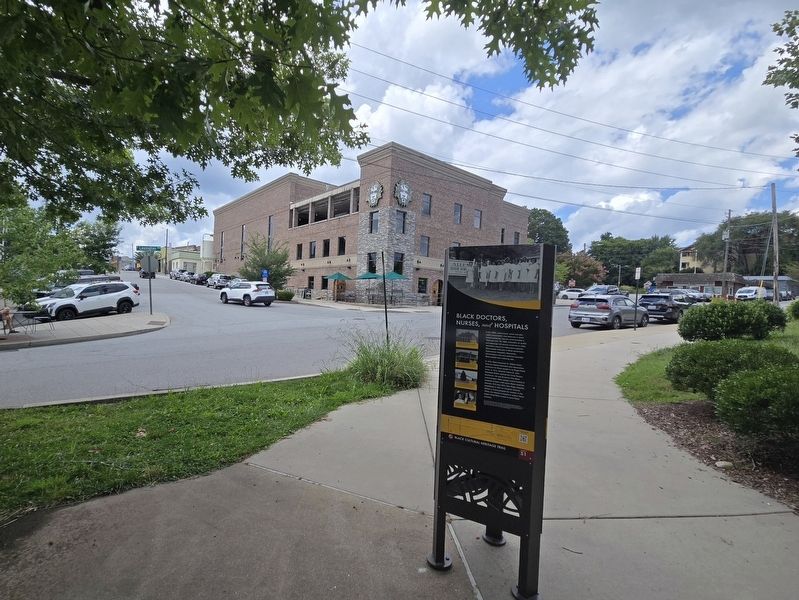
4. Wide view of the Asheville Black Cultural Heritage Trail marker
Taken from the Southside Ave. side looking towards the S. Lexington/ Buxton Ave. intersection.
Other nearby markers. At least 8 other markers are within walking distance of this marker: The Legacy of E.W. and Annis Pearson in Asheville (about 700 feet away, measured in a direct line); Black Women Fund Advocacy, Housing, and Education (about 700 feet away); The National Housing Act of 1934 (approx. 0.2 miles away); The Bunkum Stone (approx. ¼ mile away); Flora Sorrell Boarding Home (approx. ¼ mile away); Isaac Dickson and the Historical East End Neighborhood (approx. 0.3 miles away); Trinity Episcopal Church (approx. 0.3 miles away); Triangle Park Mural (approx. 0.3 miles away). Touch for a list and map of all markers in Asheville.
Credits. This page was last revised on August 28, 2025. It was originally submitted on August 28, 2025, by Mark Parker of Hickory, North Carolina. This page has been viewed 101 times since then and 14 times this year. Photos: 1, 2, 3, 4. submitted on August 28, 2025, by Mark Parker of Hickory, North Carolina. • Bernard Fisher was the editor who published this page.
