South Slope Brewing District in Asheville in Buncombe County, North Carolina — The American South (South Atlantic)
Black Women Fund Advocacy, Housing, and Education
| — | Black Cultural Heritage Trail | — |
Photographed by Mark Parker, July 18, 2025
1. Black Women Fund Advocacy, Housing, and Education Marker
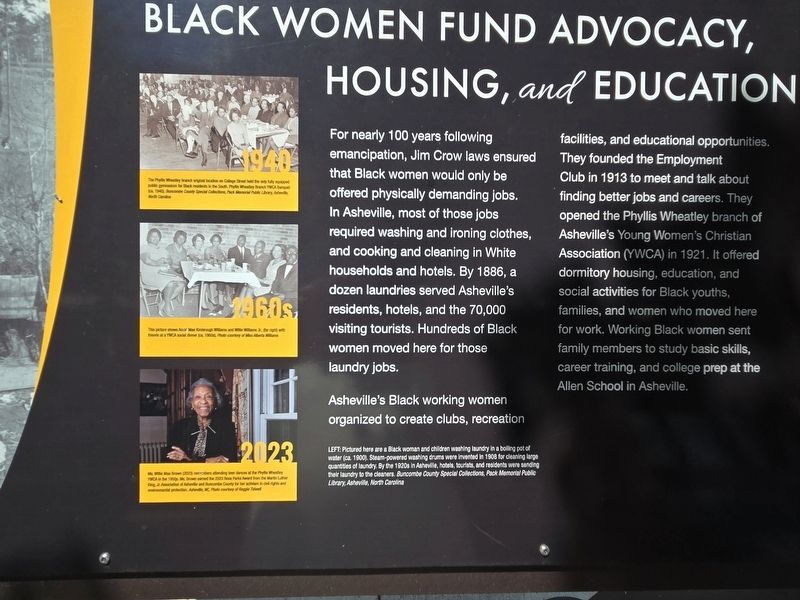
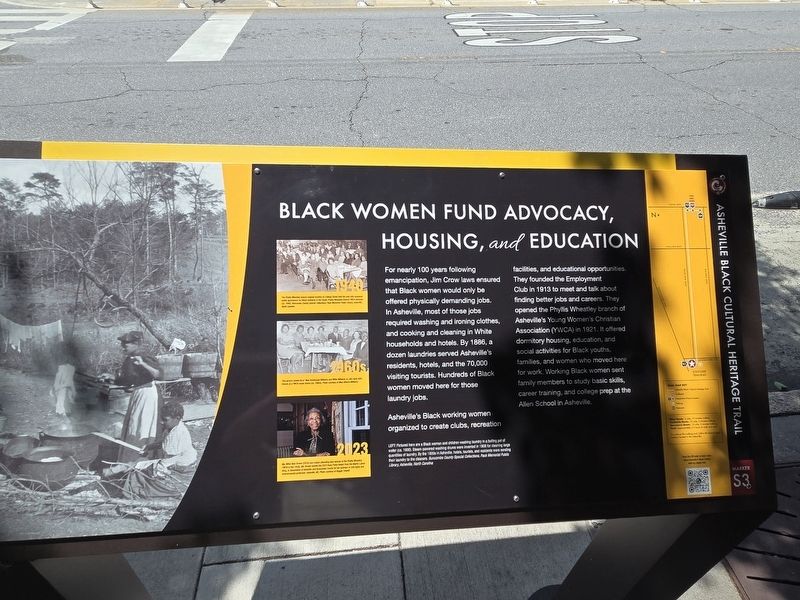
Asheville's Black working women organized to create clubs, recreation facilities, and educational opportunities. They founded the Employment Club in 1913 to meet and talk about finding better jobs and careers. They opened the Phyllis Wheatley branch of Asheville's Young Women's Christian Association (YWCA) in 1921. It offered dormitory housing, education, and social activities for Black youths, families, and women who moved here for work. Working Black women sent family members to study basic skills, career training, and college prep at the Allen School in Asheville.
(captions)
Left: Pictured here are a Black woman and children washing laundry in a boiling pot of water (ca. 1900). Steam-powered washing drums were invented in 1908 for cleaning large quantities of laundry. By the 1920s in Asheville, hotels, tourists, and residents were sending their laundry to the cleaners. Buncombe County Special Collections, Pack Memorial Public Library, Asheville, North Carolina
1940 The Phyllis Wheatley branch original location on college Street held the only fully equipped public generations for Black residents in the South. Phyllis Wheatley Branch YWCA banquet (ca. 1940) Buncombe County Special Collections, Pack Memorial Public Library, Asheville, North Carolina
1960s This picture shows Annis Mae Kimbrough Williams and Willie Williams, Jr. (far right) with friends at a YWCA social dinner. Photo courtesy of Miss Alberta Williams
2023 Ms. Willie Mae Brown (2023) remembers attending teen dances at the Phyllis Wheatley YWCA in the 1950s. Ms. Brown earned the 2023 Rosa Parks Award from the Martin Luther King, Jr. Association of Asheville and Buncombe County for her activism in civil Rights and environment protection. photo courtesy of Reggie Tidwell
Erected by Black
this page online
Topics. This historical marker is listed in these topic lists: African Americans • Civil Rights • Women. A significant historical year for this entry is 1886.
Location. 35° 35.32′ N, 82° 33.278′ W. Marker is in Asheville, North Carolina, in Buncombe County. It is in the South Slope Brewing District. It is on Coxe Avenue near Buxton Avenue, on the right when traveling north. Touch for map. Marker is at or near this postal address: 162 Coxe Ave, Asheville NC 28801, United States of America. Touch for directions.

Regionally, this marker is in the Mountains. It is also in the American South, specifically in the Upper South, in Appalachia, and specifically in Southern Appalachia. Globally, it is in North America, the Western Hemisphere, the Western World, and the Anglosphere. Historically, it finds itself in what was once the original Cherokee Nation, the territory of the Mississippian Culture, one of the original Thirteen Colonies, one of the Confederate States of America, and the Antebellum South.
Other nearby markers. At least 8 other markers are within walking distance
Photographed by Mark Parker, July 18, 2025
2. Full view of Black Women Fund Advocacy, Housing, and Education Marker
Another marker is no longer nearby. Daniel K. Moore (was approx. 0.3 miles away but has been confirmed missing).
Photographed by Mark Parker, July 18, 2025
3. Wide view of Black Women Fund Advocacy, Housing, and Education Marker at corner of Coxe & Buxton Ave
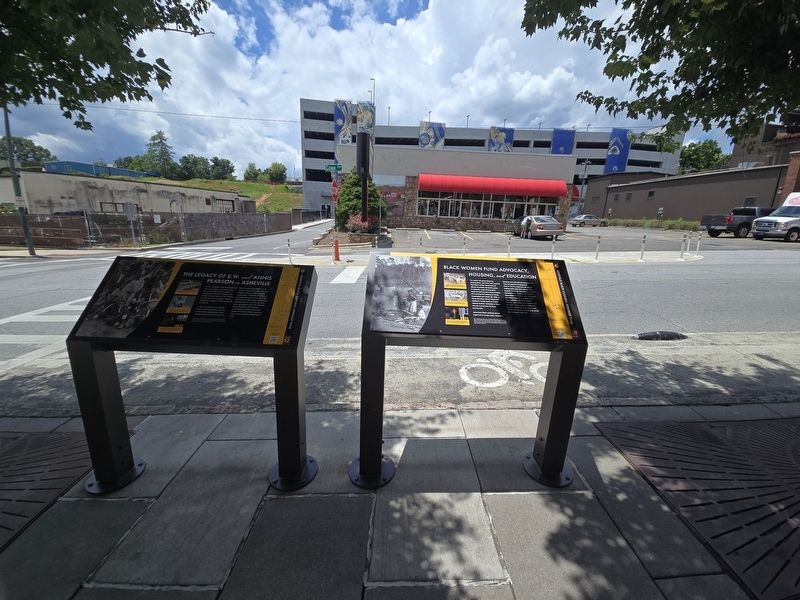
Subject marker is pictured on the right
Credits. This page was last revised on August 29, 2025. It was originally submitted on August 28, 2025, by Mark Parker of Hickory, North Carolina. This page has been viewed 80 times since then and 16 times this year. Photos: 1, 2, 3. submitted on August 28, 2025, by Mark Parker of Hickory, North Carolina. • Bernard Fisher was the editor who published this page.
