Silverton in San Juan County, Colorado — The American Mountains (Southwest)
Miner's Union Hospital
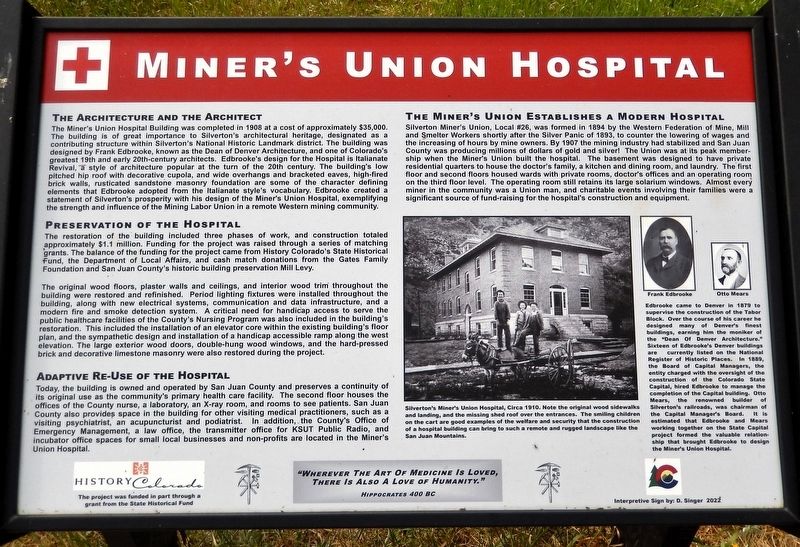
Photographed by Cosmos Mariner, July 15, 2025
1. Miner's Union Hospital Marker
The Architecture and the Architect
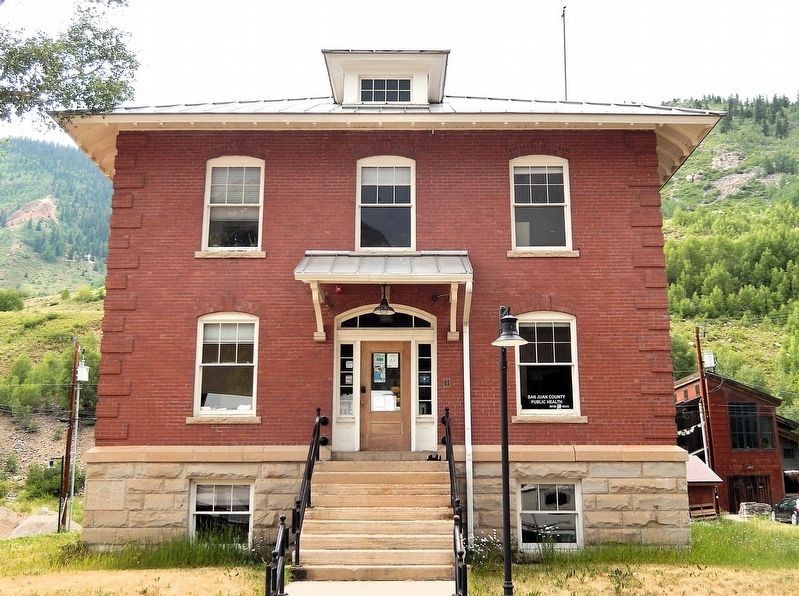
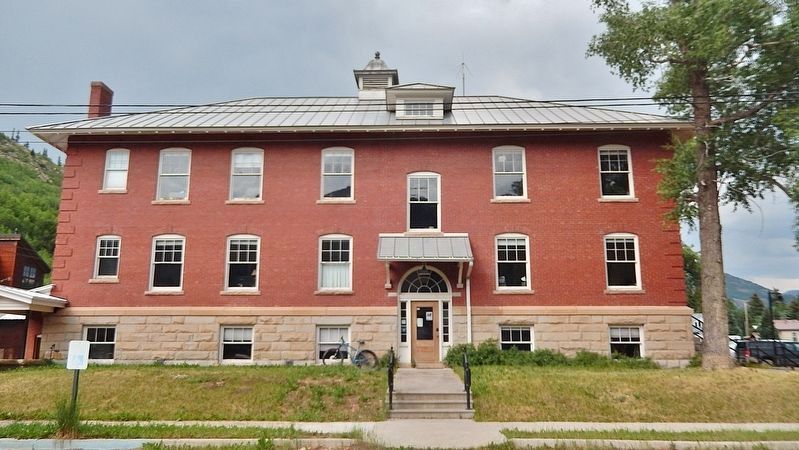
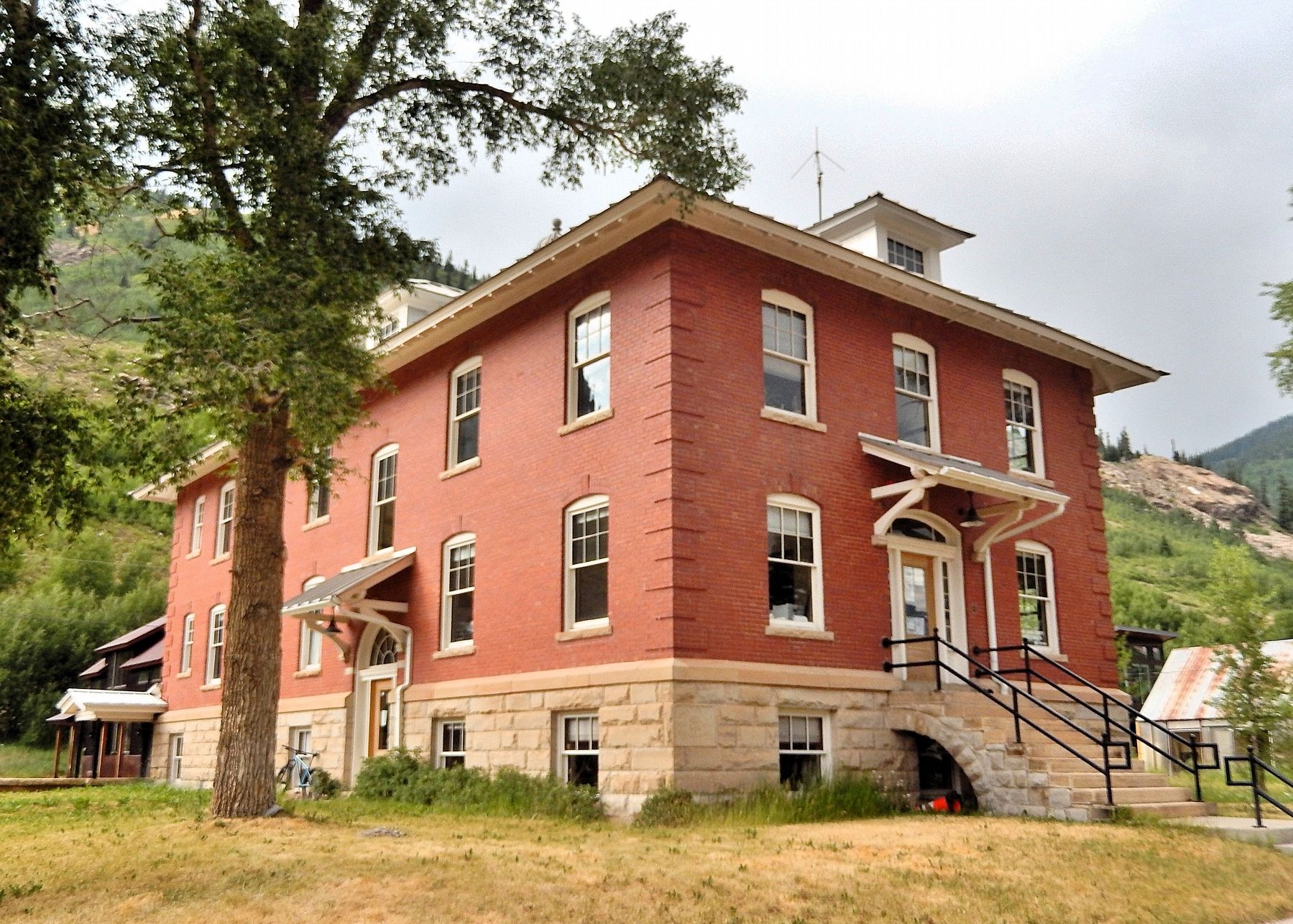
The Miner's Union Hospital Building was completed in 1908 at a cost of approximately $35,000. The building is of great importance to Silverton's architectural heritage, designated as a contributing structure within Silverton's National Historic Landmark district. The building was designed by Frank Edbrooke, known as the Dean of Denver Architecture, and one of Colorado's greatest 19th and early 20th-century architects. Edbrooke's design for the Hospital is Italianate Revival, a style of architecture popular at the turn of the 20th century. The building's low pitched hip roof with decorative cupola, and wide overhangs and bracketed eaves, high-fired brick walls, rusticated sandstone masonry foundation are some of the character defining elements that Edbrooke adopted from the Italianate style's vocabulary. Edbrooke created a statement of Silverton's prosperity with his design of the Miner's Union Hospital, exemplifying the strength and influence of the Mining Labor Union in a remote Western mining community.
Preservation of the Hospital
The restoration of the building included three phases
this page online
The original wood floors, plaster walls and ceilings, and interior wood trim throughout the building were restored and refinished. Period lighting fixtures were installed throughout the building, along with new electrical systems, communication and data infrastructure, and a modern fire and smoke detection system. A critical need for handicap access to serve the public healthcare facilities of the County's Nursing Program was also included in the building's restoration. This included the installation of an elevator core within the existing building's floor plan, and the sympathetic design and installation of a handicap accessible ramp along the west elevation. The large exterior wood doors, double-hung wood windows, and the hard-pressed brick and decorative
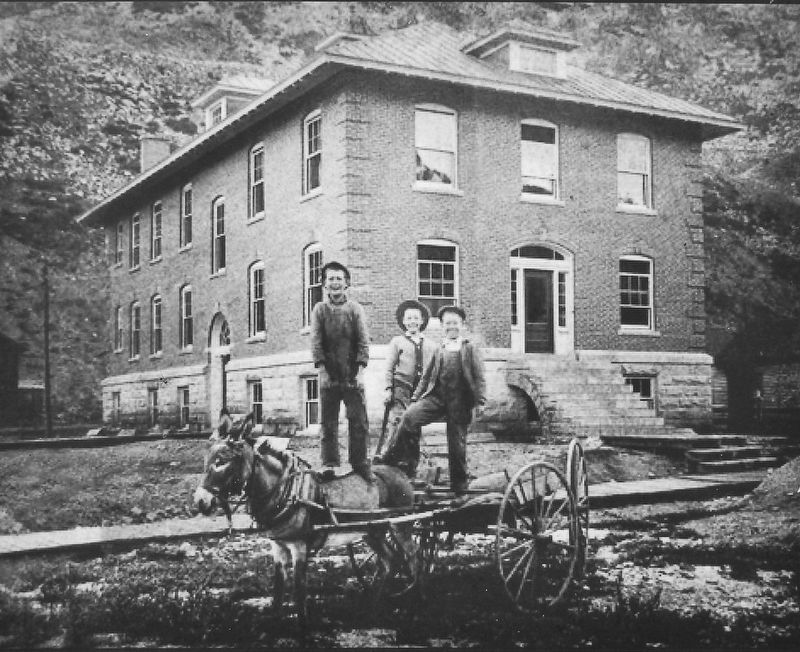
2. Marker detail: Silverton's Miner's Union Hospital
circa 1910
circa 1910
Note the original wood sidewalks and landing, and the missing shed roof over the entrances. The smiling children on the cart are good examples of the welfare and security that the construction of a hospital building can bring to such a remote and rugged landscape like the San Juan Mountains.
Adaptive Re-use of the Hospital
Today, the building is owned and operated by San Juan County and preserves a continuity of its original use as the community's primary health care facility. The second floor houses the offices of the County nurse, a laboratory, an X-ray room, and rooms to see patients. San Juan County also provides space in the building for other visiting medical practitioners, such as a visiting psychiatrist, an acupuncturist and podiatrist. In addition, the County's Office of Emergency Management, a law office, the transmitter office for KSUT Public Radio, and incubator office spaces for small local businesses and non-profits are located in the Miner's Union Hospital.
The Miner’s Union Establishes a Modern Hospital
Silverton Miner's Union, Local #26, was formed in 1894 by the Western Federation of Mine, Mill and Smelter Workers shortly after the Silver Panic of 1893, to counter the lowering of wages and the increasing of hours by mine owners. By 1907 the mining industry had stabilized, and San Juan County was producing millions of dollars of gold and silver! The
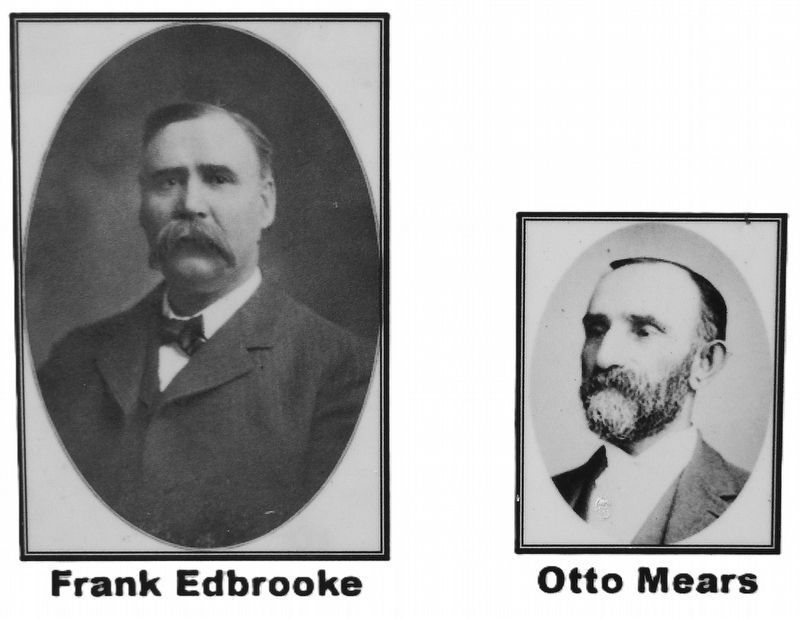
3. Marker detail: Frank Edbrooke & Otto Mears
Edbrooke came to Denver in 1879 to supervise the construction of the Tabor Block. Over the course of his career, he designed many of Denver's finest buildings, earning him the moniker of the “Dean of Denver Architecture.” Sixteen of Edbrooke's Denver buildings are currently listed on the National Register of Historic Places. In 1889, the Board of Capital Managers, the entity charged with the oversight of the construction of the Colorado State Capital, hired Edbrooke to manage the completion of the Capital building. Otto Mears, the renowned builder of Silverton's railroads, was chairman of the Capital Manager's Board. It is estimated that Edbrooke and Mears working together on the State Capital project formed the valuable relationship that brought Edbrooke to design the Miner's Union Hospital.
there is also a Love of Humanity.”
Hippocrates 400 BC
Interpretive sign by D. Singer 2022
This project was funded in part through a grant from the State Historical Fund
Erected 2022 by History Colorado.
Topics and series. This historical marker is listed in these topic lists: Architecture • Fraternal or Sororal Organizations • Labor Unions • Science & Medicine. In addition, it is included in the National Register of Historic Places (NRHP) series list. A significant historical year for this entry is 1908.
Location. 37° 48.832′ N,
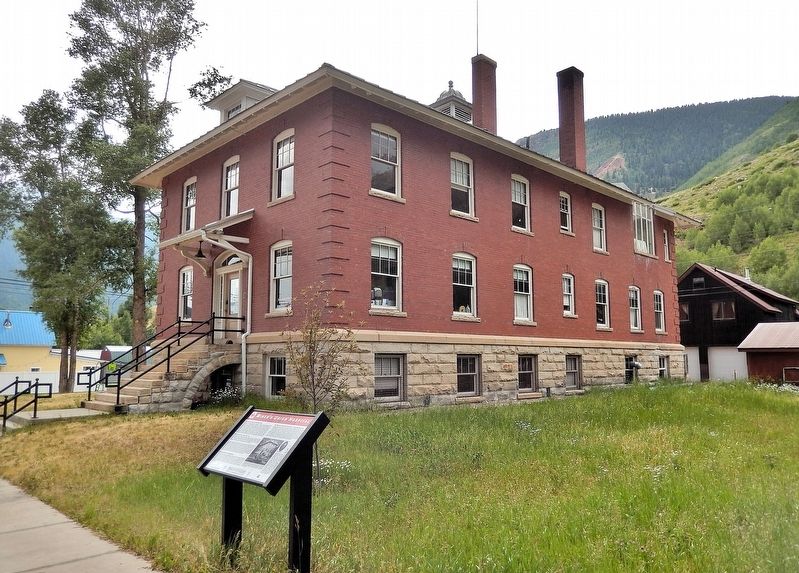
Photographed by Cosmos Mariner, July 15, 2025
4. Miner's Union Hospital Marker
The marker overlooks the northeast corner of the building.

Regionally, this marker is in the American Mountain West and at the Four Corners. Globally, it is in North America, the Rocky Mountains, the Western Hemisphere, the Western World, and the Anglosphere.
Other nearby markers. At least 8 other markers are within walking distance of this marker: 1327 Greene (about 600 feet away, measured in a direct line); 1323 Greene (about 600 feet away); 1309 Greene (about 600 feet away); 1335 Greene (about 600 feet away); 1345 Greene (about 600 feet away); 1303 Greene (about 600 feet away); 1371 Greene (about 700 feet away); 1269 Greene (about 700 feet away). Touch for a list and map of all markers in Silverton.
Regarding Miner's Union Hospital. Contributing property, Silverton
Photographed by Cosmos Mariner, July 15, 2025
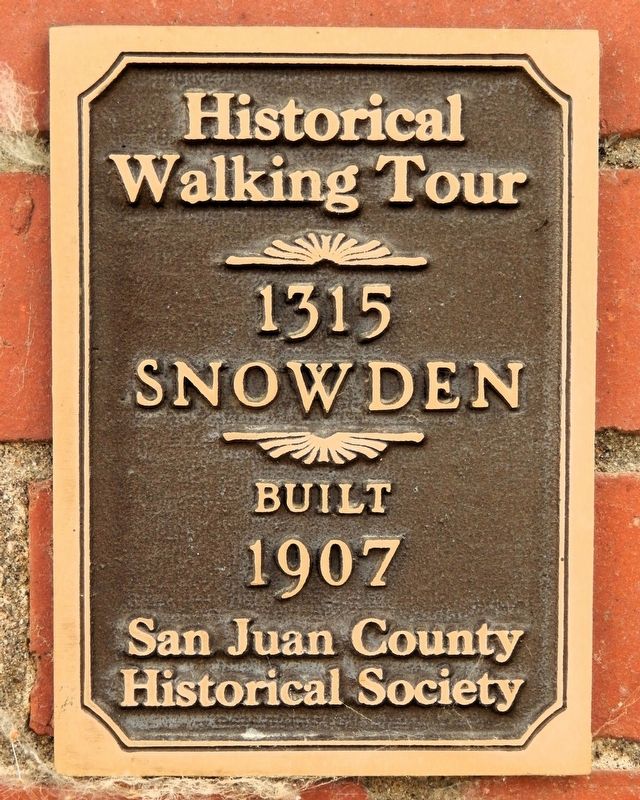
5. Silverton Historical Walking Tour Marker
1315 Snowden
Built 1907
San Juan County Historical Society
From the National Register Nomination prepared by Joseph Scott Mendinghall & Ray Matteson, 12/20/1975:
Prospecting had been conducted in this region of San Juan County, as early as the 1860's. However, it was not until 1871 that the first profitable vein was in Arrastra Gulch, just east of the town, and caused the influx of other prospectors. This early find was silver ore. Progress was rapid and Silverton by 1874 was organized into a township. Prosperity continued and by the turn of the century, Silverton became a bustling community of 3,000 people. It was at this point that institutional buildings began to be built. These buildings remain and are the central focus of the town's architecture.
The town was founded in a rich silver mining district, (from which the town received its name). This region was later found to be rich in other ores including gold, lead and copper. The prosperity of the town continued, and numerous buildings, organizations, churches, and other towns werethe result of the district's prosperity. Between 1882 and 1918, the district had produced more than 65 million dollars in precious ores.Photographed by Cosmos Mariner, July 15, 20256. Miner's Union Hospital (front/east elevation)
Much of the Silverton social life centered around the many fraternal organizations which flourished during the 1880s and 1890s. Among these were the Masons, the Order of the Eastern Star, the Woodmen of the World, Women of Woodcraft, Rathbone Sisters, Fraternal Order of Eagles, and the Silverton Miners Union which had a membership of 1,300 people.
Silverton and its surrounding towns continued to prosper well into the 20th century. In 1910, Silverton had a population of 2,153. It was a railroad supply center for the other cities of the district. Annual production of ore exceeded 2 million dollars. Gradually the mines of the district were exhausted, and the district began to decline.
Also see . . .
1. San Juan County Hospital — Miner's Union Hospital (History Colorado).
Excerpt: Nestled in the Silverton National Historic Landmark, the 1908 Miner’s Hospital in San Juan County was designed by one of Colorado’s most renowned architects, F. E. Edbrooke, whose firm designed the Colorado State(Submitted on August 30, 2025, by Cosmos Mariner of Cape Canaveral, Florida.)Capitol and the Brown Palace Hotel. For more than a century, the Italianate-influenced building has been the only public health facility in Silverton. With funding from the History Colorado State Historical Fund, San Juan County will install a small elevator, reconfigure restrooms to comply with ADA standards, restore door and window sashes, and repair brick jambs, the roof, decorative eave brackets, and the cupola.Photographed by Cosmos Mariner, July 15, 20257. Miner's Union Hospital (south elevation)
2. Silverton Miner's Union Hospital (facebook).
Excerpt: The building was a statement about Silverton's prosperity, exemplifying the strength of mining labor in the community. It remains today as a contributing building to Silverton's National Historic Landmark District, listed in the National Register of Historic Places. The building served faithfully as a hospital throughout the 20th century and still maintains that legacy today, as it is the only healthcare facility in Silverton. It houses medical offices, San Juan County's Office of Emergency Management, a visiting psychologist's office, and various nonprofit groups.(Submitted on August 30, 2025, by Cosmos Mariner of Cape Canaveral, Florida.)
Photographed by Cosmos Mariner, July 15, 2025
8. Miner's Union Hospital (southeast elevation)
Credits. This page was last revised on August 25, 2026. It was originally submitted on August 29, 2025, by Cosmos Mariner of Cape Canaveral, Florida. This page has been viewed 162 times since then and 68 times this year. Photos: 1, 2, 3, 4, 5, 6, 7, 8. submitted on August 30, 2025, by Cosmos Mariner of Cape Canaveral, Florida.
