Near Wateree in Richland County, South Carolina — The American South (South Atlantic)
The Key to the Carolinas
| — | Congaree National Park | — |
Photographed by Benjamin Rubin, August 9, 2025
1. The Key to the Carolinas Marker
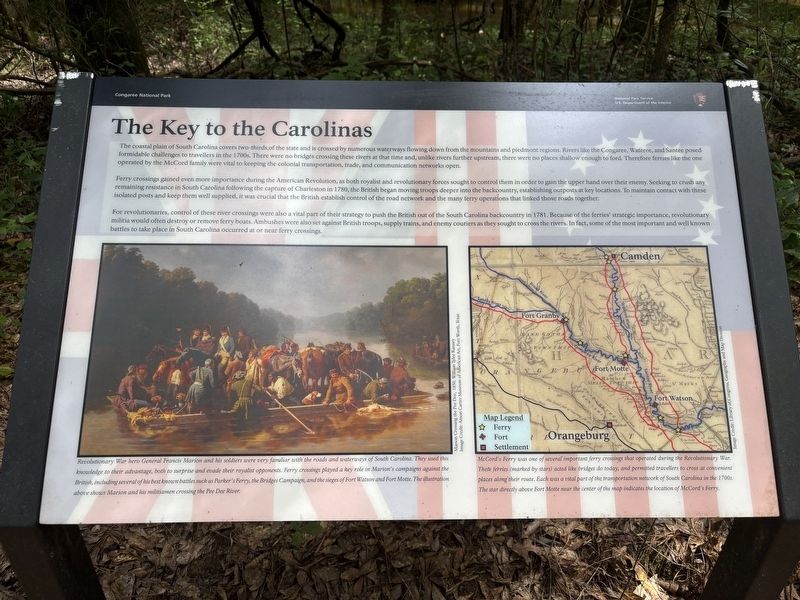
The coastal plain of South Carolina covers two-thirds of the state and is crossed by numerous waterways flowing down from the mountains and piedmont regions. Rivers like the Congaree, Wateree, and Santee posed formidable challenges to travellers in the 1700s. There were no bridges crossing these rivers at that time and, unlike rivers further upstream, there were no places shallow enough to ford. Therefore ferries like the one operated by the McCord family were vital to keeping the colonial transportation, trade, and communication networks open.
Ferry crossings gained even more importance during the American Revolution, as both royalist and revolutionary forces sought to control them in order to gain the upper hand over their enemy. Seeking to crush any remaining resistance in South Carolina following the capture of Charleston in 1780, the British began moving troops deeper into the backcountry, establishing outposts at key locations. To maintain contact with these isolated posts and keep them well supplied, it was crucial that the British establish control of the road network and the many ferry operations that linked
this page online
For revolutionaries, control of these river crossings were also a vital part of their strategy to push the British out of the South Carolina backcountry in 1781. Because of the ferries' strategic importance, revolutionary militia would often destroy or remove ferry boats. Ambushes were also set against British troops, supply trains, and enemy couriers as they sought to cross the rivers. In fact, some of the most important and well known battles to take place in South Carolina occurred at or near ferry crossings.
(captions)
Revolutionary War hero General Francis Marion and his soldiers were very familiar with the roads and waterways of South Carolina. They used this knowledge to their advantage, both to surprise and evade their royalist opponents. Ferry crossings played a key role in Marion's campaigns against the British, including several of his best known battles such as Parker's Ferry, the Bridges Campaign, and the sieges of Fort Watson and Fort Motte. The illustration above shows Marion and his militiamen crossing the Pee Dee.
McCord's Ferry was one of several important ferry crossings that operated during the Revolutionary War. These ferries (marked by stars) acted like bridges do today, and permitted travellers to cross at convenient places along their route. Each was a vital part of the transportation network of South Carolina in the 1700s. The star directly above Fort Motte near the center of the map indicates the location of McCord's Ferry.
Erected by National Park Service, U.S. Department of the Interior.
Topics. This historical marker is listed in these topic lists: Parks & Recreational Areas • Patriots & Patriotism • War, US Revolutionary • Waterways & Vessels.
Location. 33° 46.904′ N, 80° 38.454′ W. Marker is near Wateree, South Carolina, in Richland County. It can be reached from U.S. 601 0.6 miles south of Bluff Road (South Carolina Route 48) when traveling south. Located on the Bates Ferry Trail, 0.3 mile west of the Congaree National Park trailhead. Touch for map. Marker is in this post office area: Gadsden SC 29052, United States of America. Touch for directions.

Regionally, this marker is in the Midlands and in the Greater Columbia Area. It is also in the American South and specifically in the Deep South. Globally, it is in North America, the Western Hemisphere, the Western World, and the Anglosphere. Historically, it finds itself in what was once the territory of the Mississippian Culture, one of the original Thirteen Colonies, one of the Confederate States of America, and the Antebellum South.
Other nearby markers. At least 8 other markers are within walking distance of this marker: Challenging the Rebellion (approx. 0.2 miles away); McCord's Ferry: The Charleston to Camden Connection (approx. 0.2 miles away); Crossing the Congaree (approx. 0.2 miles away); What Happened to the Ferries? (approx. 0.2 miles away); Bates Ferry Trail (approx. 0.2 miles away); Leading the Way to Victory (approx. half a mile away); Rebecca Motte and the Revolution (approx. 0.7 miles away); "Obstinate and Strong" (approx. 0.9 miles away). Touch for a list and map of all markers in Wateree.
Also see . . . Congaree National Park. National Park Service (Submitted on September 1, 2025.)
Credits. This page was last revised on September 1, 2025. It was originally submitted on August 30, 2025, by Benjamin Rubin of Columbia, South Carolina. This page has been viewed 122 times since then and 46 times this year. Photo 1. submitted on August 30, 2025, by Benjamin Rubin of Columbia, South Carolina. • Bernard Fisher was the editor who published this page.
