
Niagara-on-the-Lake in Niagara Region, Ontario — Central Canada (North America)
Memorial Cairn For John Butler
Photographed by Kevin Westell, August 31, 2025
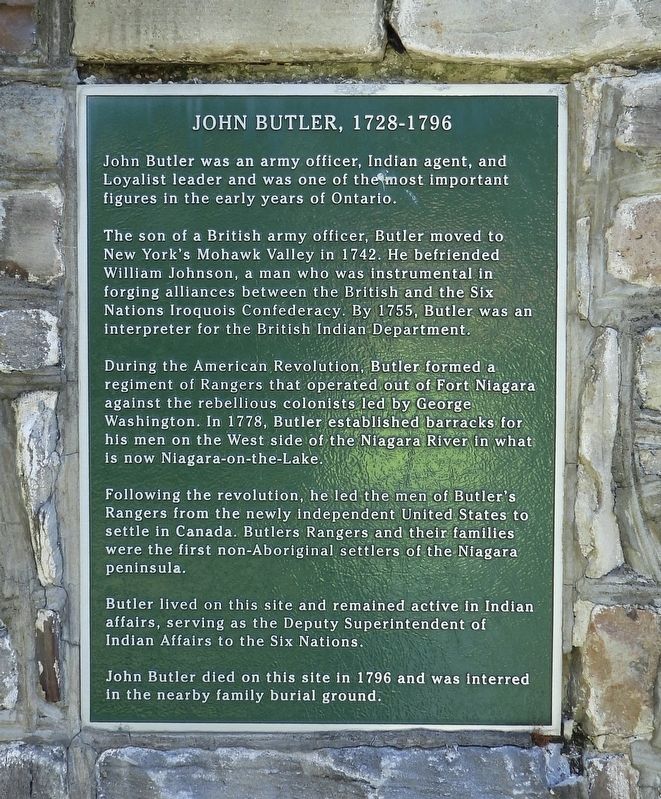
1. Memorial Cairn For John Butler - west side
[West side] John Butler, 1728-1796
John Butler was an army officer, Indian agent, and Loyalist leader and was one of the most important figures in the early years of Ontario.
The son of a British army Officer, Butler moved to New York's Mohawk Valley in 1742. He befriended William Johnson, a man who was instrumental in forging alliances between the British and the Six Nations Iroquois Confederacy. By 1755, Butler was an interpreter for the British Indian Department.
During the American Revolution, Butler formed a regiment of Rangers that operated out of Fort Niagara against the rebellious colonists led by George Washington. In 1778, Butler established barracks for his men on the west side of the Niagara River in what is now Niagara-on-the-Lake.
Following the revolution, he led the men of Butler's Rangers from the newly independent United States to settle in Canada. Butlers Rangers and their families were the first non-Aboriginal settlers of the Niagara peninsula.
Butler lived on this site and remained active in Indian affairs, serving as the Deputy Superintendent of Indian
this page online
John Butler died on this site in 1796 and was interred in the nearby family burial ground.
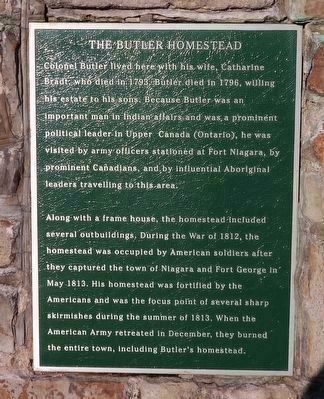
[East side] The Butler Homestead
Colonel Butler lived here with his wife, Catharine Bradt, who died in 1793. Butler died in 1796, willing his estate to his sons. Because Butler was an important man in Indian affairs and was a prominent political leader in Upper Canada (Ontario), he was visited by army officers stationed at Fort Niagara, by prominent Canadians, and by influential Aboriginal leaders travelling to this area.
Along with a frame house, the homestead included several outbuildings. During the War of 1812, the homestead was occupied by American soldiers after they captured the town of Niagara and Fort George in May 1813. His homestead was fortified by the Americans and was the focus point of several sharp skirmishes during the summer of 1813. When the American Army retreated in December, they burned the entire town, including Butler's homestead.
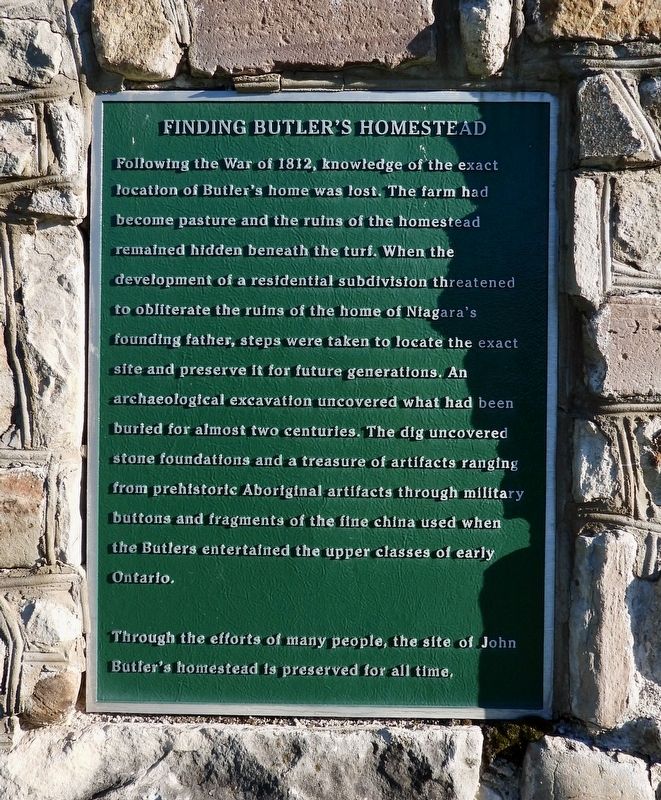
[South side] Finding Butler's Homestead
Following the War of 1812, knowledge of the exact location of Butler's home was
Photographed by Kevin Westell, August 31, 2025
2. Memorial Cairn For John Butler - east side
Through the efforts of many people, the site of John Butler's homestead is preserved for all time.
[North side is a list of donors]
Topics. This historical marker is listed in these topic lists: Colonial Era • Patriots & Patriotism • Settlements & Settlers • War of 1812 • War, US Revolutionary. A significant historical year for this entry is 1728.
Location. 43° 15.056′ N, 79° 5.31′ W. Marker is in Niagara-on-the-Lake, Ontario, in Niagara Region. It is on Balmoral
Photographed by Kevin Westell, August 31, 2025
3. Memorial Cairn For John Butler - south side

Regionally, this marker is on Ontario’s Golden Horseshoe and in Niagara Canada. It is also in Central Canada. Globally, it is in North America, the Western Hemisphere, the Western World, and the Anglosphere. Historically, it finds itself in what was once a British colony, the Viceroyalty of New France, the Haudenosaunee (Iroquois) Confederacy, and Rupert’s Land.
Other nearby markers. At least 8 other markers are within walking distance of this marker: Lieutenant-Colonel John Butler 1725-1796 (about 150 meters away, measured in a direct line); Butler's Burial Ground (about 150 meters away); The Claus Family Crypt / La crypté de la famille Claus (about 150 meters away); Action at Butler's Farm (about 180 meters away); William and Susannah Steward House (about 240 meters away); The Upper Canadian Act Against Slavery (1793) (approx. 0.4 kilometers away); Niagara Baptist Church Burial Ground
Photographed by Kevin Westell, August 31, 2025
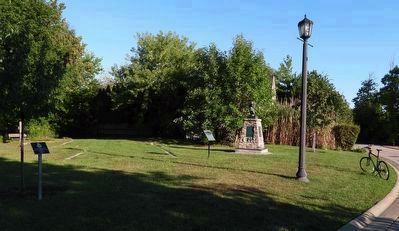
4. Park for John Butler Homestead
Photo faces north-west. The white outline on the ground is an artist's conjecture about the layout of the home.
Another marker is no longer nearby. Negro Burial Ground (was approx. 0.4 kilometers away but has been confirmed missing).
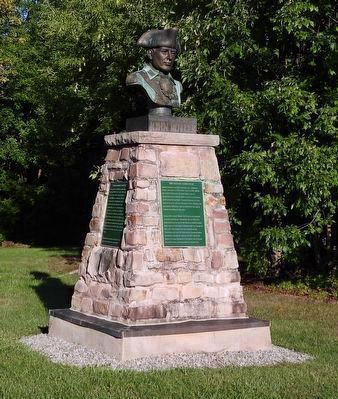
Photographed by Kevin Westell, August 31, 2025
5. Memorial Cairn For John Butler - south and east sides
The inscription for the bust is:
[front] Lieutenant Colonel John Butler;
[right side] 1728-1796
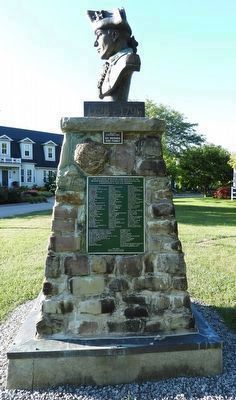
Photographed by Kevin Westell, August 31, 2025
6. Memorial Cairn for John Butler - north side
This lists the donors for this memorial park.
Credits. This page was last revised on September 8, 2025. It was originally submitted on August 31, 2025, by Kevin Westell of St. Catharines, Ontario. This page has been viewed 70 times since then and 22 times this year. Photos: 1, 2, 3, 4, 5, 6. submitted on August 31, 2025, by Kevin Westell of St. Catharines, Ontario. • Andrew Ruppenstein was the editor who published this page.
