Flat Rock in Henderson County, North Carolina — The American South (South Atlantic)
James Brown
1790-1840
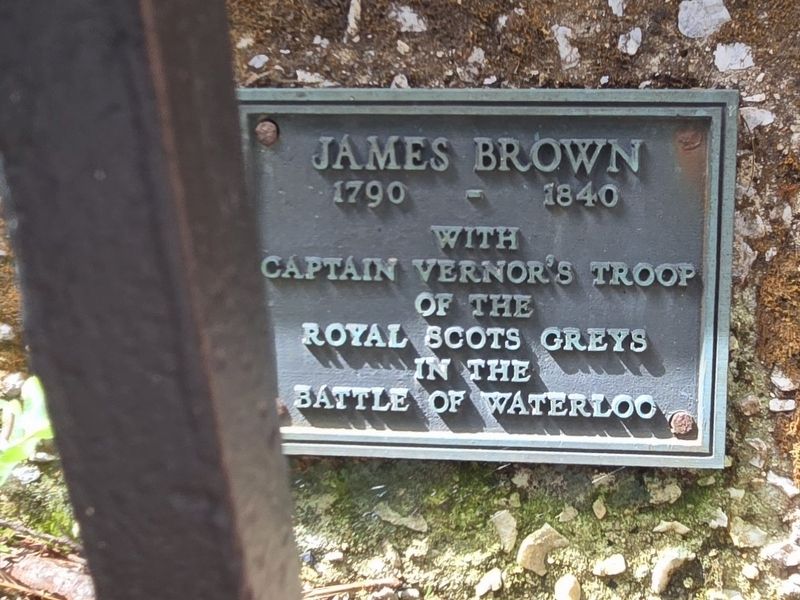
Photographed by Mark Parker, July 28, 2025
1. James Brown Marker
of the
Royal Scots Greys
in the
Battle of Waterloo
Topics. This historical marker is listed in these topic lists: Cemeteries & Burial Sites • Wars, Non-US. A significant historical year for this entry is 1840.
Location. 35° 16.95′ N, 82° 26.605′ W. Marker is in Flat Rock, North Carolina, in Henderson County. It can be reached from the intersection of Greenville Highway (North Carolina Route 225) and Rutledge Drive (County Route 1166), on the right when traveling south. The marker and gravesite is next to the north side of St John in the Wilderness Episcopal Church surrounded by an iron fence. The marker itself is at ground level. Touch for map. Marker is at or near this postal address: 1895 Greenville Hwy, Flat Rock NC 28731, United States of America. Touch for directions.

Regionally, this marker is in the Mountains and in Greater Asheville. It is also in the American South, specifically in the Upper South, in Appalachia, and specifically in Southern Appalachia. Globally, it is in North America, the Western Hemisphere, the Western World, and the Anglosphere. Historically,
this page online
Other nearby markers. At least 8 other markers are within walking distance of this marker: St. John in the Wilderness (a few steps from this marker); a different marker also named St. John in the Wilderness (within shouting distance of this marker); C.G. Memminger (within shouting distance of this marker); George A. Trenholm (about 600 feet away, measured in a direct line); Mountain Lodge (approx. 0.4 miles away); Hemlocks (approx. 0.4 miles away); Flat Rock (approx. 0.6 miles away); Connemara (approx. 0.6 miles away). Touch for a list and map of all markers in Flat Rock.
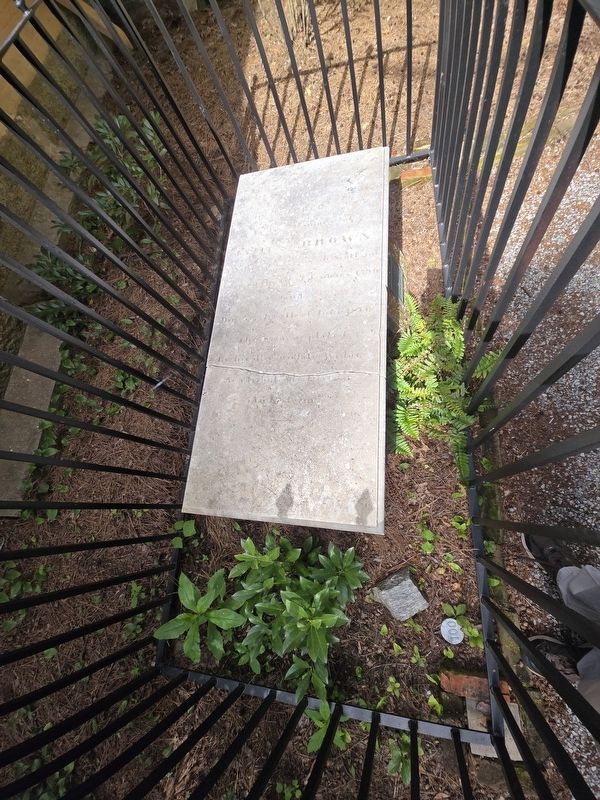
More about this marker. The gravesite was the original burial site of James Brown. He eventually was disinterred by his family and returned to Scotland.
Also see . . . Connecting Flat Rock, the Battle of Waterloo, and Moonshine Whisky. A blog entry from the non-profit group Flat Rock Together. The stories of the gravesite itself following
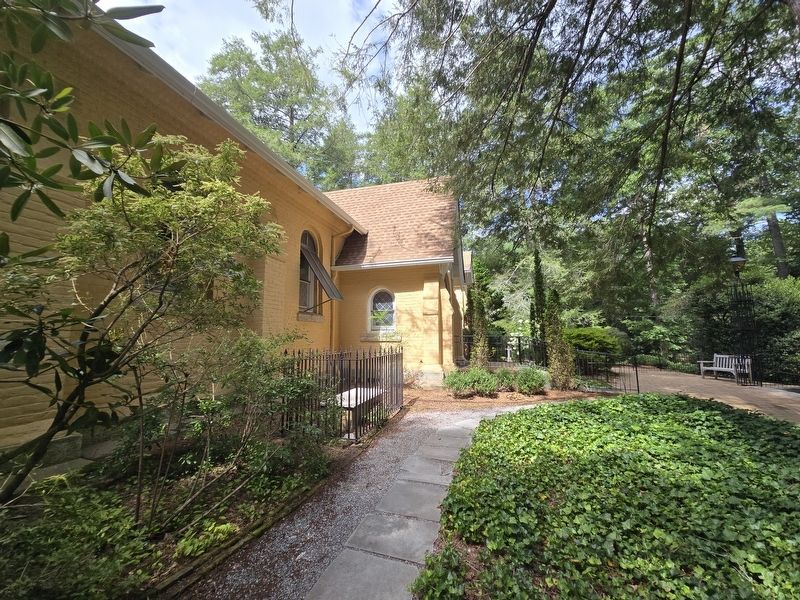
Photographed by Mark Parker, July 28, 2025
2. Original gravesite of James Brown, north side of St John in the Wilderness church
The gravesite is surrounded by the iron fence
On a Sunday morning in June of 1815, Scotsman James Brown found himself staring across the countryside of Waterloo, Belgium. A bugler for the Scots Greys, Brown clutched his instrument and prepared to enter battle against the famous French army of Napoleon Bonaparte.(Submitted on September 1, 2025, by Mark Parker of Hickory, North Carolina.)
Brown’s role was to convey his commander’s orders to the troops via the notes he played on his instrument...
Napoleon was exiled to the island of Elba. And James Brown, witness to perhaps the most iconic battle in European history, immigrated to America. Ultimately ending up in Flat Rock, NC.
Brown was employed by Charles Baring who lived in Charleston and served as a representative for the Baring Brothers banking family in England. Baring’s wife, Susan, found the Charleston summers oppressive and they built Mountain Lodge, one of the first two homes built in the summer colony of Flat Rock. Brown came to Flat Rock with the Barings and spent his summers working for them at Mountain Lodge.
Brown worked for the Barings until his death in 1840 and was buried at St. John in the Wilderness- a church the Barings built to serve as their spiritual home during summers in Flat Rock. His grave was covered with a brick masonry structure that was then topped with a marble slab. This structure still exists and is directly adjacent to the historic church.Photographed by Mark Parker, July 28, 20253. James Brown grave slab. The marker is to the right at ground level
Additional keywords. Napoleonic Wars
Credits. This page was last revised on October 13, 2025. It was originally submitted on September 1, 2025, by Mark Parker of Hickory, North Carolina. This page has been viewed 87 times since then and 40 times this year. Photos: 1, 2, 3. submitted on September 1, 2025, by Mark Parker of Hickory, North Carolina. • Andrew Ruppenstein was the editor who published this page.
